
Some years ago, a series of billboards went up with the words “I” and “Philadelphia”, with a crossed-out heart between them. A week later, in case anybody hadn’t picked up on the implication, the billboards were updated to plainly read “I Hate Philadelphia”. “They’re our arch rivals, you know”, said a team official representing the responsible party. (1)
If you were asked to guess which team put up the billboards today, you’d probably guess the Braves or the Mets. Maybe the Nationals, if you think they’ve recovered from their last ill-advised attempt to thumb their nose towards the Keystone State. But these billboards didn’t go up today. They went up in 1984, and they were put up by the Pittsburgh Pirates.
Ask a Pittsburgh front office member who their archrival is now, and you’d be unlikely to see them point towards Philly. Ask a Buccos fan who their archrival is and they’ll almost certainly name their own team’s owner; if forced to name another team, they’d probably pick one of their fellow NL Central denizens. Phillies fans have plenty of venom to go around, but little is left for the Pirates, falling far behind the Mets and Braves in the pugilistic pecking order. Amongst national observers, the Phillies-Pirates matchups are mostly known for their propensity to create funny-looking score bugs (that’s what those are called, by the way).
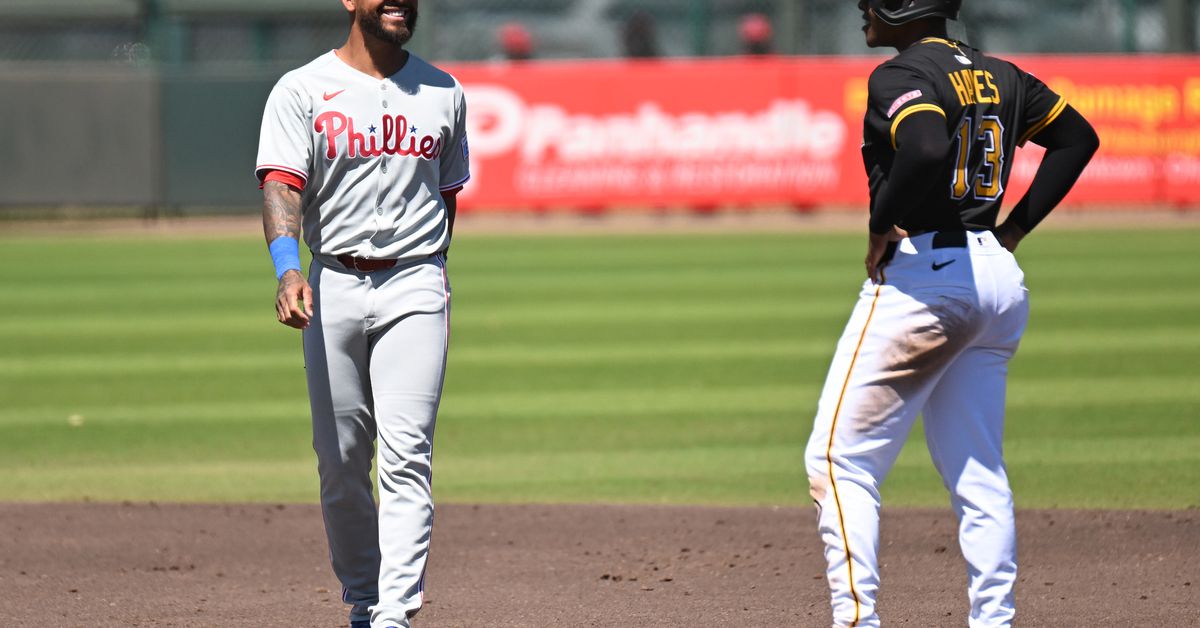
Nevertheless, forty years since those billboards went up, the Phillies and Pirates are about to play on what has been dubbed Rivalry Weekend by the powers that be. Calling the Fightins’ and Bucs rivals induces some rolling of the eyes now. But it was not always so.
Long-running matchups between teams that shared a state but not a city were a rarity in major league baseball’s youth. The late 1800s National League featured a number of New York teams (including such little-remembered squads as the Buffalo Bison, Syracuse Stars, and Troy Trojans) and a pair of Massachusetts clubs (the Boston Red Caps and the creatively named Worcester Worcesters), but most of these teams folded quickly. There was a brief period of time when the matchups between the franchises that would become the Brooklyn Dodgers and New York Giants counted, though the 1898 annexation of Brooklyn by New York turned that into a crosstown affair. But between the dawn of the 20th century and 1958, when Walter O’Malley’s machinations broke the hearts of a generation of Brooklynites and brought both their beloved Bums and the rival Giants westward, Phillies-Pirates was the only same state, different city rivalry in either the Senior or Junior circuits.
The first meeting between the Phillies and Pirates wasn’t a matchup between the Phillies and Pirates at all. In those days the future Buccos were called the Alleghenys, and the Philadelphia team hadn’t yet decided if they preferred Phillies or Quakers. It wasn’t really a meeting between a team from Philly and a team from Pittsburgh, either, since the Alleghenys played in the city of the same name, which would not become part of Pittsburgh for another twenty years (although they were still regarded as the “Pittsburg” team).
May 30th, 1887 marked dedication day for Allegheny’s Recreation Park (coincidentally, also the same name as the Phillies’ home park of the era), a modest facility in what is now Pittsburgh’s North Shore. For the occasion, there were “Two Grand Championship Games”. And these splendid showdowns were treated with the appropriate pomp and circumstance: the railroad companies ran special trains to bring the Allegheny faithful to see the “state rivals of the league”. 45 cents would get you a round trip ticket, with admission to the games included. If you didn’t need the train ticket, you could get three game tickets for a dollar at fine establishments such as McClurg’s Cigar Store. (2)
The 6,500 base ball fanatics (two words; it would take another decade for the one word construction to take hold) who got up early to attend the first game with its 10:15 start time were treated to six and a half innings of scoreless ball, following which the Alleghenys took a one run lead, then surrendered a run in both the eighth and ninth to drop the inaugural meeting. A few hours later, a slightly larger Allegheny crowd was treated to a slightly more cheering affair as their team pummeled a hapless Phillie/Quaker hurler to the tune of five runs in the ninth, taking the game 6-4. (3) Though it is doubtful that anyone on hand could have appreciated the historic nature of the contests, they certainly would have appreciated the break from the gloomy news of the era; other headlines reported alongside the game recap in the Wilkes-Barre Times Leader were “Fatal Boiler Explosion”, “Probably Fatal Quarrel” and “Sixty-two Bodies From the Coal Pit”. (4)
At any rate, the rivalry was underway.
The Phillies had the better of their cross-state rivals early. At the start of the 1891 season, when the former Alleghenys formally became the Pirates, the Philadelphias had a 52-23 lead in the all-time series. That lead held until June 16th, 1904, when the Pirates tied it at 142-all. Just under a month later, on July 13th, the Pirates bludgeoned the Phillies 11-0, taking a series lead; the Phillies would tie it back up at 149 games apiece on October 10th of the same year, and then fall behind for good.
By 1908, demand to see the teams face off was so great that a series opener in Philadelphia featured “a complete circle of fans [that] stretched from the bench of the Pittsburg players around the outfield and then down the left field foul line to the Phillies bench, and at certain points they were standing six deep”. “Amply policed,” reported the Philadelphia Inquirer, “everything went off nicely at the park with the one exception that the Phillies lost”. They were defeated in the 10th, when “Honest Honus Wagner…shot a sizzling single to right field”. (5) Boy, could they alliterate in those days.
The passion for the rivalry could get some fans into hot water. In 1949, a 56-year old resident of York, PA, decided to visit a local watering hole. Though he wasn’t typically a drinker (so he claimed), he found himself enraptured by a Phillies-Pirates game on the radio and decided, like so many baseball faithfuls over the years, to pair the affair with some suds. “This was a bad game to become engrossed in,” reported York’s Gazette and Daily, “because it went eighteen innings”. (6) Jackie Mayo batted in the winning run for the Phillies, Jim Konstanty pitched a whopping nine innings in relief, (7) and the soused listener was arrested for public drunkenness. Lest he be accused of giving the national pastime’s adorers a bad name, he proved himself to be an honest man: when the judge remarked it was his first offense, the defendant noted it was actually his second. (6)
But the rivalry really reached its peak in the late seventies. The creation of the National League East in 1969, and the placement of both Keystone State squads in it, had focused even greater amounts of their attention on each other. Of the first ten NL East Pennants, the Pirates won five and the Phillies took three. Geography breeds contempt, but competition even more so. “It may be the hottest rivalry in baseball,” reported the United Press in June of 1977. Mike Schmidt noted that both teams couldn’t seem to win on the other’s home turf. Al Oliver reached for the age-old rivalry fuel of disrespect: “Everyone says the Phillies are better, so every time we play them, we bear down”. “Whenever we play,” said Garry Maddox, “there’s something in the air”. (8) Maddox might’ve covered the third of the earth not covered by water, but even he couldn’t quite catch and pin down what made the rivalry so intense.
1978 saw the Phillies and Pirates neck and neck for the division title as the championship season came to a close. The Pirates had fallen 11 and a half games behind, then strung together two dozen consecutive home victories to get back in the race. It came down to the final series, a 4-game set between the two at Pittsburgh’s Three Rivers Stadium. A sweep would deliver the division to the Pirates. Anything else, and the Fightins’ would be popping the champagne. The Stargell Star-spangled Buccos took both halves of a Friday doubleheader as their fans sipped the deadly draught of anticipation. Saturday saw the man who doled out those stars swat a grand slam in the bottom of the first. But the Phillies had power of their own. The Phillies scored ten unanswered, and a ninth inning comeback from the Pirates fell just short. Their season ended with the tying run at the plate.
After the fact, both teams seemed reasonably content with the events. The Phillies had their division title, and the Pirates had the satisfaction that they had not gone down meekly. “That last inning was just a product of determination. They won it, but they had to earn it,” said Willie Stargell. (9) With the benefit of hindsight, that sense of acceptance seems perfectly reasonable. The best days for both clubs were still ahead. 1979 saw the Pirates capture the flag to the tune of We Are Family. 1980 saw the Phillies finally reach the promised land that the Whiz Kids had briefly glimpsed.
But after that, the wave of rivalry crested. The Pirates went through a lost decade in the eighties. The Phillies won another division title in 1983, but most of the eighties’ NL East pennants belonged to the Cubs, Cardinals, and Mets. The Pirates surged back into contention in the early nineties, taking the first three of the new decade’s divisional pennants, but the Phillies were in a swoon and didn’t put up much of a fight for them. 1993 saw the Phillies assemble the swaggering Macho Row and emerge as a contender again, but by then it was too late. The addition of the Colorado Rockies and Florida Marlins, sporting the nineties’ trendiest colors, to the senior circuit in 1993 had forced a divisional realignment. The Pirates were sent to the brand new NL Central along with the Cardinals and Cubs, as the Phillies remained behind to greet the Fish and, a year later, the Braves, who finally escaped their baffling placement in the NL West.
One can imagine the bad blood, the legendary spitting, sneering, and spatting, that could’ve emerged if the spiky, smirking ‘93 Phils had a proper in-state rival to feud with. But one has to imagine it. After 1992, the Phillies and Pirates would never again fight for a divisional title. They still play each other, of course. But there has been little to fuel any fires. The Pirates have been marooned since the divisional realignment, making the playoffs just three times since. Their resurgence in the mid-2010s produced three playoff berths, but occurred while the Phillies were wandering a desert of their own and did not last long enough to intersect with the Fightins’ revitalization in the Harper era.
And so we arrive at Rivalry Weekend, with a rivalry that was, but isn’t.
Associated Press. “Pirates erect billboards proclaiming ‘hate’ of Philadelphia”. Indiana Gazette. Wednesday, Feb 22, 1984. Pg. 19
Unsigned advertisement. “Base Ball!” The Pittsburgh Post. May 28, 1887. Pg 3
No author given. “The Athletics’ Big Day”. The Philadelphia Times. Morning edition, May 31, 1887. Pg 3.
No author given. “News by Telegraph”. Wilkes-Barre Times Leader. Evening edition, May 30, 1887. Pg. 1
No author given. “Pittsburgh wins first game of the series from the Phillies, but it takes them 10 innings to pull off the trick; Athletics are downed in first clash with Cleveland and Boston gets in on one game at St. Louis”. The Philadelphia Inquirer. Aug 9, 1908, page 22.
No author given. “Fan Arrested for Drunkenness After Hearing 18-Inning Game in Tap Room”. The Gazette and Daily (York, PA). Morning edition, Jun 11, 1949, pg. 4
Retrosheet: Pirates at Phillies 6/9/1949 Boxscore: https://www.retrosheet.org/boxesetc/1949/B06090PHI1949.htm#
United Press. “Bucs, Phillies in baseball’s hottest rivalry?” New Castle News. Jul 11, 1977, pg. 23
United Press. “Phils Gulp Bubbly, Bucs Speak of Pride”. Santa Cruz Sentinel. Oct. 1 1978, pg. 52