
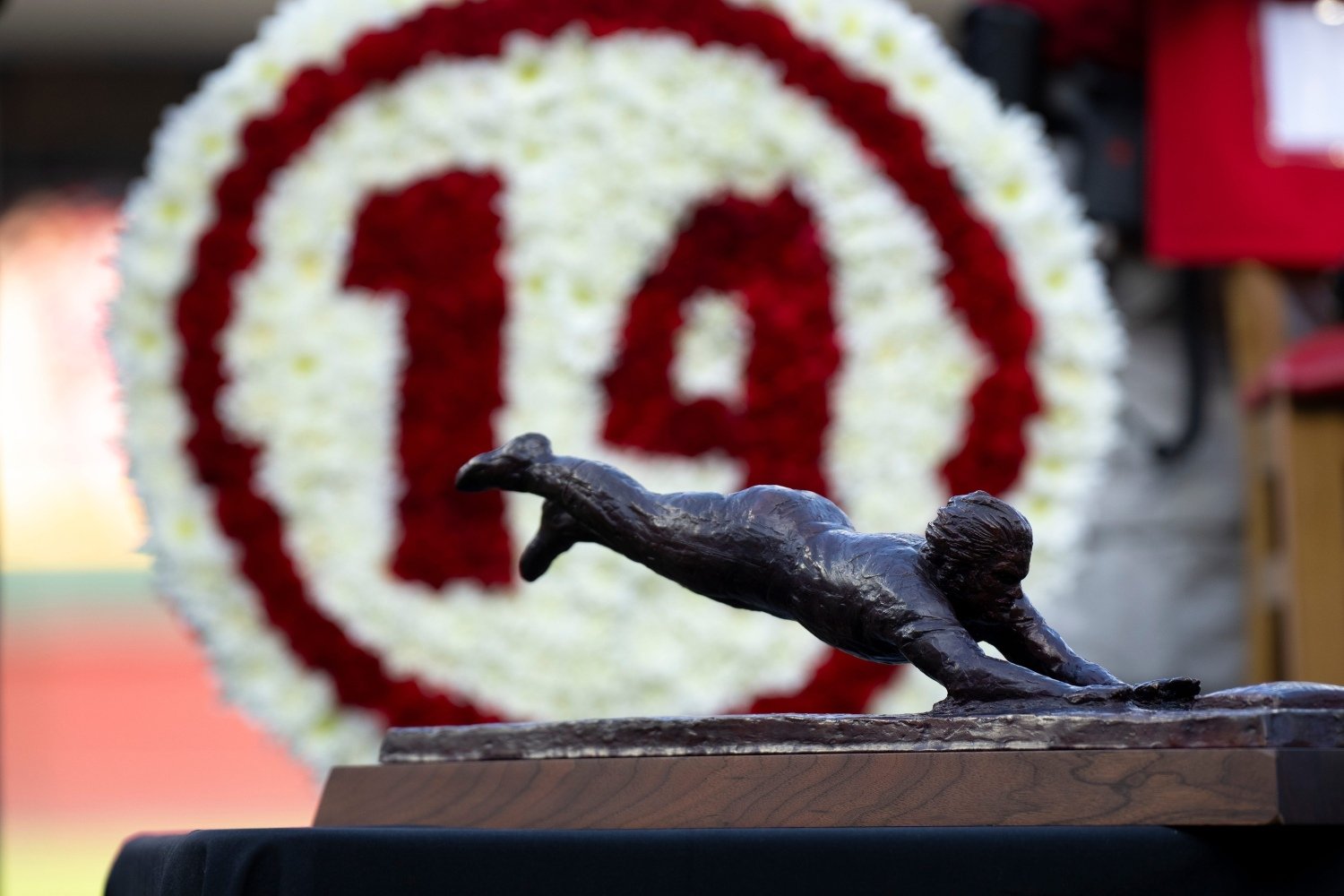
Pete Rose should not be in the Hall of Fame. He should not be celebrated. As a player and a manager, he committed a cardinal sin against Baseball. He broke the game’s Golden Rule. It’s obvious, but lately, it seems to have become almost a secondary talking point. We should fix that.
I’m not here to talk about Rose’s off-field foibles. Between you, me, and the wall, I fall more on the side of ignoring those things in reference to Hall of Fame candidacy. What Rose did as a player and as a manager (i.e., on-field), however, requires Baseball to permanently excise him. It shouldn’t be any more complicated than that—and the stain of his sins hasn’t faded with time.
I’m not breaking new ground here. I don’t have any secret insight. But I want to talk about gambling—the one thing Baseball has ever put its foot down on.
When people talk about Rose’s great sin against Baseball, it’s often framed around his moral character. We borrow the Golden Rule label from world religion and philosophy as a euphemism for gambling on baseball. We use words like “the integrity of the game.” But the “integrity of the game” isn’t some moral standard; it’s a pragmatic one. When we say integrity, it’s not about doing the right thing; it’s using the original definition—the structural foundation of the sport.
The day that gambling seeps onto the field of play is the day Baseball dies. This isn’t about right and wrong. It’s about the game continuing to exist.
Intrinsic to our love of baseball—and sports in general—is a basic assumption: anything can happen. Two groups square off in a battle of wits, talent, effort, strength, and guile. May the best man win. Any given Sunday. Whatever the coach in Miracle said. And we have the pleasure to watch it play out.
That’s why we buy tickets. It’s why we pay for an entire yearlong cable package subscription just to watch our hometown nine play all summer. We get to watch the best athletes in the world do what they’ve trained for decades to perfect—and we don’t know how it will end. It’s sweet. It’s heartwarming, even, to watch our favorite boys win. And it’s agonizing—heart-wrenching even—to watch them lose. Much of that emotion is learning our favorite team’s fate in real time. We ride the roller coaster along with them. They go up, and so do we. They plummet down, and so do we.
But what if it was all preordained? What if there were no feats of strength or clever tricks or mental games? We would, instead, be watching WWE, or a low-budget movie.
Now, there’s nothing entirely wrong with WWE or cheap films as a form of entertainment, but that’s not baseball. It’s not Baseball.
Don’t get me wrong; one single person gambling on the games that they play or manage, whether they’re only betting on their team to win or not, isn’t enough to transform MLB into professional wrestling. But the true structure isn’t the only thing that matters, either.
As soon as the people stop believing that the game in front of them is real, it’s as good as dead. That’s what Baseball is fighting against. It’s why the game needs to take these sins seriously. It doesn’t just make you feel icky; it threatens the institution.
Those who threaten that game need to be banished. They’re damned. There’s no purgatory for those who break the one rule. It’s nothing personal; just business. You cannot be associated with the sport after doing something that threatens to ruin it. It does not matter how many hits you had or how hard you hustled or how much children loved you. You voluntarily chose to separate yourself from Baseball. You committed a mortal sin.
And yes, that sin against Baseball is far worse than other popular sins against Baseball. Steroids don’t hold a candle to the dangers associated with gambling. The winners being the baseball players who take the most drugs is a time-honored tradition, and the games are still decided on who is the best, strongest, and most focused. That’s far preferable to the winners being the players the gamblers choose to win that day. Wanting to win so badly that you cut corners is a crime; being willing to trade the drive to win for profit or the satiation of some darker urge is a worse one.
The league aligning itself with gambling services as advertisers is also a separate topic, my own thoughts on which aren’t relevant here, but it’s brought up as a strawman in this discussion so we might as well address it. Put simply, the league encouraging fans to gamble has no bearing on the game on the field. If there’s ever evidence that the league is influencing games for any gambling-associated purpose, I want all involved parties burned at the stake, as well. But until that happens, MLB partnering with those services is irrelevant.
There is no coming back from what Rose did as a player and as a coach. Gambling on the game (specifically) does not make him a bad person. But it does make him a sinner against the sacred game. Baseball, with a capital B, cannot afford to welcome Rose back into the fold. That’s why it’s Baseball’s Golden Rule. Not petty morality, but an existential guard against ruin. Rose’s faults of character away from the park are between him and eternity, now. His gambling is very much between him and the game—and it needs to stay there, holding the two separate.