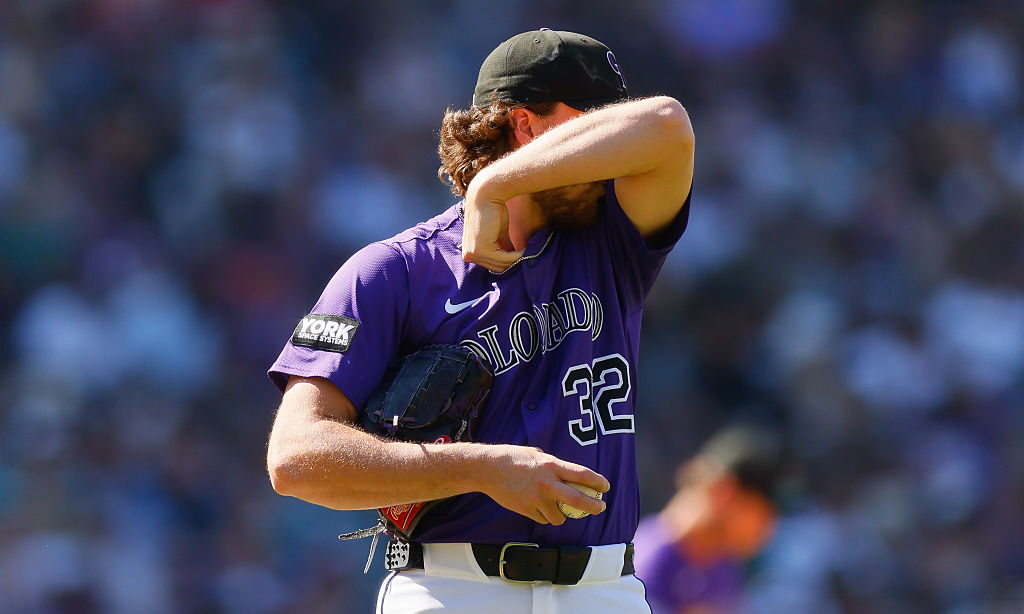
Pitching prospects don’t always hit the way you want them to, and that’s just life, but when there’s only one promising young arm in your entire organization, he’d better cash.
Chase Dollander’s rookie year for the Colorado Rockies was anything but money. His 6.52 ERA in 98 innings was fourth-worst in baseball, with two of his teammates — Antonio Senzatela and German Marquez — somehow ranking even worse. It’s a hint at how desperate the situation on the mound has become for the Rockies, who have lost 100 or more games for the third-straight season.
Dollander isn’t necessarily supposed to be the savior, but the ninth overall pick in the 2023 MLB Draft should be representing the hope of young arms coming up to take the ball from the older group, who are no longer cutting it. Instead, the righty’s rookie year is a giant red flag that more of the same subpar pitching performances are coming to Coors Field.
“[This season had] a lot of ups and downs, for sure,” Dollander told SB Nation. “A lot of learning moments, and a lot of growing pains, I guess you could say. But most importantly, I took a lot of positives from it. If you focus on all the negative stuff, you’re not going to get too far. So, I’m trying to be positive about it, knowing I ended on a good note. I finally started to feel like I was making some ground on some stuff, and I’ve got to take that into the offseason and into next season.”
The most concerning part of Dollander’s rookie year is likely his strikeout rate. In the minors, it was 12.6 per nine innings over his 27 starts, and in the bigs, it fell to 7.5. Over his first eight starts, he had five games with five or more strikeouts. But then he had a forearm issue that kept him out a few weeks, and he returned for a stretch where he didn’t get more than four strikeouts over his next seven starts.
Dollander was sent down to Triple-A and came back in August, where he struck out five or more in five of his final six starts of the year before landing on the Injured list one more time with a season-ending knee injury. The strikeout jump at the end, as well as his home run rate cutdown, are encouraging signs. He allowed 18 homers on the year but only three in his final six starts. Couple the Ks and Dinger mark improvements and a bright sophomore season coming for Dollander, even if his ERA remained high.
“I could get away with just throwing a fastball in the middle of the zone, kind of top rail, and in the minor leagues, I would get away with it no matter what happened,” he shared more to SB Nation. “And [in MLB] it’s like if you fall behind in a count and do that, you’re gonna get punished for it. So having the command and how important it is to throw strike one and win 1-1 counts [are important lessons].”
Dollander said his debut was the highlight of his season, a fun time on Rockies’ opening weekend. But his main reflection on this year is learning how to pitch, especially by shaping his fastball better and improving his mindset.
“It was just a mindset switch for me,” he said. “Especially in that last start, I basically got tired of just being timid. I wanted to go out there and prove to the league, ‘Hey, I belong here and I’m going to be a problem for hopefully the next 12-15 years.‘ So I made a statement. I truly believe that I have the stuff and the mindset and everything to be the best pitcher in the world, so I’m looking forward to building on that.”
Dollander isn’t wrong; his stuff is elite — now it’s about becoming one of the many ballplayers who took lumps and learned during their rookie year, only to come back as a star in their second season.