
Last October the Dodgers had three starting pitchers, one of whom with a 5.38 ERA that very accurately described his season. But they rode their deepest postseason bullpen of this extended run all the way to a championship.
This year the script has been flipped, with the Dodgers stopping their annual tradition of simply running out of healthy starters. Less than two weeks before the postseason begins, the Dodgers have six healthy and exceedingly productive starters. But the bullpen has been terrible of late.
The Dodgers held leads in each of the first two games against the Phillies, and even came back to tie after blowing leads on both Monday and Tuesday. But the bullpen had other ideas.
Seven of nine relievers were used on Monday and/or Tuesday, and six of them allowed home runs. The only one that didn’t was Tanner Scott, who has two straight scoreless outings dating back to Saturday but whose season has gone so poorly that he said this month, “Baseball hates me right now.”
Blake Treinen took the loss in each of the first two games against the Phillies, in separate ways. Treinen is usually bad at holding runners, with 47 steals in 54 attempts in five years and 172 2/3 innings with the Dodgers. But he usually gets around that by mostly avoiding allowing folks to reach base.
So Treinen wasn’t the ideal pitcher to bring in with the free runner on second base in the 10th inning on Monday. He allowed a double steal in the inning, which helped the winning run score on a sacrifice fly. Treinen’s nine steals allowed are tied for second-most on the Dodgers, despite pitching only 23 innings. On Tuesday he got two outs in the ninth before allowing a double, walk, then a three-run home run by the Phillies’ No. 9 hitter, Rafael Marchán.
The only two relievers who didn’t pitch Monday or Tuesday were Michael Kopech, who since returning from the injured list has walked a third of his batters faced, and Kirby Yates, who has pitched so badly that he only comes in when trailing or when the Dodgers are up by a lot. The last time Yates entered a game the Dodgers were leading by three or fewer runs was July 23, before his second injured-list stint this season, and 11 appearances ago.
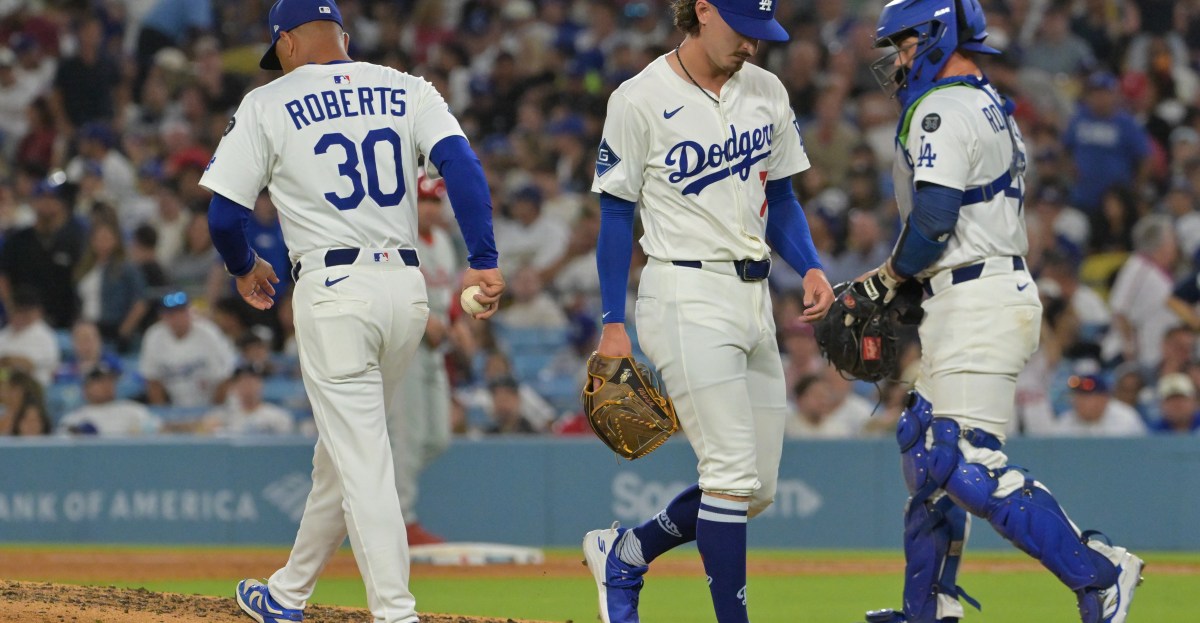
Of late, it hasn’t really mattered who Dave Roberts has called for out of the bullpen because they’ve all been shaky.
Dating back to the Yoshinobu Yamamoto near-no-hitter on September 6 in Baltimore, the Dodgers have played in 10 games. Here are the splits from those 10 games, counting Emmet Sheehan’s opener-following Monday appearance with the rotation:
Dodgers pitching in last 10 games (since September 6)
Starters: 61 2/3 IP, 1.75 ERA, 20 hits, 12 runs, 21 walks, 77 strikeouts
Relievers: 29 1/3 IP, 7.36 ERA, 28 hits, 26 runs, 19 walks, 35 strikeouts
The bullpen giving up more hits, almost as many walks, and more than double the runs as the starters despite pitching under half of the innings is wild.
Even with the unreliability of late-game situations, the Dodgers have still won six of those 10 games. The offense has averaged 6.2 runs per game during that stretch, which serve as a nice reminder that there are many ways to win a baseball game.
During the Dodgers’ stretch of 12 straight years making the postseason, they won championships in the years they averaged 5.94 (2024) and 5.61 (2020) runs per game. The only other year they averaged over 4.4 runs per game was in 2017, when they scored 5.47 runs per game en route to a pennant. Scoring a lot can help sweep other problems under the rug.
The Dodgers will need to hit to win in October — which for the Dodgers’ purposes also includes September 30 because it’s nearly a certainty they will have to play in the wild card round — even with their stacked starting pitching. But they’ll also need something, anything from the bullpen to avoid an unceremonious early exit from the postseason.