
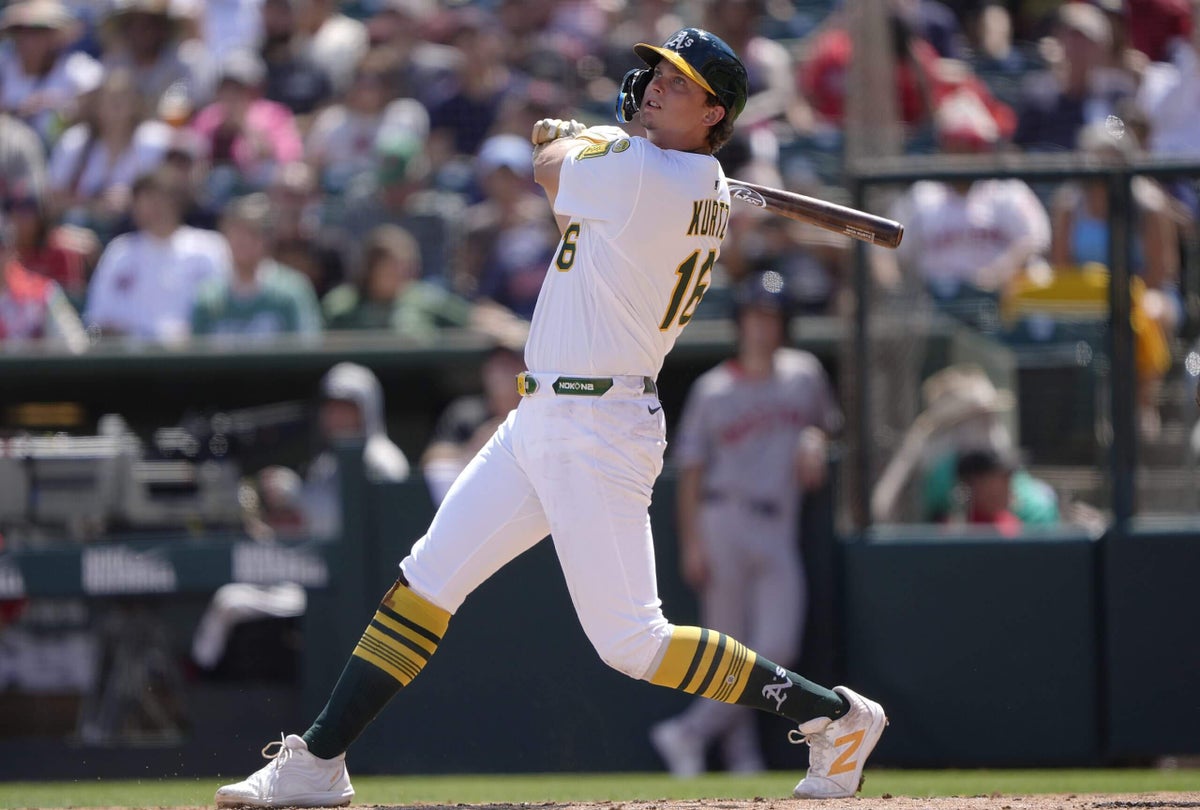
Since July 25, the night Nick Kurtz crushed four home runs in Houston, opposing pitchers have been faced with a difficult choice.
Pitch to the phenom power hitter, in the hopes you can get him out, or simply walk him and be done with it.
Following that historic 6-for-6 game, more and more pitchers have opted for the latter. Even in a potent Athletics lineup, facing anyone but Kurtz has become the overwhelming preference.
But with the bases loaded on Saturday night in West Sacramento, Cincinnati Reds reliever Scott Barlow didn’t have the luxury of that option, as he stared down the mound at one of the game’s most unexpectedly feared sluggers.
With Cincinnati down two runs in the eighth inning while in the midst of a wild-card chase, Barlow had to throw Kurtz a strike. Barlow knew it, Kurtz knew it, and everyone inside the bandbox Triple-A ballpark did too. The result? A 493-foot blast over the batter’s eye, the longest home run hit in the big leagues since 2023.
Kurtz came back to the dugout and watched his homer on an iPad with teammates flanking him, living vicariously through the replay while the hitter himself sported a sheepish grin.
“I don’t know if there’s words to describe that at-bat,” A’s manager Mark Kotsay told reporters after the game.
Kurtz’s career — his life — has undoubtedly changed since that fateful July night in Houston. He gets a crush of media requests, city to city. All of his teammates walk around the clubhouse sporting a shirt with his nickname, the Big Amish; a hat tip to his hometown in Pennsylvania’s Amish country.
But the most noticeable changes have come in the batter’s box. There exists a clear line in the sand for how pitchers attacked the 22-year-old before and after his four-home run masterpiece. In his first 66 games, Kurtz’ walk rate was 10.3 percent, but it has ballooned to 18.3 percent in the 39 games since.
An 18.3 percent walk rate is higher than the walk rates for Aaron Judge (17.4 percent), Juan Soto (18 percent) and Shohei Ohtani (15.3 percent). Over the course of a full season, it would be the highest mark in all of baseball.
The A’s lineup is full of imposing bats. Going into Wednesday’s game, Brent Rooker was one home run shy of a third consecutive 30-home run season. Jacob Wilson and his .318 batting average represent the most effective bat-to-ball threat in the game. And Shea Langeliers’ 129 OPS+ and 30 home runs make him the best power-hitting catcher not named Cal Raleigh.
Kurtz — the likely unanimous Rookie of the Year — is so good, however, that he’s the one giving the lineup protection.
“You get pitched a little bit differently, especially soon after that (four-homer) game,” Kurtz said. “I wasn’t getting a lot of pitches to hit.
“If they missed, it was a ball. It wasn’t in the heart of the plate. They were being very particular in what they threw. It’s one of those things you have to adjust to, and figure out how to come back.”
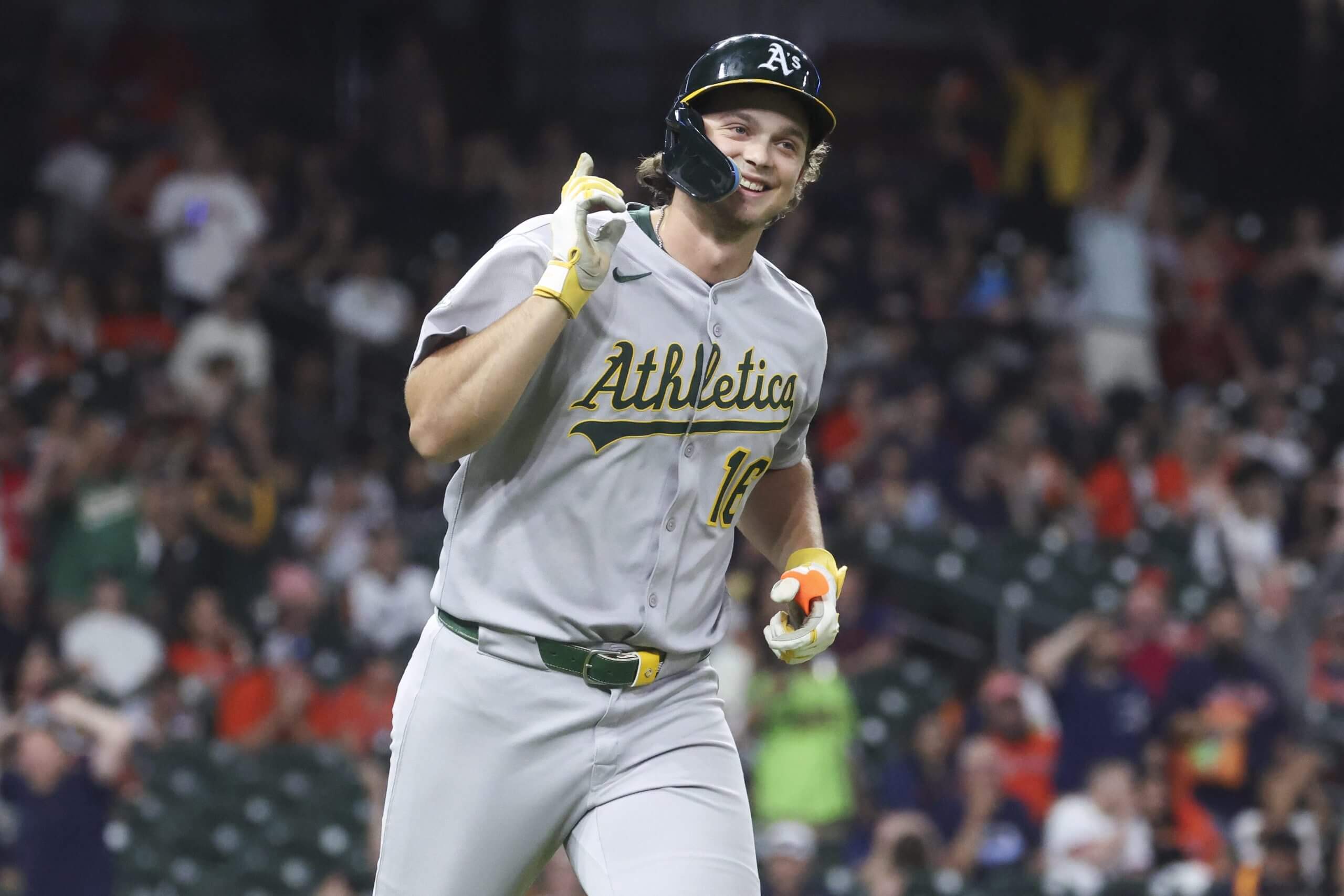
Kurtz smiling after he hit his fourth home run on July 25. (Troy Taormina / Imagn Images)
None of this is particularly new for Kurtz. During his sophomore year at Wake Forest, he hit one spot ahead of Brock Wilkin, who became the Atlantic Coast Conference’s all-time home run leader that season. That meant Kurtz got pitches to hit.
Wilkin was taken in the first round by the Brewers after that season, leaving Kurtz on an island in the Demon Deacons’ 2024 lineup. Kurtz hit 22 homers as a junior (two fewer than he did as a sophomore), but he also walked 30 percent of the time. As a draft-eligible junior, it was frustrating. He had something to prove, but was seldom getting a chance.
“It certainly weighed on him his junior year, there was no question about that,” Wake Forest head coach Tom Walter said. “The biggest thing we had to get him around, was ‘Hey, there’s lots of ways to help your team win.’
“Him having gone through that — the ups and downs of his junior year — has helped him in pro ball.”
Kurtz instilled no fear in opposing pitchers when he was first called up to the big leagues on April 23 — barely nine months after he was selected fourth in the 2024 MLB Draft. He didn’t walk once during his first 32 plate appearances because pitchers had no reason not to challenge him in the strike zone. It took 63 plate appearances for him to hit a homer, then 22 more to hit another. He was a vulnerable rookie that pitchers licked their chops to face.
That sentiment has evolved both quickly and significantly as Kurtz’ season-homer totals have continued to climb (32 going into Wednesday). Angels starter Yusei Kikuchi walked him twice, both on four pitches, during a start in early September. Kurtz was walked twice more the next night, and for good reason: When he finally did get a pitch to hit, he blasted it 447 feet onto the rocks in center field.
“He has plate discipline well-advanced for his age, and he kind of always has,” said Angels interim manager Ray Montgomery, who assisted the team in scouting Kurtz leading into last year’s draft.
“He has enormous power. You have to be careful when you’re attacking him. He’s the biggest leadoff guy I’ve ever seen.”
Twins pitcher Bailey Ober never walks anyone. His 4.8 percent walk rate is nearly twice as good as the MLB average. He’s issued just seven total free passes in his last 11 starts.
When Ober faced the A’s on Aug. 20, he made an exception. He struck out the first two batters of the third inning, giving him a permission slip to walk Kurtz. Five pitches, all out of the zone, one called a strike. It was Ober’s only walk issued in a three-start span.
“Everything on his report was that he’s crushing the baseball,” Ober said. “Try to use your strengths to try and get him out somehow. And if that’s walking him, that’s fine.
“His approach that series,” Ober added, reflecting on Kurtz going 6-for-10 with two doubles, a homer and five walks over three games, “I’ve never seen anybody be able to adjust like that mid-at-bat.”
Around the game, Kurtz has everyone buzzing. Three time zones east, on Sunday morning in the Guardians clubhouse, players were marveling at what Kurtz had done to Barlow, an ex-teammate who spent the 2024 season in Cleveland.
Several players saw the highlight. One heard about it on the radio. They all knew the particulars: 493 feet, launched into orbit and over the batter’s eye in center field in West Sacramento. A couple players debated whether Barlow threw the right pitch, a 92-mph fastball that caught too much of the plate. But then again, what are you supposed to do?
“He’s so good,” said Tanner Bibee, Cleveland’s ace who allowed a homer to Kurtz in June. “He has power to all fields, bat-to-ball (skill). He’s really good.”
Bibee, Barlow and everyone else has a difficult choice to make when it comes to facing Kurtz. More and more frequently, pitchers are picking the same option. Walk him, and move on to the next batter.
“I’ve always had that confidence in myself, that I’m able to do that — be the centerpiece of a lineup, and help that lineup score a bunch of runs,” Kurtz said, adding that the A’s lineup is full of threats. “I think having that confidence in yourself is huge in this game.”
(Top photo: Thearon W. Henderson / Getty Images)