


Michael Massey stood off to the side during batting practice.
For a few short moments, Massey took a couple of short hacks. Each time, he stopped his bat in the middle of the swing.
The reason?
He needed to visualize the correct angle — and depth — before he completed his follow through. And, getting the right angle was important. It could ultimately be the difference between a strikeout or a two-run homer.
Massey just needed to understand why.
“The earlier and longer you could be in the zone, it gives you a much bigger timing window,” Massey said.
Since his Kansas City Royals debut, Massey has been lauded for his impressive swing path. It’s a sight to behold from the left side of the plate. He has the ability to drive the baseball to all fields — as evident by his 279 hits in four seasons.
Last year, Massey started to display more power. He belted 14 home runs in 100 games while dealing with lower back issues. The Royals expected more production coming into the 2025 campaign from their Opening Day second baseman.
Yet, Massey got off to a rough start. He posted a .202 batting average with a .479 OPS (on-base plus slugging) during the first half of the season.
The results weren’t there. Meanwhile, Massey dealt with various injuries, including a left ankle sprain, that hindered his production.
The Royals allowed him time to heal. As he recovered, the club gave Massey an extended rehab assignment in Triple-A Omaha. He needed to show he was fully healthy, but also that he could make the necessary adjustments at the plate.
So Massey got to work.
“I tried to use it as a positive experience,” Massey said. “Obviously, you want to be with your teammates and kind of go through the same grind that they are going through. But, you know, the best I could do with my injuries at the moment was to go down and work on my swing and try to get a little bit better.”
A change of direction
Massey took significant time to study the mechanics of his swing. There were different areas that could be fixed with slight adjustments. However, he understood that any big changes would need to be made during the offseason.
His first adjustment was to avoid doing what felt familiar.
“When you struggle a little bit, you start to go back to what’s safe,” Massey said. “You go back to what you know.”
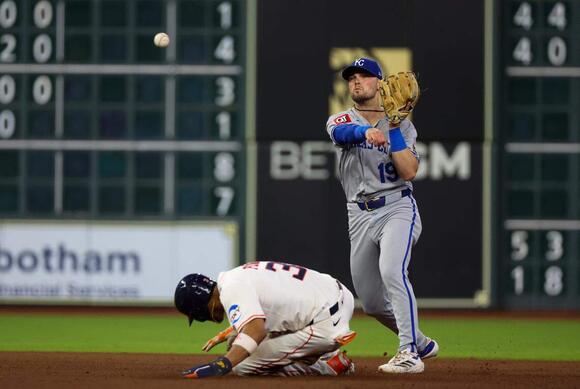
Massey relied on hand-eye coordination throughout his early playing days. It was a comfortable approach that allowed him to hit the baseball where it was pitched.
At times, the strategy worked in his favor. Massey found ways to hit mistake pitches and generate massive results. However, things got difficult as the quality of pitching increased through the minors.
“I’d argue that’s been my default for most of my career,” Massey said. “So it was a matter of how I can be better about recognizing when I’m going back to my default and be able to make those adjustments quicker.”
Once he arrived with the Royals, Massey had to switch his strategy. As he gained major-league experience, his goal was to shrink the strike zone and force pitchers to attack him in his hot areas at the plate.
It reminded him of a cat-and-mouse game.
“If you are going up there trying to cover all 17 inches (of the plate) because you are worried about just trying to put the ball in play, you are going to make a lot of weak contact,” Massey said. “… Guys at this level are going to pick the ball up and throw you out at first base. They are going to track a ball down that’s hit 92-mph in the gap and you are going to be out.”
Massey was on the right path this spring. He hit .408 and posted a 1.054 OPS in Cactus League play.
However, the wheels started to fall off early in the season. Massey was striking out more and not looking like his usual self. He also was shifting between second base and left field as the Royals tried to balance both him and newcomer Jonathan India.
Massey appeared in 56 games during the first half of the season. He recorded 32 strikeouts and walked five times — showcasing an inability to consistently get on base.
So with a chance to get healthy, Massey worked with Triple-A Omaha hitting coaches Bijan Rademacher and Darin Everson off the field.
“You know, I think my (swing) path is a tick better than it was before,” Massey said. “… It’s still a work in progress and I think there still are going to be some bigger adjustments moving ahead.”
A revamped mentality
Massey tinkered with his swing primarily in the batting cage. He worked hard to level his swing and control his bat speed at different quadrants of the strike zone.
The goal: Be on time and give yourself room to overcome errors.
“You really have to impact the ball optimally in order to be successful over a long period of time,” Massey said. “So I think being more selective at the pitches I swing at. And again, trying to get my swing in a spot to where when I do get that pitch, they are not going to get the ball back.”
Massey was able to find success in Omaha. He started to hit for power and saw better results in the short stint. He also honed his skills in left field and was deemed ready to return to the Royals in August.
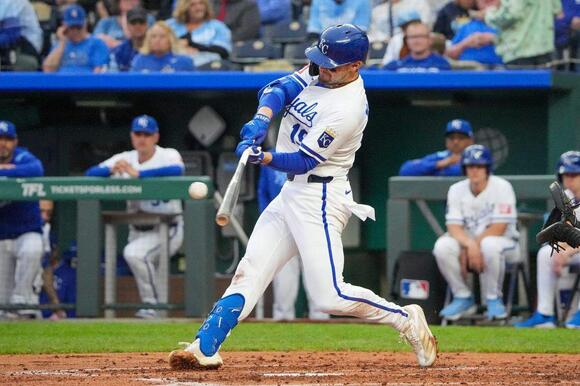
“Michael’s had success at this level,” Royals assistant hitting coach Keoni DeRenne said. “So it’s always good for him to try to find ways to revert back to that. Lean on your past experiences. Unfortunately, the injury took time away from the game. Every at-bat that he has up here is still a development where the league has adjusted to him.”
And Massey’s counter-adjustments have made him into a better player. Since returning from his rehab assignment, Massey has posted a .310/.356/.713 slash line.
The Royals will look to find playing time for him down the stretch. The club is loaded with left-handed bats but Massey is still considered a key part of the team. If healthy, he could be someone who rebounds ahead of the 2026 season.
“He’s a confident player,” DeRenne said. “He knows what he needs to work on and he knows that he is definitely not a finished product. Like a lot of these guys, they are not finished yet and there is always growth for him to find small bits and wins throughout the course of the major league season.”
The Royals still have three years of team control left. Massey will enter his first year of arbitration this offseason.
It’s no secret the Royals will look to upgrade offensively. There is a chance Massey could provide more production with a better campaign during his age-28 season. As it stands now, he hopes to finish on a high note in order to build momentum moving forward.
And the Royals are hopeful themselves.
“I still don’t think I’m in an area that I’m capable of being in,” Massey said. “But certainly things are better. I think we are going in the right direction.”