
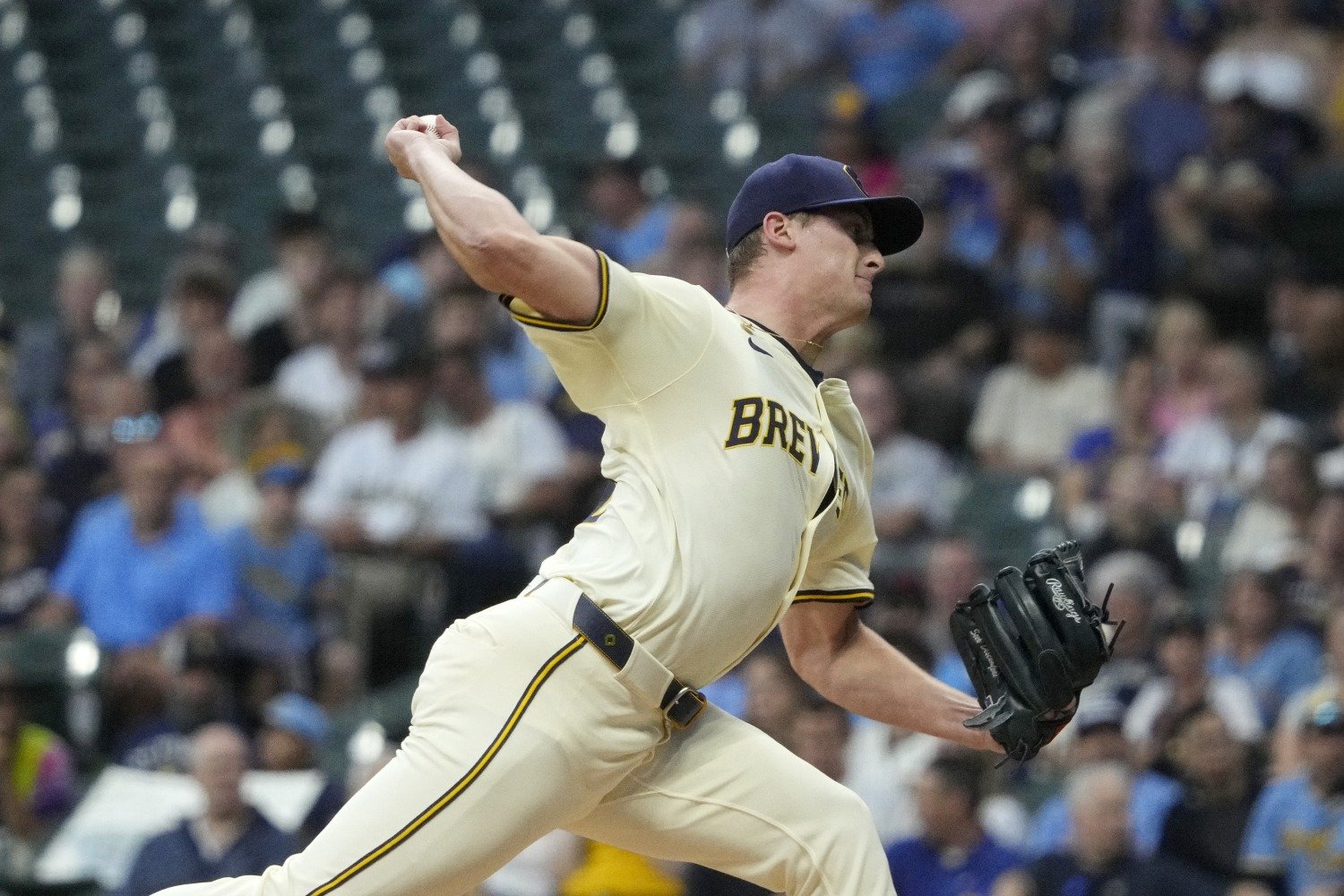
The Brewers’ three-game sweep of the Los Angeles Angels was not all that remarkable. It was, perhaps, even expected. The Angels are a bad team, and the Brewers did what good teams should do against bad opponents. There are takeaways to be gleaned from how they did it, though—particularly on the run-prevention side.
The Angels have a poor offense, ranking 23rd in baseball with a 92 wRC+, but they’re especially feeble against pitches with lift and glove-side break. Their -16 run value against cutters is the worst in the league, and their -15 run value against sweepers is fourth-worst.
While no one said it outright, it sure looked like the Brewers’ gameplans centered on that weakness, and their last two starters exploited it best. Brandon Woodruff, whose new cutter had largely been an auxiliary pitch to support his two existing fastballs after losing some velocity post-shoulder surgery, threw cutters at a season-high 45% rate on Wednesday. Angels hitters whiffed on eight of 16 swings against it.

“I’m not going in and saying I’m going to throw 30 cutters,” said Woodruff, who claimed that leaning on the pitch so heavily was not part of his original game plan that night, “but if it’s working and it’s playing right, I can use it to help out the other fastballs.”
Sinkerballer Quinn Priester followed suit the next night, throwing his cutter a season-high 40% of the time en route to his third outing of the season with double-digit strikeouts. Four of his 10 strikeouts came on cutters, which yielded six whiffs out of 16 swings.
“It’s just something that’s keeping the guys off the sinker, and when it’s working and guys aren’t making the adjustment, we can kind of keep rolling with it,” Priester said.
It wasn’t just those two starters attacking the Angels with glove-side movement. Chad Patrick and Erick Fedde, former starters who are not typical high-leverage pitchers, received opportunities in the late innings with four-run leads during the series. Patrick struck out the side on Tuesday with his usual cutter-dominant mix, while Fedde threw a cutter or sweeper for 20 of his 24 pitches across two scoreless frames the following night.
Carefully orchestrating matchups to win each moment becomes even more crucial in the postseason. When the Brewers face much better lineups in more meaningful situations in October, they could deploy more specialized pitch mixes as they did this week. In last year’s Wild Card series against the New York Mets, they threw several pitchers with riding fastballs from high arm angles.
That might mean rostering certain pitchers over others and using them in key situations because of how their mix profiles against a lineup rather than their regular-season performance. Starters with deep arsenals might sequence differently. Identifying something that works and maximizing it to the extreme could become a more immediately obvious theme for Milwaukee in a couple of weeks.