
There is nothing new under the sun. And since baseball is played under the sun (unless it’s a dome), it should stand to reason that there is nothing new in the world of baseball. This isn’t really true, of course. Baseball provides a constant stream of firsts. But it mostly provides novel events and individuals. New players come along (and too often, go) constantly, but there aren’t very many new types of player. We’ve had our national pastime long enough to see all the archetypes: the slugger, the slick fielder, the flamethrowing ace, the crafty hurler, etcetera. Every so often we’ll see a true unicorn, like Shohei Ohtani or Aaron Judge. But most players look, in terms of their performance, like someone else.
That’s why we have the Similarity Score, a measure, invented by sabermetric pioneer Bill James, that tells us how similar one player is to another, based on their career statistics. A few weeks ago, I wrote about how Aaron Nola and Zack Wheeler are each other’s closest match by similarity score. Thinking about similarity scores made me wonder: Which Phillie is the most unique? The higher the similarity score (the maximum is 1000), the closer the match. By extension, the lower the similarity score for a player’s closest match, the more unique they are.
Bryce Harper occupies a one of a kind place in the minds of Phillie fans, but by Similarity Score he’s reasonably close to Tim Salmon (score of 940.1). J.T. Realmuto is a close match for another Phillie backstop, Mike Lieberthal (943.1). Shave Brandon Marsh (if you can), and you get Clint Hurdle (score of 973.5). When I started writing this article, I figured Kyle Schwarber, whose highest similarity score comes via a comparison to Rob Deer at 904.3 points, would be the most unique. He combines uncommon power with terrific ability to work walks and a willingness to accept Ks. There aren’t a lot of players like Schwarber today, and there were even fewer in earlier eras when strikeout rates like his were shunned. I was going to write about how Schwarber both represents the sea change in how hitters are evaluated and appreciated in modern baseball, and how he stands out as unique even within modern baseball.
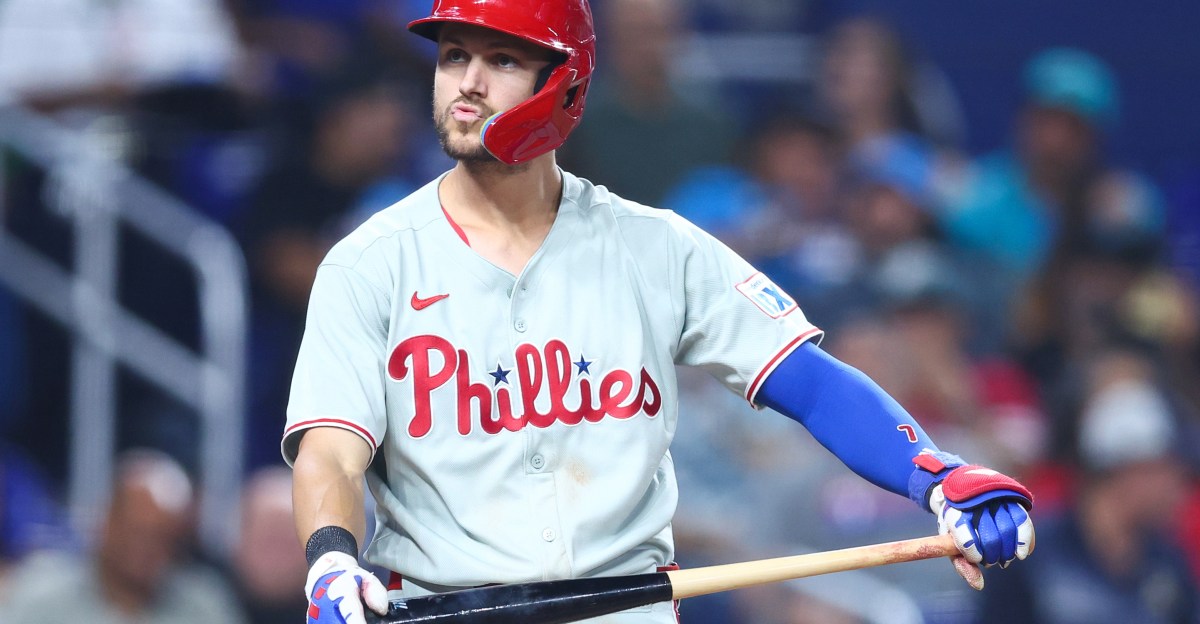
But Kyle Schwarber is not the most unique Phillie by similarity score. That would be Trea Turner. The comparison to Turner’s closest match, Corey Seager, produces a score of 890.5; he’s the only Phillie to have a best match with a score lower than 900. It’s easy to see what makes Schwarber such a unique figure. But Turner, despite his excellence, doesn’t seem quite so iconoclastic. He’s a swift-footed shortstop who hits well. That’s not the most common type of player—a good bat on that part of the defensive spectrum is hard to find— but he hardly seems to be as much of an outlier as Schwarber and his patented blend of selectivity and superhuman strength.
So, what makes Turner so unique? To find out, let’s compare him to Seager, and see where they differ. Similarity score is built on the following inputs:
Games played: Turner has 1265 to Seager’s 1131.
At bats: Turner has 5155 to Seager’s 4344.
Runs scored: Turner has 870 to Seager’s 702.
Hits: Turner has 1531 to Seager’s 1254.
Doubles: Turner has 282 to Seager’s 270.
Triples: Turner has 48 to Seager’s 13.
Home runs: Seager has 221 to Turner’s 186.
RBI: Seager has 667 to Turner’s 641.
Walks: Seager has 473 to Turner’s 383.
Strikeouts: Turner has 1028 to Seager’s 875.
Stolen Bases: Turner has 315 to Seager’s 21.
Batting average: Turner has posted a .297 to Seager’s .289.
Slugging percentage: Seager has posted a .509 to Turner’s .479.
There’s a couple things here that stand out—Turner has played 130 more games than Seager thanks to better injury luck, and Seager’s got the better plate discipline. But what really stands out is the speed difference. Seager’s not just slower than Turner (who isn’t?) but much slower than the average big leaguer, ranking in the 8th percentile by sprint speed this year. Thus the massive gap in stolen bases (and less massive, though still sizable, gap in triples) between them.
It’s not a surprise that Turner is fast; anyone with eyes knows that. But while there are few players, if any, who are as fast as Turner, there are others who are pretty speedy. I would’ve guessed that Turner’s combination of speed and batting wouldn’t have proven more unique than Schwarber’s power and selectivity: champions of the three true outcomes like Schwarber are a newer model of player, whereas the combination of speed and batting average has been appreciated from the moment the Knickerbocker club laid down the rules. But perhaps it’s rarer than I thought.
Looking at Turner’s compatriots at the top of the sprint speed leaderboard shows a couple players who seem similar enough to him in combining speed and batting: Bobby Witt Jr and Byron Buxton. But most of the other players who can get close to matching Turner’s speed aren’t great bats: Victor Scott II, Jorge Mateo, and Brandon Lockridge all pale in comparison to Turner at the plate. And among those who can hit like Turner, few have the speed to make for a proper doppelgänger: Turner is flanked on the OPS leaderboards by Eugenio Suárez, with his 25th percentile sprint speed, and Jacob Wilson Jr., whose speed is in the 39th percentile.
But there’s one more way in which Turner sets himself apart from his colleagues. As noted above, Witt Jr. and Buxton seem like pretty good matches for Turner. Witt hasn’t been playing long enough to be properly compared to Turner using the accumulated statistics that make up similarity score. But Buxton has. The reason why Similarity Score doesn’t consider him a close match for Turner is simple: thanks to his unfortunate injury history, Buxton just hasn’t played enough. He’s a match for Turner by skillset, but not by accomplishment. Turner has been remarkable durable over the course of his career; he played in every game in the 2018 season, and has had only two seasons in which he played fewer than 140 games since (not counting 2020).
Turner certainly isn’t flying under the radar. He’s a three-time all-star in a big market with his own Netflix documentary. He’ll pick up some MVP votes this season. But in a sense he is underrated. When we talk about baseball’s true unicorns, we mention Ohtani, Judge, Schwarber. Maybe we should mention Turner too.