
ARLINGTON – When he was considering the Rangers offer three autumns back, Bruce Bochy sought to sift through potential fluff to get real answers about the state of the organization. He’d listened to the things Chris Young had said and that Ray Davis had promised and he’d been impressed.
It wasn’t until after he called Scott Littlefield that he became convinced.
Bochy had worked with Littlefield nearly 20 years earlier in San Diego and they’d formed a close bond. Bochy loved managing games. Littlefield loved evaluating players. They both loved talking baseball and the occasional playful barbs that are part of baseball banter. They spoke the same language. One of mutual trust and respect.
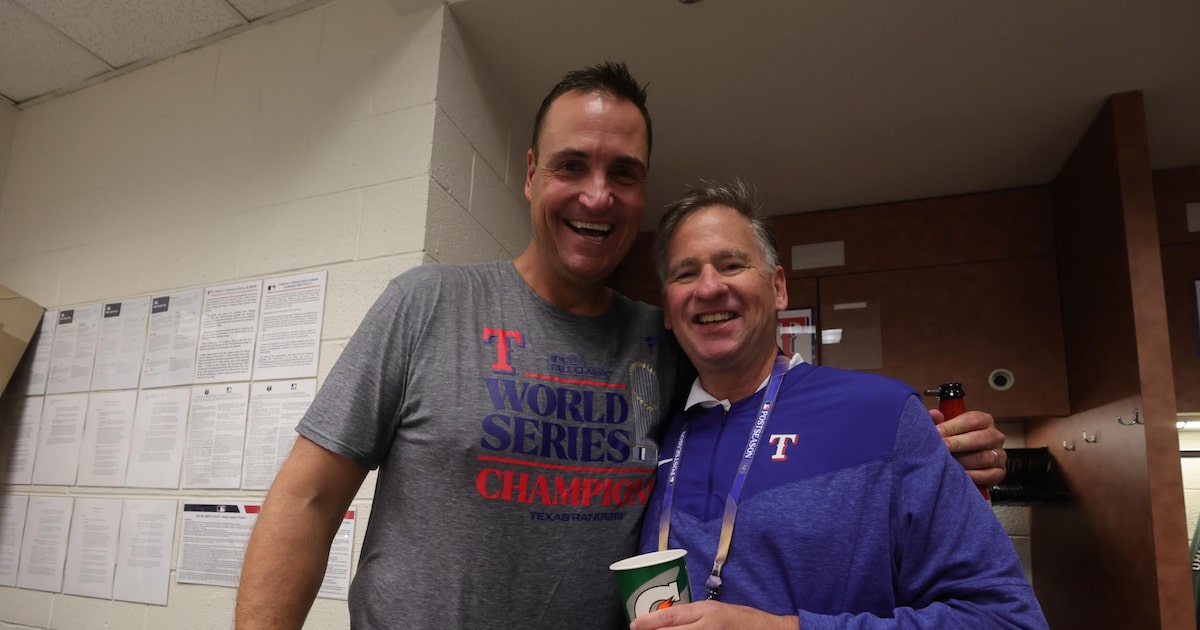
“You knew you would get no bull from him,” Bochy said Saturday afternoon between occasional sobs as he tried to reckon with the news that Littlefield, a Rangers special assistant for player personnel, had died at age 59 in his Houston hotel while on an assignment a day earlier.
Rangers

Texas Rangers’ late scout Scott Littlefield and his wife Heather.
Courtesy Photo: Texas Rangers
“He told it like it was. And he was really excited about the future. You could feel it when you talked to him. He talked about how close the Rangers were to winning a championship. He believed it because he knew talent and what they had put together. And I believed it because I trusted his perspective.”
On Saturday, even after he was gone and the Rangers’ front office was reeling with grief, he gave them more perspective. It has been a terrible week for the Rangers on the field. A sweep at the hands of the Astros to start the week dashed any remaining hopes of a run to the playoffs. Losing to the Marlins in 12 innings would have been like pouring a shaker full of salt into a cut.
By the start of Friday’s game, however, the Rangers had gotten word that Littlefield, who had spent 33 years in baseball as a scout, the last 15 of them with the Rangers, had passed away. After his family was unable to reach him, he was found unresponsive at his hotel in Houston where he’d been on assignment to scout the Astros-Mariners showdown in the unlikely event the Rangers reached the postseason. There was no foul play suspected, said his brother, Dave, a former GM and long-time scout. Littlefield had a heart issue in 2023, but had worked without issue since.
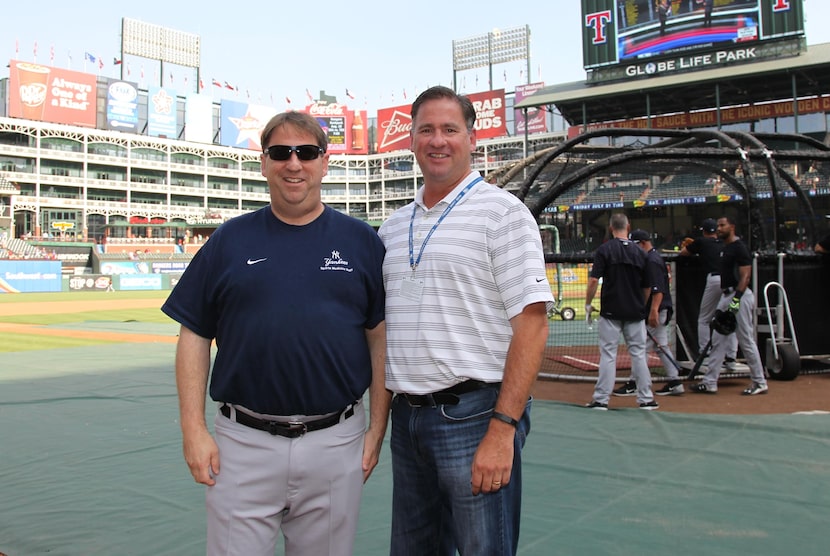
Texas Rangers’ late scout Scott Littlefield and his brother Mark, who is the medical coordinator for the New York Yankees.
Courtesy Photo: Texas Rangers
He’d come to Houston early, to spend the Rangers-Astros series with his bosses, to talk baseball, and to laugh. For scouts, who spend their lives on the road, alone in hotel rooms, almost nothing could be more fulfilling than feeling connected to the team for a few days.
We’d say that with more certainty, except that in the case of Littlefield, his family definitely came first. His two kids, son Tyler and daughter Erika, had followed him into baseball, working in scouting with San Diego and Baltimore, respectively. You could say it was in their genes. On both sides. Littlefield had married the former Heather VanOrnum, daughter of long-time scout John VanOrnnum, who had also served as the catcher on the original TV version of Home Run Derby. Theirs was a marriage destined to produce another generation of evaluators.
Related
This was what the Rangers’ front office group who knew him best said on Saturday. He had an innate feel for “winning players.” He was blunt and direct, with the pragmatism of a New Englander born and raised in Portland, Maine. He could be crude, both as a compliment and a criticism. He was prone to practical jokes. And he was selfless with his time, particularly for any scout or young person wanting to get into the game.
Fenstermaker remembered a rainout early in his own scouting career, which meant a six hour round-trip drive with the visiting Littlefield to see a mid-round prospect. After the rainout, Fenstermaker was prepared to move on to the next prospect.
“He said, ‘Oh, no, we go back; the job is not done’,” Fenstermaker said. “So, we drove back to the hotel, had a couple of beers, spent the next couple of hours talking baseball shop and life. And then we went back and saw the kid pitch. And it wasn’t a first-rounder. We ended up taking the kid in the 15th round. That was the job.”
The pitcher was Jerad Eickhoff. The Rangers traded him in the Cole Hamels acquisition four years later, for which Littlefield was also a driving force. Then GM Jon Daniels had been deliberating on the proper “value” to include in the package. Littlefield’s advice: Stop hemming and hawing; the guy is a winning player, go and get him. Hamels helped the Rangers to a pair of division titles; Eickhoff spent six years in the majors. It was that kind of sensibility that both Daniels and Young, his successor, came to admire so deeply in Littlefield.
“He had a great feel for what winning baseball looks and feels like,” Young said Saturday. “He loved the game. He was always available and always connected. He had an unbelievable way, with his New England practicality, of making points and an amazing sense of humor that could disarm any situation. What he offered was always truthful and accurate. He was part of the fabric of this organization.”
His positive reports almost always began with: “This guy loves to play.” It was the highest praise he could give. And it’s an innate talent that the best scouts have in a field that is being decimated daily by data analysis. Which might explain why so many players have perfect on-plane swings, but don’t manage to reach their projected ceilings. There is no measurable for desire, determination and the ability to optimize talent. It’s easy to see talent; it’s harder to see how guys will help a team win games by using that talent.
“You want talent, everybody wants high-end talent, but he knew you also needed guys who could play the game,” Daniels said Saturday. “You need guys who impact the game in a big way, but the smaller nuances of the game matter, too. He excelled in that area. It always showed up in a big way.”
Littlefield had been among the most vocal advocates after the 2020 season for the Rangers to acquire an extraneous first baseman from Tampa Bay’s surplus stock: Nathaniel Lowe. And when Daniels again struggled with which player to include as a second option, Littlefield told him to pick one and get the deal done.
“We’re getting the winning player,” Daniels remembered Littlefield telling him. “He was adamant. And he was right.”
On Saturday, the memories of Litttlefield came pouring out from every corner of the organization. Josh Boyd, the assistant GM who oversees professional scouting and who was responsible for bringing him to the organization in 2009, joked that he may not know how many hours there are in a day any more because every member of the support staff had said Littlefield spent multiple hours with them in Houston.
After the game Wednesday, he sat alone with Young in a back room at Daikin Park and said: “We need more winning players.” The next day, on which he didn’t have a game to cover, he sent texts throughout the organization and baseball. At 8:52 p.m., he texted Fenstermaker how much it meant to be around the team for three days and how much he’d enjoyed seeing him grow in his role.
“I wrote back how much it meant to me hearing that from him, just knowing the amount of time and investment that he poured into me,” Fenstermaker said. “It was a special moment for me.”
When Littlefield got back, he was done with the fluff.
“OK,” he wrote. “How are we gonna get better next year?”
Longtime Texas Rangers scout Scott Littlefield found dead Friday in a Houston hotelRangers’ loss to Marlins a microcosm for 2025 as Texas’ playoffs hopes slowly vanish
Find more Rangers coverage from The Dallas Morning News here.
Click or tap here to sign up for our Rangers newsletter.