
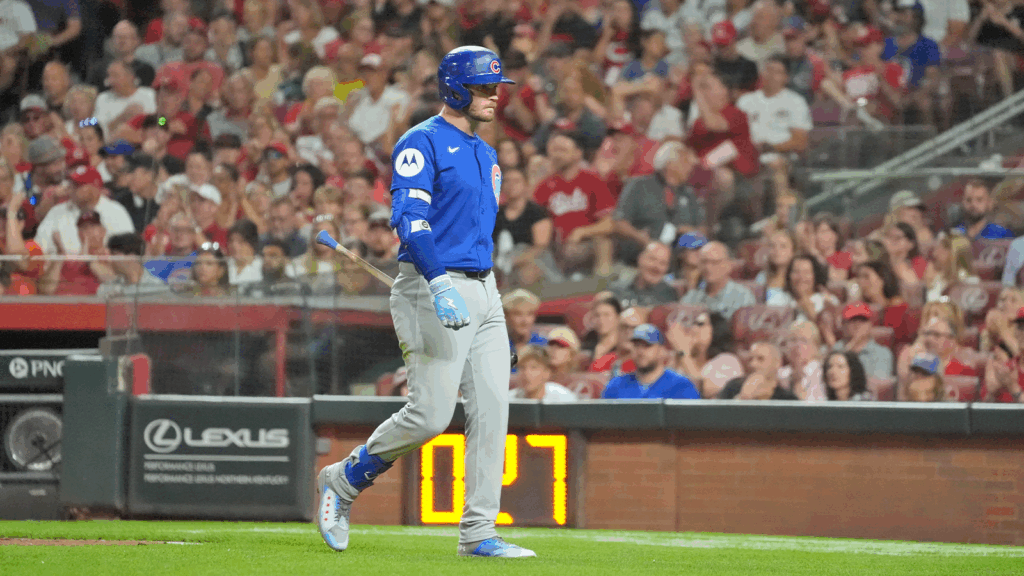
CINCINNATI — The Cubs stressed they had plenty to play for after clinching a playoff spot on Wednesday in Pittsburgh.
But since then, they’ve lost three straight games – albeit against a team desperately trying to keep their playoff hopes alive – as they fell to the Cincinnati Reds on Saturday, 6-3. The Cubs (88-67) drop the four-game set against the Reds (79-76) and will look to avoid the sweep in Sunday’s matinee.
The loss means the Cubs’ lead for the top spot in the NL Wild Card over the San Diego Padres reduces to 4.5 games. The Padres held a late lead over the White Sox on Saturday, so that number might drop to four by the end of the night.
The Reds, meanwhile, move to a game back of the New York Mets for the final spot in the NL playoff field. The Mets wrap up a series with the Washington Nationals on Sunday.
Here are three takeaways from the loss:
Busch’s historic feat
Michael Busch gave the Cubs the lead in the top of the third with a solo blast – his 30th home run of the season and putting him in some elite company.
The homer continues a nice little stretch that he’s been on – since Sept. 10, Busch is slashing .286/.350/.714 (1.064 OPS) with four home runs. That’s a welcome sign for a player who was a pillar of the Cubs’ offense in the first half, when it was one of the top run-scoring teams in baseball.
But Busch has hit just .205 (.690 OPS) since the All-Star break, one of four players – Kyle Tucker, Seiya Suzuki and Pete Crow-Armstrong are the others – who have hit second-half slumps. At this point, there’s not a ton of value in playing the “what if” game on what could have been if those four played like they did to start the year. The Cubs are in the playoffs, and that’s the important thing.
Now, it’s about trying to make sure those guys are in somewhat of a groove going into October, and Busch might be the prime candidate to be an offensive spark if it continues this way.
Tucker is in Tampa, Fla., receiving treatment on his left calf strain, with a potential return during the homestand not a guarantee. Suzuki battled illness last weekend and returned to the lineup this week, but was given the day off on Saturday after playing three games in a row. Crow-Armstrong continues to play Gold Glove defense but is still hitting just .214 with a .623 OPS in the second half.
While the Cubs would ideally like to see one or all three of those guys in rhythm come the playoffs, Busch can still be a good catalyst.
Bullpen musings
Drew Pomeranz pitched an inning of relief after Javier Assad on Saturday, with Aaron Civale pitching two innings and Andrew Kittredge pitching the eighth inning.
That most likely isn’t going to be the winning formula for Craig Counsell to end games over the final seven games or in the playoffs, but the bullpen is an area to keep an eye on down the stretch. The Cubs optioned Porter Hodge on Saturday afternoon, recalling Jordan Wicks to take his place, as the picture of what the playoff bullpen could be is coming into focus.
Ryan Brasier is rejoining the Cubs when they return from their final road trip of the season and it’s possible he could be activated. If he’s healthy and pitching well, the veteran who won a World Series last year could be a contender for the relief corps come October.
The biggest x-factor, though, is closer Daniel Palencia. He’s been on the 15-day IL with a right shoulder strain since Sept. 8. He pitched 0.2 innings on Saturday with Iowa, allowing a pair of hits and an unearned run with two strikeouts. His fastball topped out at 100.5 mph in his 21-pitch outing.
If he’s able to return, that’s another leverage arm for Counsell to slide in next to Brad Keller, Caleb Thielbar and Andrew Kittredge.
Late-game strategy
The Cubs sparked an eighth-inning rally on Saturday with back-to-back doubles from their No. 8 and 9 hitters, Willi Castro and Reese McGuire. After the latter, Counsell turned to Kevin Alcántara to pinch run for the catcher, giving him a speedier option in scoring position.
They failed to push the tying run across – Ian Happ struck out, and Moisés Ballesteros grounded out to shortstop Elly De La Cruz to stymie the threat – but it may have given us a slight peek at factors at play in the playoff roster construction.
The Cubs will have a 26-man roster in the playoffs, with a maximum of 13 pitchers on that roster. In a three-game Wild Card series, there’s no guarantee they fill 13 spots with hurlers. They might opt to try and give Counsell some roster diversity on the bench.
If that’s the case, you could see maybe 14 or 15 position players, although the latter number might be unlikely.
Picture this situation: The Cubs are in a leverage at-bat with Michael Busch due up against a southpaw (.596 OPS against left-handers). Counsell probably turns to Justin Turner (.775 OPS against lefties) to pinch hit, but the Cubs might want Carlos Santana on the bench for defensive purposes at first instead of Turner.
In that scenario, that’s two of the four bench spots on a 13-player position group. And in that 13-man group, including Santana and Turner, means the rest of the bench is probably Willi Castro and the backup catcher, assuming full health for Tucker. That leaves your bench thin, and you might want to carry someone like Ballesteros for a left-handed hitting option. Alcántara’s speed and defensive ability provide a potential backup to Crow-Armstrong.
These are all the things the Cubs will have under consideration over the final seven games, and as they await and see who they play in the playoffs.