
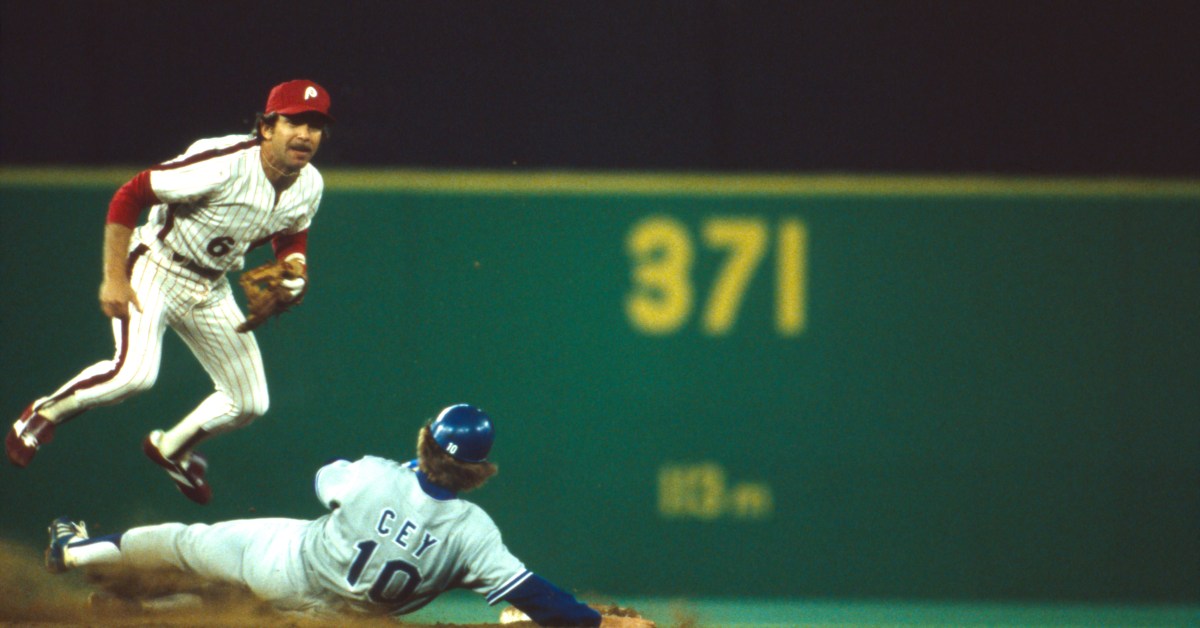
“Phillies: Losers all over again”, ran the headline in the evening edition of Carlisle, Pennsylvania’s Sentinel 1. This was in 1978, and the Phillies did indeed lose that year, defeated in the National League Championship Series by Tinseltown’s celebrated Dodgers (who would subsequently fall to New York’s even more celebrated Yankees). But that headline was not published following the game four defeat that ended the Phillies season. It was published following their loss in game one. Granted, the loss was a particularly deflating way to begin a postseason campaign: the Phillies scored first to whet the appetites of the 63,460 fans that filled even the capacious Vet to bursting, then allowed seven unanswered to the visitors and never recovered. But it still seems odd, even for the famously tense atmosphere of the Philadelphia sports world, for the Phillies to be deemed losers after the first game of the postseason.
In context, though, the early despair of disappointed Philadelphians seems a little more reasonable. Even if we put aside the decades of despondency that had produced not a single World Series victory for the charter club, the Phillies had been, to use parlance that was not used at the time but describes their experiences accurately, going through it. 1978 was the third consecutive postseason visit for the Phillies, no small feat in an era where only two teams in each league made the postseason, and certainly no small feat for a club that had never made consecutive postseasons prior to that streak. But they hadn’t done much once they made it. The 1976 NLCS, their first playoff appearance since 1950, saw them swept by a large crimson device in Cincinnati, and 1977 saw them take game one in Chavez Ravine before dropping the next three to the Dodgers and NLCS MVP Dusty Baker (not the last time he would figure in breaking the hearts of baseball-loving Philadelphians). Add in every other playoff game in the history of the club and their record was a less than glorious 2-14. Not only had the Philadelphias never entered a postseason game with the possibility of clinching a series, they had never put together more than one win in a series.
So in that light the Philadelphia press drafting the obituaries for the fallen Phillies after a game one loss seems somewhat more understandable. And like all postseason disappointments, the search for a cause was on. The discussion, as it so often does, focused on pressure. Before game one, Mike Schmidt was quoted as saying that he felt that the NLCS produced more pressure than the World Series. In those days, the NLCS was the first stop for the Senior Circuit’s division champions, and it was shorter, too: a five-game affair. Less margin for error, less time to mount a comeback, made for more tension— not to mention the fact that it came right after the grueling regular season. “The playoffs,” said Schmidt, “are THE thing to win in my book”. In that era, “playoffs” solely referred to the championship series rather than the postseason as a whole; he was keeping himself focused on the task at hand. Still, he tried to remain level-headed. “It’s an important game, but it ain’t gonna be anything different for me… I hope I can get nice and relaxed.” 2
Pressure always figures into the narrative about a postseason loss, though the blame falls into one of two categories: the players either didn’t care enough, or they cared too much. Somehow, though, the Phillies managed to take their lumps for both possible shortcomings. The author of the Sentinel piece, Bill Calaman, noted that the Phillies seemed calm and cheerful at batting practice preceding the game one loss. “Pressure to show nonchalance is overwhelming and it is quite possible this pressure gets to the Phillies when the playoffs arrive”, he wrote. He also noted that the Phillies might’ve failed to recognize that “mellow…is a West Coast phenomenon”. 1
The Dodgers, however, were not inclined to think of themselves as chilled-out Californians. “Aggression is our key to to success”, said Dave Lopes after the Dodgers’ victory in game two put them on the pennant’s doorstep. The press were already content to deem the Phillies as having failed again: “playoff flops at home for the third year in a row” was how the Associated Press referred to them. This was, if anything, overly charitable: the Phillies had only won one playoff game at home in the history of the franchise, and that was back in 1915. Without much to hang his burgundy cap on, Mike Schmidt was left with nothing to say but the oldest platitude in sports: “Nobody in the athletic world right now thinks we have a chance—except us”.3 That sort of sentiment is often exaggerated, and it seems odd to the modern ear to remark that a club lead by future inner-circle Hall of Famers Schmidt and Steve Carlton could be doubted so. But Schmidt had endured a down season during which he was booed by disappointed Philadelphia partisans 2 , and Carlton was at the time noted for a lack of postseason success, having made four such starts (two with St. Louis), taking the loss in three of them and his club losing the full quartet.
Narratives shift fast though, especially when the sample size is so small. United Press International summed up things concisely in their headline following the Phillies’ 9-4 victory in game three: “Things right for Phillies”. And most right of all was Lefty, who not only got the win, going the full nine, but also hit a three-run homer and provided what proved to be the winning runs via two-RBI single. Pressure, or lack thereof, was of course to be credited. “Everybody was just loose tonight,” said Greg “The Bull” Luzinski, showing a degree of relaxation entirely unbefitting of his nickname. “This club was looser than it has been since I’ve been here”.4
Things didn’t stay right for long. The 1978 Phillies were laid to rest the next day, Saturday, October 7th, as the Dodgers walked off the Phillies in the bottom of the tenth. Garry Maddox’ error on a fly ball from Dusty Baker (not the last time he would figure in breaking the hearts of baseball-loving Philadelphians) set up Bill Russell’s winning hit. The hero of the day was, of course, inclined to discuss pressure. Yes, Russell said, the tight schedule (back-to-back games in Philadelphia, followed by a game in LA without an intervening off day) was tough to deal with. “The only advantage was that we didn’t have time to think of the pressure”. 5
The press were inclined to discuss the subject too, but in the context of the losing club. “For the third consecutive year they failed to win the National League Playoffs and second straight year, they cracked like the Liberty Bell under pressure,” 6 said the United Press International (the loss in ’76 apparently didn’t count as a failure under pressure because it didn’t swing on late-inning miscues in the series-ending game). If the UPI was acerbic in their criticism, sportswriter Bob LeNoir of the Tampa Bay Times was outright venomous.“They are the original Not Ready for Prime Time Players,” he wrote. “You’ve heard of the $100,000 infield. Well, this fall the Phillies have introduced the 10-cent infield…the sportswriters around Philadelphia keep offering all sorts of suggestions as to what should be done with the Phillies, but Disneyland keeps writing back and saying it doesn’t want a franchise”. He felt that the Phillies failures were, of course, partially the result of their reaction to pressure, though he didn’t care to determine whether the Phillies felt too much of it or too little of it. “The Phillies themselves offer as many wildly divergent solutions as the outsiders do. They’re either too tight or too loose or too high or too low or maybe it’s in the stars or the way they comb their hair.”
The Phillies weren’t the only victims of LeNoir’s pointed (and, admittedly, very funny) barbs. He also mocked the Royals, who, like the Phillies, had just lost their third consecutive championship series: “These are two teams who take to post-season play as Marie Antoinette took to the guillotine”. Though he clearly felt the Royals were decidedly peasant-like in their failure to win a crown, he was inclined to give them more credit than the Phillies: “The Royals, of course, at least cause a scene when they go. They get carried off kicking and screaming”.7
Both the Phillies and Royals would trade postseason despair for regular season disappointment in 1979, with the former finishing fourth in the NL East and the latter the runners-up in the AL West. But 1980 saw the two of them shrug off their reputations as they captured their respective pennants. The Royals had the joy of beating the team that had thwarted them in their last three playoff appearances, finally taking down the Yankees. The Phillies had to settle for working out their frustration against the Houston Astros (they’d have to wait until 1983 until becoming a trolley that the Angelenos couldn’t dodge). They took game one at home, giving the team their first home playoff win in 65 years. They were aided in their efforts by a new addition whose refusal to shy away from pressure had made him both a perfect fit for the Phillies and a hero to baseball at large (though eventually, a pariah). “The only pressure in baseball is in the playoffs,” said Pete Rose. “There is no pressure in the World Series.” 8 Rose credited the lack of pressure in the Series to the fact that it played out over seven games and involved opponents who one hadn’t dueled with across the regular season, though one suspects the fact he already had two rings played into his nonchalance.
The Phillies, of course, still hadn’t won any. By the time they finally made their long-awaited reappearance in the Series, the pressure was both on and off. “…Rose knows there is more pressure ahead because Phillies fans want a World Series. It’s been 30 years since Philadelphia has had a team in the World Series, and no one here lets the Phillies forget that,” wrote one sportswriter. 8 But not everyone was thinking about the weight of history. “The Phils, who have matured and finally overcome the frustration of playoff losses in recent years, should be in fine shape to go out and win their first World Series. They have proved they can perform under pressure by winning the Eastern Division on the final weekend at Montreal and then taking two games from the Astros at Houston in the playoffs,” wrote Chuck Tanner. This was probably the same Chuck Tanner who played for four teams and managed the same number, though the lack of a bio in the article leaves it slightly unclear. If it was him, his enthusiasm for the Phillies was characteristic: his SABR bio refers to him as “an eternal optimist who was known as baseball’s Mr. Sunshine”. 10 He wasn’t the only one feeling sunny. “This was the pressure series,” said Rose as his teammates celebrated their pennant. “The World Series will just be fun.”11
45 years later, it is impossible to imagine a Phillie, or any major leaguer, saying something similar. The expansion of the playoffs has given teams the chance to accomplish something even if they fall short of a pennant— a team that loses in three straight Championship Series in modern baseball must have accrued at least three, and as many as six, series victories over the course of those postseasons. But this also means that a postseason series victory no longer means as much as it once did. A team that won one in 1978 took home a pennant. A team that wins a postseason series in 2025 may be rewarded with nothing more than a loss in the Divisional Series and a footnote in the record books. The World Series is now the ultimate pressure cooker: a pennant is nice, and produces a ring, but if a season doesn’t end with a Fall Classic victory it is still regarded as a failure. If the late 1970’s Phillies had done what the 2020s Phillies did— start their playoff streak with a Series loss before falling shorter in the next two years— their pennant would’ve fended off the worst of the criticism. But the contemporary Phillies have found that a pennant is considered a consolation prize in the minds of modern observers. The nature of the tension may change over time, but pressure is eternal, and the only way out is through.
1. Calaman, Bill. “The Phillies: Losers All Over Again”. The Sentinel. October 5, 1978. Pg. 132. Juliano, Joe. “Schmidt Sets Playoff Goal”. The Daily News (Huntingdon, PA) October 4, 1978. Pg. 53. Associated Press. “Lopes, John Lead LA to 4-0 Win Over Phils”. Seymour Daily Tribune. October 6, 1978. Pg. 194. United Press International. “Things right for Phillies”. The Ottawa Journal. October 7, 1978, pg. 26.5. Associated Press. “Russell’s Hit Beats Phillies”. The Palm Beach Post. October 8, 1978. Pg. E16. United Press International. “Phillies Losers For 3rd in National League Series.” The Galveston Daily News. October 9, 1978, pg .147. LeNoir, Bob. “It’s October! Phils, Royals are gone.” Tampa Bay Times. October 9, 1978, pg. 8.8. Martz, Ron. “At 39, Phil’s Rose still enjoys playing the game.” St. Petersburg Times. October 9, 1980. Pg. 159. Tanner, Chuck. “Carlton, Schmidt Top Phils’ Assets.” The Palm Beach Post. October 14, 1980. Pg. 24.10. Fields, Dan. “Chuck Tanner”. SABR Bio Project. https://sabr.org/bioproj/person/chuck-tanner/11. Associated Press. “Phils Finally Drink Bubbly”. Rocky Mount Telegram. October 13, 1980. Pg. 10.0 Comments