
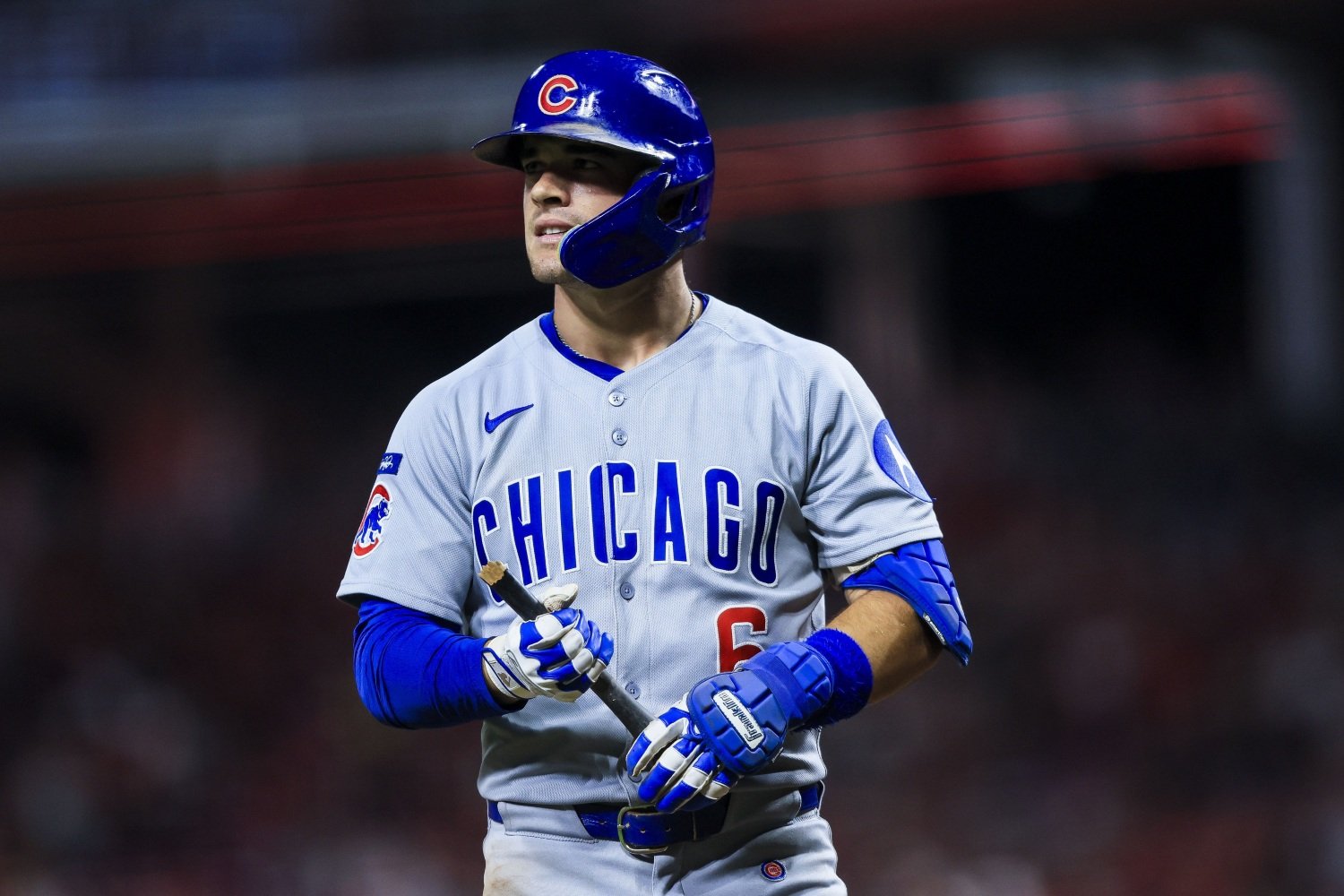
For the first month of the second half, Matt Shaw‘s bat was almost carrying a limping Cubs lineup. Craig Counsell stubbornly resisted the temptation to move Shaw up to the middle of the batting order, but even though he was getting fewer plate appearances than any other regular, Shaw was a vital cog in the offense. Over 34 games from the start of the second half through August 24, he batted .298/.343/.691 in 102 plate appearances. He did it by leaning into an extreme approach, pulling the ball at an exceptional rate.
With a flat bat path, Shaw’s attack direction is changing faster than his attack angle when he reaches the contact point. His insight at the outset of the second half was that he could tap into his power by taking an aggressive, pull-focused approach and getting around the ball. However, he’s taken that much too far. To see how, consider his production and his key swing metrics for the three major segments of his rookie campaign:
First Half: 63 G, 232 PA, .198/.276/.280, 69.4 mph swing speed, 9° attack angle, 4° opposite-field attack direction
July 18-August 24: 34 G, 102 PA, .298/.343/.691, 69.8 mph, 13° attack angle, 6° pull-field attack direction
August 26-Present: 24 G, 84 PA, .200/.274/.293, 69.9 mph, 12° attack angle, 10° pull-field attack direction
His average contact point in April and May was about 25 inches in front of his center of mass. In June and July, it moved out to about 30 inches. In August, it swept out past 35 inches. This month, his average contact point (sometimes hypothetical, as he’s been swinging and missing much more often lately) is out to 37.8 inches in front of his body. Some hitters can have a modicum of success when contacting the ball that far out, and when their bat is swung about 10° around to their pull field by the time they make contact. Shaw, however, is not one of those players. He’s too small to be reaching that far, and thus, being that early is only leading to lots of medium-strength, utterly unthreatening contact.
You can see this visually, by locking in on the attack direction. Here’s a rolling 75-swing average of his attack direction for the full season.
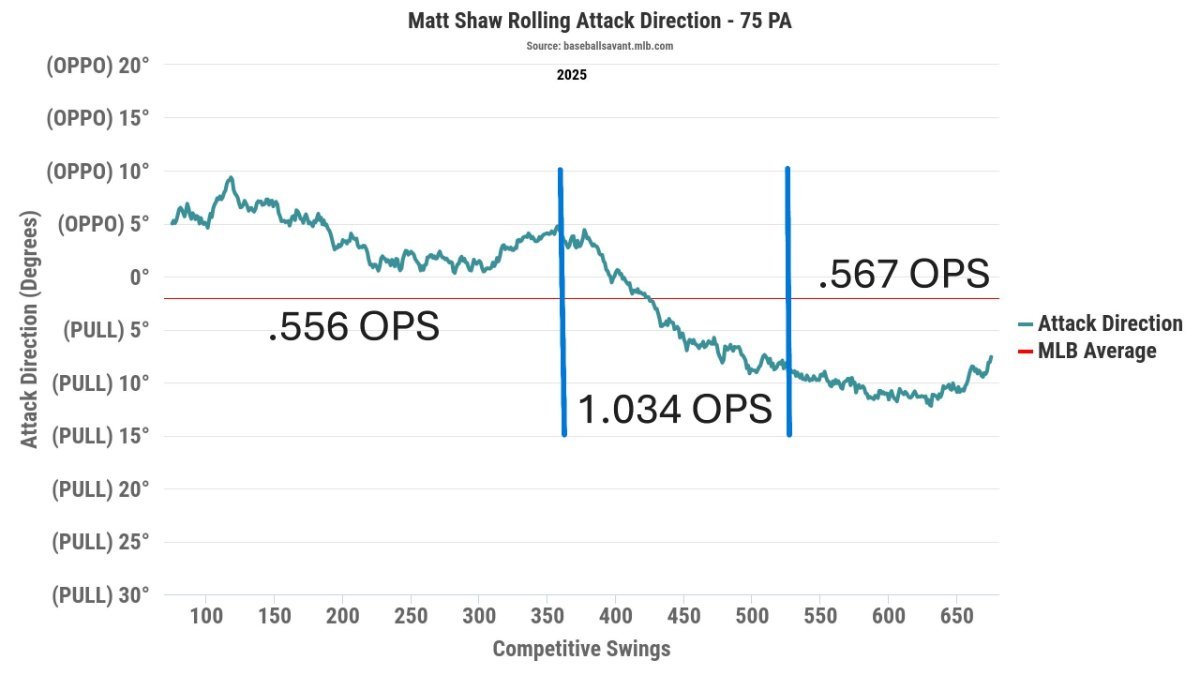
This is a classic overbalancing. It’s not uncommon from a rookie. Shaw has leaned too far in one direction; he’s let success steer him into failure. He’s gotten too attached to one idea at the plate; he needs to recalibrate and find a better balance. The Cubs’ other key hitters are in similar states of confusion or disrepair. To go anywhere in October, they’ll need Shaw to get back to what was working for him—but that means being open to yet another set of changes. He has to let the ball travel a bit more and open up the center of the diamond a bit.
When he’s been available, Shaw has been an asset in the field and on the bases, even during this prolonged slump. However, he can only deliver that value when he’s good and trustworthy enough to be written into Counsell’s lineup. The Cubs are running short on time to assess his utility to the team in the postseason. He showed some signs of returning to form during the team’s road trip to Pittsburgh and Cincinnati, not only homering in one game against the Reds but squaring the ball up better in Wednesday’s tilt against the Pirates.
With Willi Castro available as an alternative, though, the team should evenly divide the duties at third base over their final six games. Castro has a .370 on-base percentage in September. He’s not the same dynamic upside play as Shaw, but Shaw needs to prove he can get back on time in order to earn his place once the bunting is hung from the railings. So far, Shaw’s summer spree looks a bit more like a hiccup than a sustainable improvement, at least for this year. He was incredibly productive, but that success is now sandwiched between long stretches of failure.