
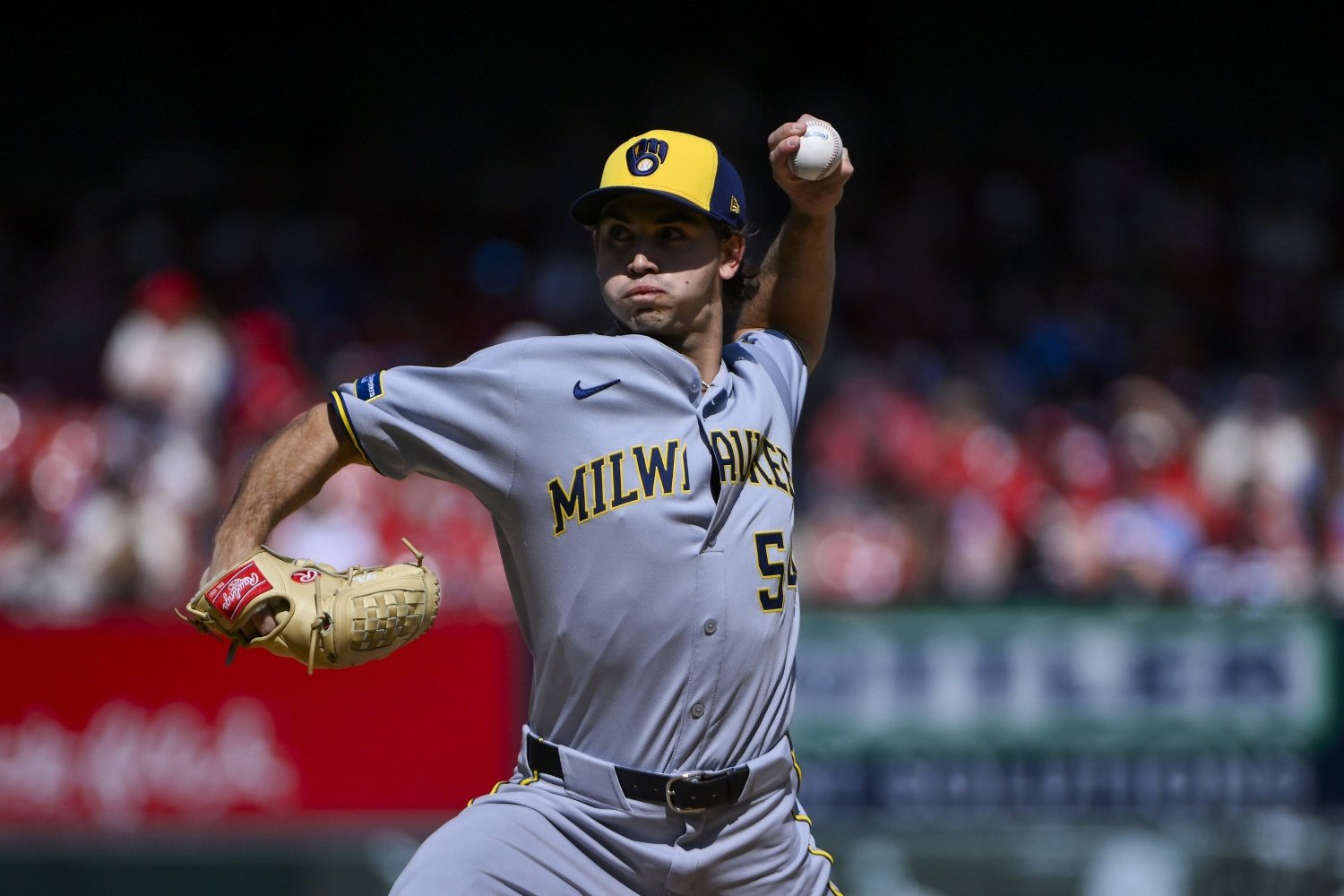
Suddenly, there’s some chance that Robert Gasser will need to pitch a significant number of playoff innings for the 2025 Milwaukee Brewers. Freddy Peralta will start Game 1 of the National League Division Series, 12 days from Monday. With Brandon Woodruff looking unlikely to be ready for that series, though, Quinn Priester just moved up a spot in the team’s prospective starting rotation. Jacob Misiorowski has been uneven. Chad Patrick hasn’t fully regained the trust of Pat Murphy. Jose Quintana is down with a strained calf muscle, and is no more likely to take the ball at the front end of the NLDS than is Woodruff.
Gasser won’t start in the Division Series, unless things somehow go even more haywire, but he could very much factor into the team’s plans. Murphy will hope that both Peralta and Priester deliver starts of reasonable length, but Game 3 will be a hodgepodge. Specifically, a piggyback plan would make a world of sense, with either Patrick or Misiorowski as a right-handed starter and Gasser as the left-handed counterpunch in the middle innings.
For that to be viable, of course, Gasser has to prove that his stuff and command didn’t stay behind when he got up off the surgeon’s slab. He had Tommy John surgery in June 2024. Fifteen months later, he’s back in the majors, but there’s never a guarantee when a pitcher first reclaims their place. On Sunday, he pitched to big-leaguers for the first time, and while the final stat line looks unimpressive, he was a good enough facsimile of his former self to inspire some confidence.
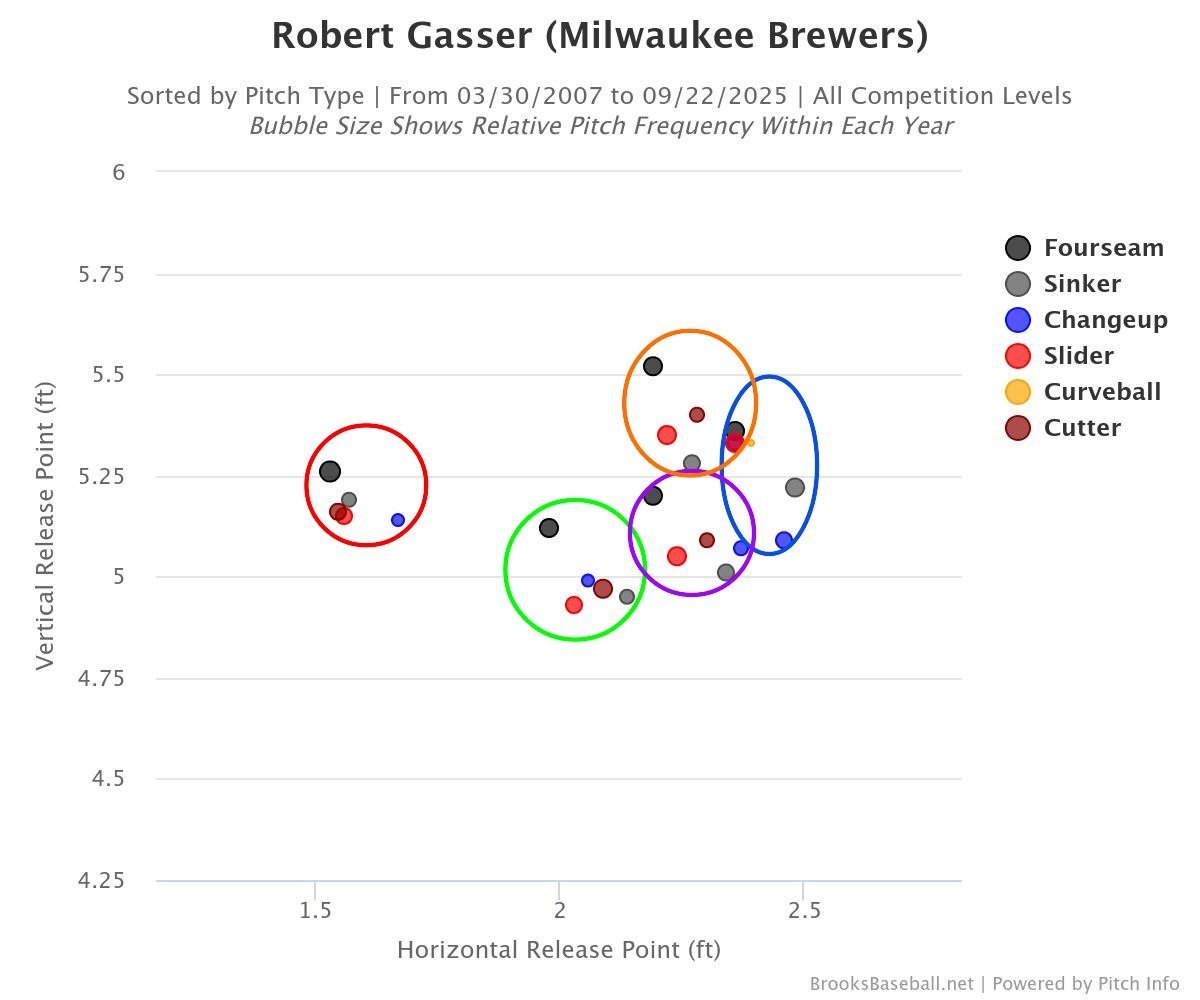
Gasser’s release point is slightly up this year; he appears to have compromised slightly on the high-energy launch down the mound that characterized him the last time he pitched at the highest level. Here are his average release points by pitch type for each season since 2021. That year is circled in blue. His 2022 is circled in red; 2023 is in green; and 2024 is in purple. The release points for 2025 are circled in orange. As you can see, this is a relatively small change, but it’s there. Gasser’s arm angle hasn’t materially changed, but he’s not as deep in his legs or coming as aggressively down the mound. Hence the higher raw release point.
Gasser’s fastballs still sit around 93 miles per hour. His sweeper is still a bat-missing out pitch, with great lateral movement and the lift you want out of that offering. It induced three whiffs in five swings against the Cardinals across Gasser’s three innings Sunday. His cutter remains very much a bridge pitch, functional only insofar as it might help keep hitters off his four-seamer, sinker, sweeper and changeup. The rest of the offerings can be better, though, and he showed at least the willingness to throw each Sunday.
Ultimately, Gasser only pitched three innings Sunday. He gave up just one hit, but it was a home run. He walked two and gave up four hard-hit balls. Yet, he also fanned two, and the stuff looked good. The Brewers need an extra arm, capable of pitching multiple innings even in an October crucible. Gasser has made it back, and not a moment too soon. He might not be fully himself until next season, but even this version of him could turn out to be a huge playoff X-factor.