
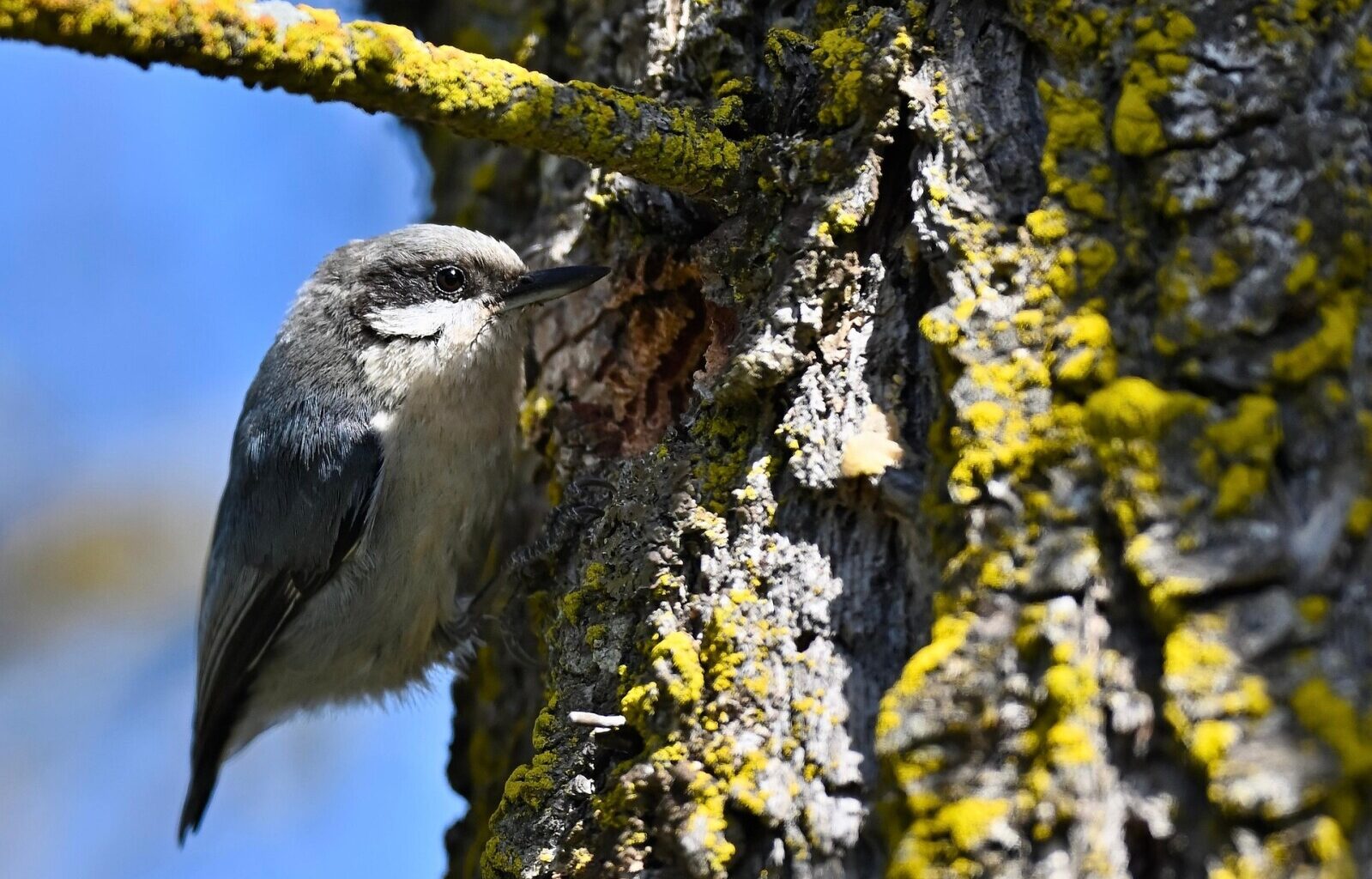
While sitting on a forested mountain slope in northwest Colorado recently and taking a break from hunting elk, a tiny bird landed on the trunk of a nearby lodgepole pine tree.
I recognized the bird immediately as a nuthatch, but it was a different species than what we encounter in Minnesota. Indeed, the bird was none other than a pygmy nuthatch.
At first, I didn’t recognize the species. So short was its tail, it was almost as if it was tailless. But after some thought, I remembered the first time I observed pygmy nuthatches. It was in the beautiful and rugged ponderosa pine forests of the Nebraska panhandle.
In all, North America is home to four species of nuthatches: white-breasted, red-breasted, brown-headed and pygmy nuthatches. The first two species live year ‘round here in Minnesota and both are common visitors to our backyard bird feeding stations, especially the white-breasted.
All nuthatches share similar body shape and features. Their squat stature, specialized and somewhat upturned slender pointed beaks, large heads, short tails, and short legs are so-designed for their particular feeding style.
Inching their way headfirst up, down and around tree trunks and limbs, nuthatches spend their arboreal lives clinging and climbing as they search for insects and other food atop, beneath and between the fissures of bark and within pinecones and foliage.
Pygmy nuthatches are closely related to the brown-headed nuthatch found in southeastern/eastern United States. In fact, the pygmy nuthatch is considered the “western counterpart” of the brown-headed nuthatch. Both species are small, not much longer than four inches, and have darkish caps, though the pygmy’s cap is grayer.
Partial to pine forests of the American West, especially forests dominated by mature ponderosa pines, pygmy nuthatches are typically found in low to mid-elevation forestland. According to Cornell Lab of Ornithology, pygmy nuthatches are one of just a few songbirds in North America that enlist the support of “nest helpers.”
Mated pairs frequently “… get assistance from relatives — including their own grown offspring — when raising a young brood.”
These so-called helpers also help defend nests from competitors and predators, in addition to even sharing in the incubation and feeding duties.
Another interesting behavior that isn’t necessarily unique amongst birds, is the pygmy nuthatch’s penchant for “communal cuddling” by gathering in large numbers inside tree cavities to survive cold winter nights.
However, what is distinctive is that the pygmy nuthatch is one of only two North American species of birds to employ the three known energy-saving techniques for surviving long, cold winter nights: seeking shelter inside of tree cavities, huddling together for sharing body warmth, and entering states of torpor or mini-hibernation.
The other species that also utilize these three survival mechanisms is the Vaux’s swift.
Regarding their penchant to roost with others of their kind, one biologist observed in the 1950s watched as 150 individual pygmy nuthatches entered various cavities of a single tree to roost for the night. One hole alone he watched as 100 birds entered the single cavity. To back up this claim, there are no known records of pygmy nuthatches roosting alone.
During my three-week stay in the Colorado Rockies, I heard the songs and calls of pygmy nuthatches more frequently than I visually observed them. They seem to have a habit of occupying higher portions of pine trees as they search for food, so viewing them was difficult at times.
Their piping calls were easy to pick out, however, and sometimes when there was many feeding together, their chattering was quite loud, which is surprising given their small size.
Like other species of nuthatches, the diet of pygmy nuthatches is comprised of insects and seeds. A variety of insects are obtained by probing with their beaks the cracks on tree trunks and limbs, from flaking off loose bark, and from foraging within needle clusters and cones.
They also cache seeds year around like other nuthatches do, too. Insects include everything from beetles to caterpillars and from bugs of all kinds to spiders, winged insects, and even wasps.
My time in the mountains was enhanced with being surrounded by different species of birds and other flora and fauna. Along with observing pygmy nuthatches, I frequently saw Canada jays, Stellar’s jays, Clark’s nutcrackers, and sometimes Townsend’s solitaires.
Mother Nature, with all its diversity, ever dynamic and ever resilient, is but a wonder as we get out and enjoy the great outdoors.