

Last Friday, the Minnesota Twins announced that Matt Wallner’s season is officially over, with an oblique strain sending him to the injured list. For the 27-year-old Forest Lake native, it closes the book on a year where he fell short of expectations. Hopes were sky-high for Wallner entering the season, as the team talked glowingly about him throughout the spring and even had him penciled in to take over the role of leadoff hitter. By season’s end, that felt like a remote memory.
Injuries and Rhythm
Wallner never really found his footing in 2025. A hamstring strain cost him six weeks during the first half, and the interruption seemed to derail his offensive rhythm. Across 104 games, he slashed just .202/.311/.464, numbers that look odd for a player with his track record. For context, over 2023-24, Wallner had posted an .885 OPS and was worth 4.4 WAR in just 151 games, even with plenty of time spent shuttling back and forth from St. Paul. This year, he ended up with only 0.5 WAR in 104 games.
“It’s not the way anyone wants their season to end, but his goal now is to make sure he’s going into the offseason as healthy as possible to get himself in a good spot,” said Twins manager Rocco Baldelli. “I don’t think that’s going to be an issue, but it might take some time once the season ends to make sure his body is in a good spot.”
An Unorthodox Stat Line
Wallner’s statistical profile has always been unusual, but 2025 took that reputation to another level. His 22 home runs set a career high, yet he drove in only 40 runs, the fewest RBIs ever for a player with at least that many long balls. Barring a ferocious finish by Kody Clemens, Wallner will finish second on the team in home runs and slugging percentage, behind Byron Buxton.
There’s more: of his 68 hits on the season, 41 went for extra bases. He joined just three other players in MLB history to reach 40 extra-base hits while finishing with fewer than 70 total hits. That’s the definition of boom-or-bust.
Still, a .776 OPS equates to a 110 OPS+, meaning he was 10 percent above league average offensively. That tells the story of 2025 Matt Wallner perfectly: disappointing compared to his past, but still valuable in the Twins’ lineup.
Baldelli was asked about the potential adjustments Wallner could make.
“Closing up some gaps in his [swing] path, taking away some direct avenues in the way pitchers will attack him,” the manager said. “Close up any of those holes—not completely, just by a fair amount—and it takes away a lot of different ways to pitch him.”
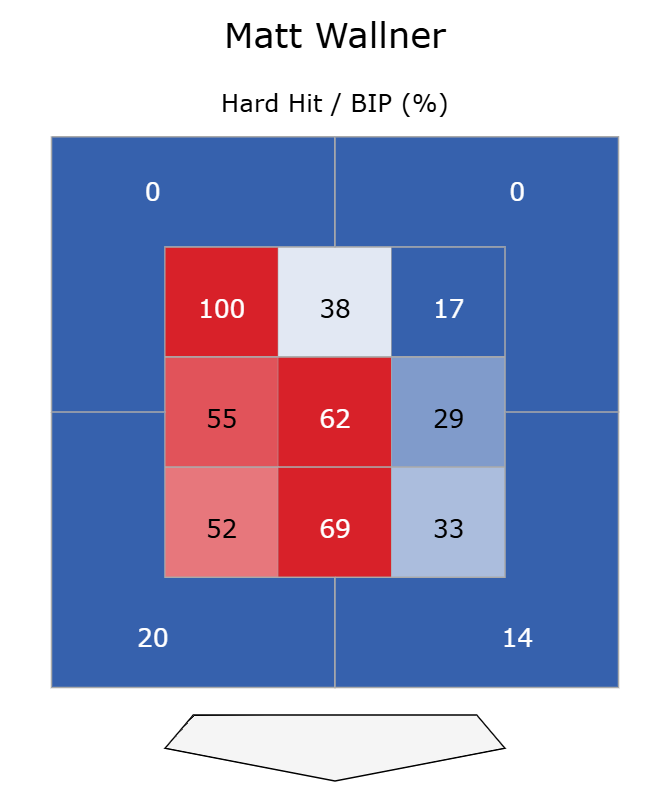
Indeed, the league has figured out how to pitch Wallner, even after he made a major change to his swing this season. His next step is to make another adjustment, be it physical or in his approach, to create more hard contact on pitches inside and cover the top half of the zone better.
What Went Wrong?
The most obvious source of lost value was Wallner’s batting average. After hovering in the .250-.260 range the last two seasons, Wallner cratered to .202. However, a closer examination suggests that some bad fortune may have played a role. His BABIP fell to .228, after sitting above .300 in each of his first three seasons. His ground-ball rate only crept up a little, and he still hit the ball with authority. On top of that, his strikeout rate actually dipped slightly to 29%, and his walk rate also improved.
Those ingredients typically indicate better outcomes, which makes 2026 a strong candidate for positive regression if Wallner can stay on the field.
What Comes Next?
The Twins have some decisions to make with Wallner. He won’t reach arbitration until after next year, so he remains a cost-controlled power bat. If healthy, it’s easy to envision a 30-homer season in 2026. The bigger questions revolve around his role:
Outfield spot? He’s serviceable in the corners, but the Twins have more athletic options coming, including Austin Martin and top prospects Walker Jenkins and Emmanuel Rodriguez. His strong arm has been his calling card on the defensive side, but he’s rarely created real value with it, and opponents don’t fear it.
DH role? Shifting Wallner to a full-time designated hitter role could keep him healthier and maximize his power, while allowing others to handle the outfield workload. The Twins haven’t employed a dominant DH since Nelson Cruz was traded to Tampa Bay. Perhaps Wallner can take over this role next season.
Platoon future? Wallner is a career .181 hitter with a .641 OPS against left-handed pitching, which means he may always be a matchup-dependent bat. Some fans have called for the team’s left-handed bats to get more opportunities against southpaws, but the Twins aren’t likely to follow that path with Wallner.
Even with those caveats, it’s worth noting: Wallner’s “down year” still included 22 homers and a 110 OPS+. For most players, that’s a career year. For Wallner, it just felt strange. The Twins will gladly roll the dice on positive improvements and good health in 2026, because if he looks more like the 2023–24 version, Wallner remains one of the franchise’s most dangerous hitters.
What do you make of Wallner’s 2025 season? Leave a comment and start the discussion.