
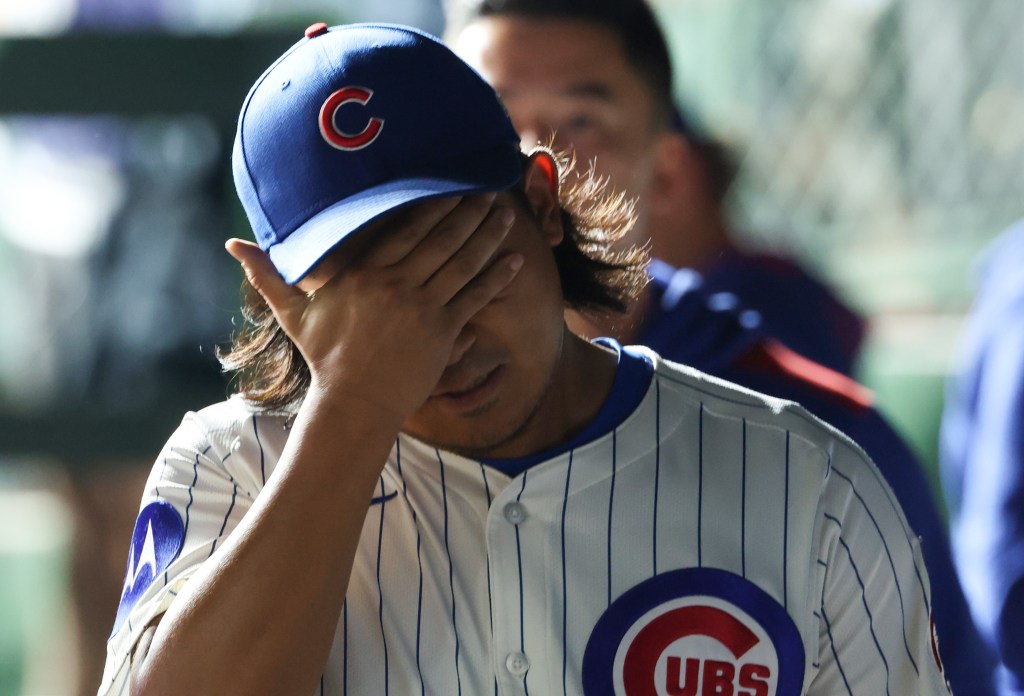
Shota Imanaga is maintaining a positive outlook with his final regular-season start in the books.
At least, that is how the Chicago Cubs lefty wants to approach an underwhelming start Thursday night against the New York Mets. Imanaga surrendered a season-high eight runs on nine hits, including two home runs, over 5 2/3 innings in an 8-5 loss at Wrigley Field.
While the Cubs have not yet given any insight into how they will line up their rotation for the wild-card series against the San Diego Padres, Imanaga’s typical consistency would make him a logical choice. His lack of execution versus a Mets team trying to hold onto the final wild-card spot showed how thin the margin of success can be for Imanaga, who has seen a decrease in strikeouts and uptick in home runs allowed this year compared with 2024.
“If I said I was confident, I think people hearing that would just think I’m just trying to be optimistic,” Imanaga said of his confidence level entering the playoffs through interpreter Edwin Stanberry. “But within the next coming days, I just want to do all the adjustments that I need to make to regain that confidence.”
Seiya Suzuki slugged two home runs — his first since Aug. 6 — and Dansby Swanson went deep, but it wasn’t enough to dig out of the six-run deficit by the fourth inning. With the Los Angeles Dodgers winning the National League West title Thursday afternoon, the Cubs and Padres are locked into one of the two wild-card matchups next week. The Cubs (89-70) hold a two-game lead over the Padres to host the best-of-three series beginning Tuesday.
“Look, Shota has to execute, I mean, that’s been his story, and he is really good at executing,” manager Craig Counsell said. “That means every pitch has to be executed. Fastballs down for Shota are not going to be good results. So he’s got to execute pitches. He does give up homers. That’s kind of part of how he gives up runs. He doesn’t give up baserunners, but he does give up solo home runs. On a night like tonight, it’s both certainly.”
Imanaga’s rough outing came shortly after Counsell shared that rookie Cade Horton’s MRI showed “areas of concern” in his ribs though for now is still a go for the postseason. Imanaga, Horton and veteran lefty Matthew Boyd all seemed to be in the mix to get the ball in the wild-card series.
“I never want to have a staff that’s afraid to give up a home run,” pitching coach Tommy Hottovy told the Tribune last week. “The minute you do that, and I think you can see by that our DNA of who we are as a staff this year, we throw the most strikes in baseball, we’ve attacked the strike zone early, throwing the fewest pitches of any team in baseball, because we’re not afraid to attack the strike zone. Now, at times that’s going to lead to giving up some damage, but if they’re solo homers we can live with that.”
Imanaga’s home run damage has been largely of the solo variety, such as when Francisco Lindor took him deep in the third to put the Mets up 3-0. However, that wasn’t the case in the fourth. Brett Baty took advantage of an 0-1 fastball up in the zone that Imanaga didn’t put high enough, and it went 371 feet for a three-run homer.
Imanaga’s 31 home runs allowed are third most in the big leagues behind the Cincinnati Reds’ Zack Littell and Washington Nationals’ Jake Irvin (both with 36) while his 1.93 home runs per nine innings is second highest.
Photos: Chicago Cubs lose series finale to New York Mets at Wrigley Field
“My goal with Shota is, he is an elite strike-thrower, like a 2% walk-rate kind of guy, that sometimes errs on the strike side of like, ‘Oh, I just want to throw a strike here’ when you don’t really have to,” Hottovy said. “He’s earned the right to not have to throw strikes, or earned the right to use bigger parts of the strike zone.
“You can navigate a lineup and give up one, two runs and no matter how they look like, we’re going to have a lot of success. But for him, it’s just understanding how much room he has with the fastball. He doesn’t always have to give in to the bigger parts of the zone.”
For the Cubs to make a deep postseason run, they need the version of Imanaga they saw midseason who limited walks, pitched into at least the sixth inning seven times in an eight-start span and had fewer questions marks from start to start rather than the inconsistency and unknowns over the last month. When Imanaga is at his best, his splitter-fastball combination can be a nightmare for opposing lineups.
“We’ve got guys that have gotten us here,” Counsell said. “We’ve got guys that have had a lot of success in this league, a lot of success during the season. That absolutely matters.”