

It didn’t take long for Nolan McLean to establish himself in the majors. Just a little over a month into his big league career, and he’s looking back at a 1.27 ERA over 7 starts. Of course, the numbers will regress eventually, but that’s not the point. He’s mowing hitters down like a seasoned veteran, and he’s making it look easy. This is no small task for any pitcher, let alone a former two-way player who’s only been on the mound full time for a couple of years. Despite this, he already wields a varied mix of great pitches that can get him through any situation, any type of hitter.
Deception and Dominance
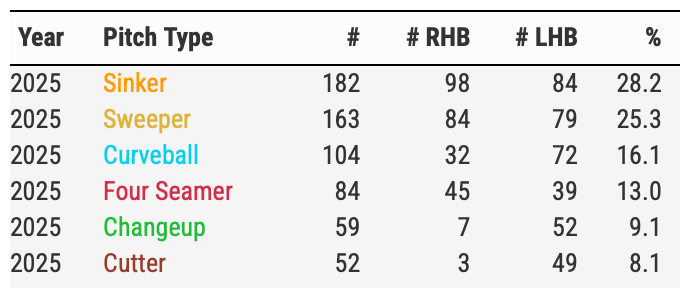
McLean throws everything. He doesn’t have a primary pitch so much as he has two pitches he throws slightly more often than the others, but just against righties. We’ll go in order by total usage when we break them down, but it’s something to keep in mind that the way his pitches work off of each other is a bit different than a pitcher with a more standard 40% of a single type of fastball approach. With the full use of a wide arsenal, all of the pitches gain an advantage as hitters can’t reliably sit on anything, especially when he has multiple go-to opening, get-me-over, and strikeout pitches.
Just as important, McLean has a very unique delivery. He releases the ball from way out to the third base side, more than three and a half feet from the center of the rubber. Only three starters this season have a wider release point. This creates an unusual look for hitters that invokes caution, and they tend to take more pitches against him than they should. He carries the league’s lowest swing rate among starters at just 42.0% despite an above-average zone rate. It’s especially evident in his ridiculously low middle-middle swing rate at just 55.6%.
Hitters don’t see the ball well against him, be it that they aren’t picking it up, or they’re auto-taking to get a better idea of how the ball comes in from his hand. McLean’s aggressiveness is allowing him to take advantage of this. This is more the icing than the cake itself, though. Having a deceptive delivery that causes hitters to act differently is a bonus, but the real thing driving McLean’s dominance is that he has this to enhance his already great stuff.
His sinker is a solid pitch that, like everything else in his arsenal, plays up due to his release point. Going somewhat against conventional wisdom, he peppers the low arm-side quadrant of the zone with this pitch. This is theoretically the worst spot to get called strikes with a sinker, as the ball is running down and across the zone toward the corner, rather than toward the zone from outside of it. And yet, he has an 85th percentile called strike rate on it. I think the bizarre angle he throws from, combined with the 16” of run, is making a look that hitters struggle to deal with. He doesn’t create a steep VAA for this pitch, which is what you usually want in a sinker. This is due to his release point being quite a bit lower than the average pitcher’s, just over five feet off the ground. Despite this, the constant throwing it low, the difficult look, and the lower-than-average IVB for his release height have helped him to induce ground balls at will with it.
His sweeper is absurd. 16.6” of glove-side movement on a pitch in the mid-80s is unfair. Unsurprisingly, the wide release makes this pitch even more difficult for hitters to deal with, though over time, this will likely be more evident in swing decisions than contact/whiff rates. His relentless aggression in the zone with this pitch, at a 93rd percentile 52.1% zone rate, has netted him a 26.4% called strike rate with it.
Lowest Zone Swing Percentage On Sweepers by Starters
The low whiff rate on it so far is likely due to a combination of sample and locations. His map for this pitch isn’t the prettiest ever, and it’s been a big part of the few times he’s been burned this season. A little bit of fine-tuning, and this should play like the elite pitch it is.
McLean’s curveball is potentially the most ridiculous pitch I’ve ever seen. In the Hawk-Eye era, which began in 2020 when MLB updated the Statcast technology with improved cameras, there have only been two pitches with more total movement than this one. This is the kind of movement you only get when you throw a curveball with that much spin and nearly all of it being active. The difference between McLean and the ones ahead of him is how hard he throws it.
Highest Average Total Movement on any Pitch (2020-2025)
I’ve never seen anything like it. Unfortunately, he has no idea where it’s going yet. I can’t really blame him for that, though. A pitch that moves this much at that velocity seems like it would be nearly impossible to command. Even still, despite a hideously low 21.2% zone rate, it gets an average amount of chases and has an 87th percentile SwStr% because it’s impossible to hit. It’s a truly astonishing pitch. Fear the day he figures out how to throw it around the bottom or sides of the zone semi-consistently. It will never have been more over for hitters should that occur.
McLean’s 4-seam works because it creates a just barely good enough shape to potentially be effective on its own, which is then amplified by how it fits into his arsenal. He gets a substantial negative difference between his spin direction and movement direction. I assume he accomplishes this by cutting it. The result when paired with his sinker is two fastballs released at about the same arm angle and spin direction that have 11.3” of vertical separation. That is more than enough to get extra whiffs at the top of the zone and above it, not to mention his low release creates a flat VAA for it. Unsurprisingly, hitters haven’t been able to do much of anything with it, even with his somewhat scattershot command of it so far.
His changeup is reminiscent of Mets’ rotation mate Clay Holmes’. Not in their shape so much as in how they fit into their arsenals. McLean, like Holmes, throws a kick change. These changeups are thrown with a unique grip that causes the ball to leave the hand at a much lower spin direction than would be possible with a traditional changeup grip, while also maintaining the ability to get substantial seam-shifted wake. The funny thing with these two is that they have such good sinkers for their arm slots that the changeup doesn’t wind up having that much separation from it. Unlike Holmes, McLean uses his 4-seam more often, and 15.6” of vertical separation between those two pitches for him is ridiculous. They also have good velocity separation and come from the same exact arm angle. Using those two pitches in tandem should help with any potential platoon problems he could run into.
Lastly, McLean throws a cutter that I assumed would be a bridge pitch between the massive east-west spread that is his pitch mix. That is not how he uses it. It is thrown exclusively to lefties, to whom he throws fewer sinkers and sweepers. In limited usage, he’s been throwing it high, but it’s worked in that capacity. Cutters are difficult pitches to evaluate. Currently, he seems content to hit the top of the zone with it now and then and get called strikes and whiffs from hitters who take too long to realize it’s not any of his other pitches. In that way, it kind of loops back around to being a bridge for everything in his movement-heavy arsenal. Admittedly, it’s not a big enough sample to really judge intent without pristine command. He might be trying to land it just off the glove side more than he has and missing, but it’s working anyway.
Boss Fight
As a pitcher about to finish his second-ever season as a full-time starter, McLean unsurprisingly has some rawness in his profile. The command falters at times, as you might expect from an inexperienced pitcher wielding a six-pitch mix. He’s thriving more on his quirky release and great stuff than on his execution right now. I don’t want to take credit away from him; drilling the zone has been more than enough with his other traits. It’s because of this that the only way to beat him right now is waiting for him to make a mistake and praying you can capitalize on it.
When he’s got everything working in sync, landing his pitches where he wants, it’s like an invincibility state on a video game enemy. Hitters are unlikely to beat him on a well-executed pitch because his stuff is so good. They have to wait for him to leave himself vulnerable. Be it a sweeper left in the middle of the zone, getting into bad counts with waste pitches, that sort of thing. 10 of his 29 hits allowed so far have come off of two-strike pitches that I’d say didn’t land in an ideal spot given the swing-heavy situation. It speaks to his ridiculous ceiling that he’s got so few innings under his belt and already has enough going for him that more often than not, the guy that’s beating him is himself.
I could end this by talking about the things that he has left to work on, but I’m not sure there’s much point. He already has pretty optimal pitch usage. I don’t think there’s much need for adjustment there.
(Image courtesy of BaseballSavant)
Until his current pitch strategies stop working, I don’t think there’s much to be gained by messing with those either. His current plan is as follows: Throw the sinker low in the zone and in on righties, force hitters to fight the sweeper in the zone, high 4-seams, curveballs for whiffs, especially against lefties, low changeups, and high to glove side cutters, both exclusively to lefties. I guess he could try to specialize a bit more and throw more 4-seams and fewer sinkers against opposite-handed hitters, but why tinker with something that’s working? Maybe reduce the curveballs a bit until the handle improves? I’m nitpicking at this point.
It should be evident from previous statements that he could stand to sharpen up his control and command. But that’s hardly abnormal for a rookie pitcher, especially one with McLean’s background. Given how quickly he’s developed an arsenal from a smaller base when he was in college, I don’t think it’s crazy to expect him to improve substantially in that regard. He just needs time and innings to do so.
The Mets took a raw athlete with less than 60 college innings but incredible aptitude and have turned him into a borderline ace with more room to grow in the span of two years, and they cannot be commended enough for it. McLean is the stuff of hitters’ nightmares, and he’s only getting scarier.
Statistics as of September 23, 2025
Adapted by Aaron Polcare (@abeardoesart on Bluesky and X)