
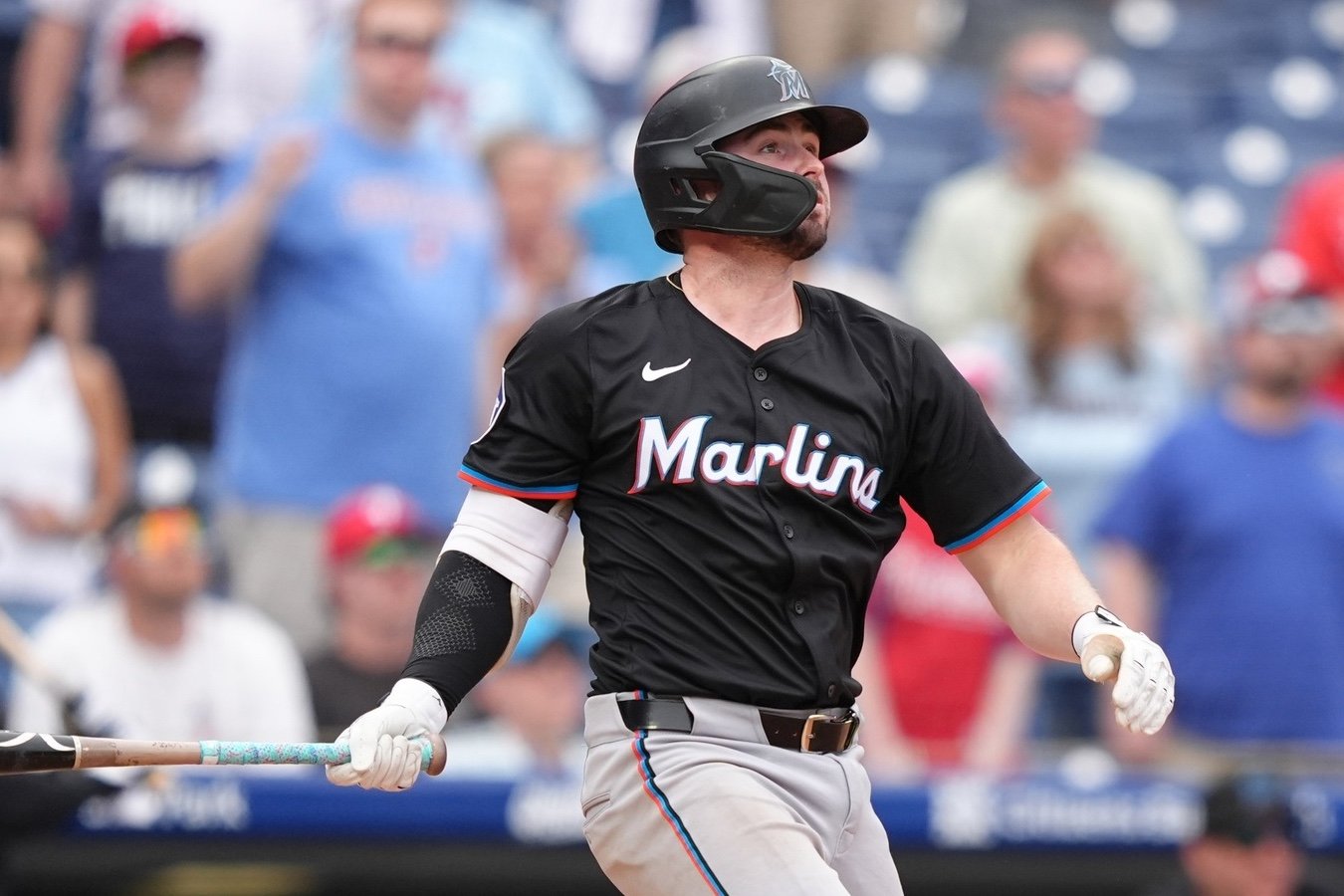
MIAMI—The Miami Marlins knew it would be an uphill battle to get Liam Hicks up to speed at the major league level.
They selected him in the Rule 5 draft this past offseason, marking just the fifth time in 15 years a catcher had been taken. Picked in the ninth round of the 2021 amateur draft by the Texas Rangers, Hicks was traded to the Detroit Tigers organization in 2024, and had never played above Double-A prior to this year.
Hicks was eligible for the Rule 5 because he was a former college draftee who had been left off his team’s 40-man roster at the end of his fourth professional season. That’s not uncommon—the development process is more gradual for catchers than players at other positions. They are rarely taken in the Rule 5 because the learning curve is particularly steep for them when making the transition to the majors.
For context, you’d have to go back to 2007 to find a catcher who had any modicum of success after being picked in the Rule 5, when the Washington Nationals selected Jesús Flores. The then-23-year-old had a very respectable year in DC, slashing .244/.310/.361 in 79 games and starting 42 of them. He accumulated 0.4 fWAR. The performance was good enough to earn him the starter role next year and carve out a solid career with the Nationals through 2012.
Well, Hicks has not only stuck around all year, but has set himself up to stay in the team’s plans going into next year. His 94 OPS+ is the best from a full-time Marlins catcher since Nick Fortes in 2022. His .346 on-base percentage is fifth-best among rookies with at least 300 plate appearances this year.
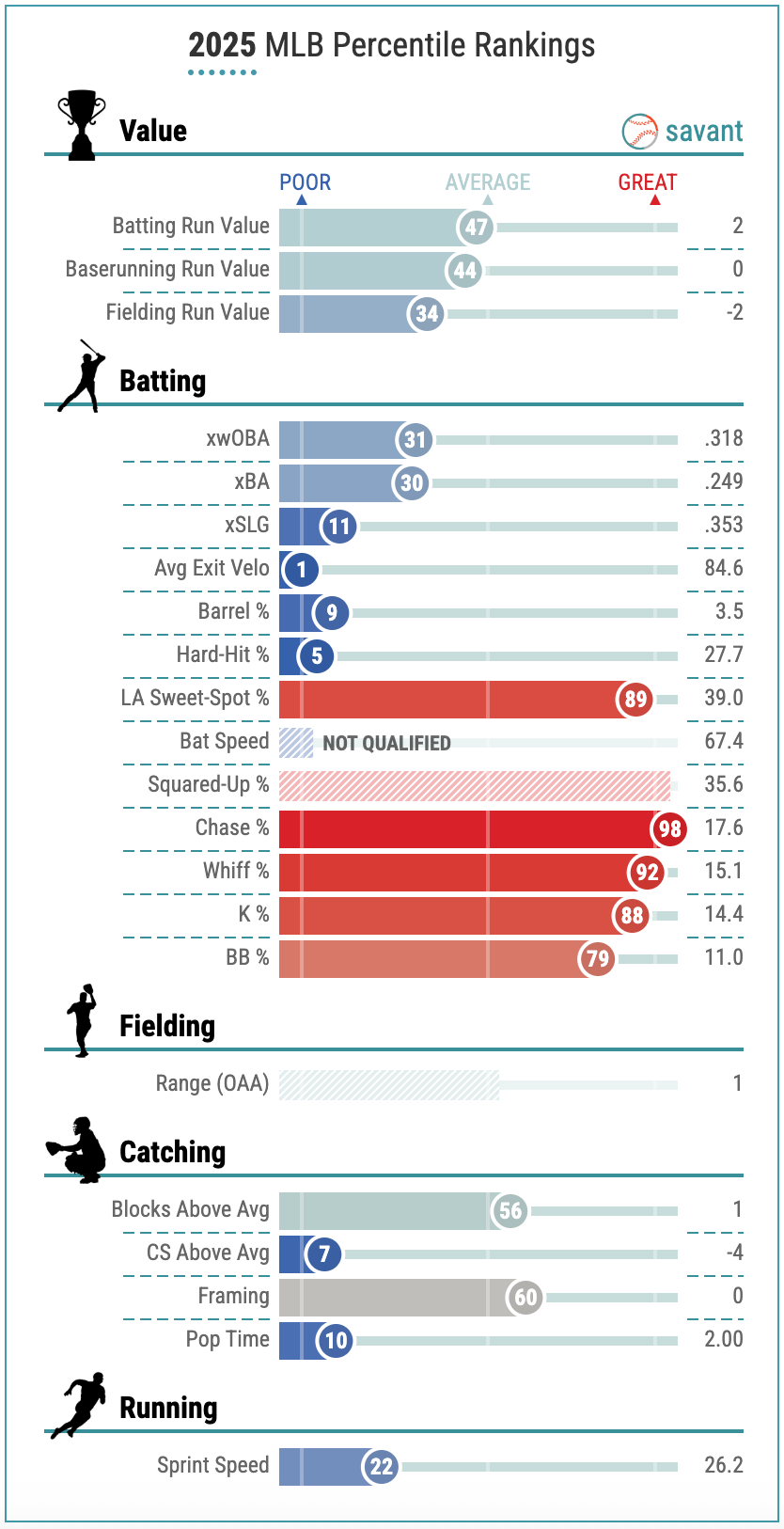
Offensively, the 26-year-old has a unique hitting profile. He doesn’t hit the ball hard—he only has six home runs and is near the bottom of the league in average exit velocity and barrel rate—but he has near-elite plate discipline and solid bat-to-ball skills. His chase rate of 17.4% is behind only Juan Soto, Gleyber Torres, and Trent Grisham. He’s also in the 92nd percentile in whiff rate at 15.1% and is fourth-best among rookies in walk rate at 11.0%.
 The hard work to get to this point started a month before spring camp even started. Marlins catching coach Joe Singley worked with Hicks in January in West Palm, along with minor league catcher Ryan Ignoffo.
“He put his nose to the grindstone from day one,” Singley said. “It’s just a testimony to who he is as a human, being able to climb up that battle, make the team, stay here all year. He’s worked his tail off literally every single day. And I don’t think that’s possible if he’s not the human that he is.”
From the start, they worked on being more explosive and athletic, keeping strikes as strikes, blocking the ball, and throwing.
Hicks said he and Singley will look back at film from those early workouts and laugh at how unpolished it looked.
“We were watching the first video of me receiving—he’s literally just flipping the ball to me, and it looks terrible,” Hicks said. “And we were just laughing at how much better it looks now when it’s a full-speed MLB game with guys throwing 100 miles per hour, and you’re making it look a little bit better than when we were just flipping it underhand.”
Ironically, receiving is what Hicks excelled at the most this year. He has recorded plus-one blocks above average and average framing, per Statcast.
Singley attributed the improvement to Hicks’ ability to get his body in better athletic shape.
“The work he’s put in has been tremendous,” Singley said. “Every day, there’s a heavy urgency to get better.
Grading on a curve, performing at league average as a catcher who never played above Double-A is pretty impressive. But Hicks knows—taking a saying from his catching coach—“there’s still a lot of meat on the bone.”
“Average isn’t really the standard. We want to be a lot better than that,” said Hicks, who is also expected to be on Team Canada’s roster for the 2026 World Baseball Classic next spring. “Joe’s a guy that’s gonna want to work every day. He’s gonna hold you accountable. He studies the game so much from a catching perspective. There’s no one I trust more about catching than him.”
The main critique about Hicks’ 2025 campaign is inability to throw out runners. He’s only caught 10.5% of attempted base-stealers, and his pop time of 2.00 seconds is near the bottom of the league.
Singley said the organization is putting catchers through a “throwing boot camp,” with emphasis for Hicks being on improving his mobility, arm strength, and quick release.
“Just continue to stack the days,” Singley said. “Hopefully he shows up next year with a rocket and stops everything behind the plate. That’s the goal.”