
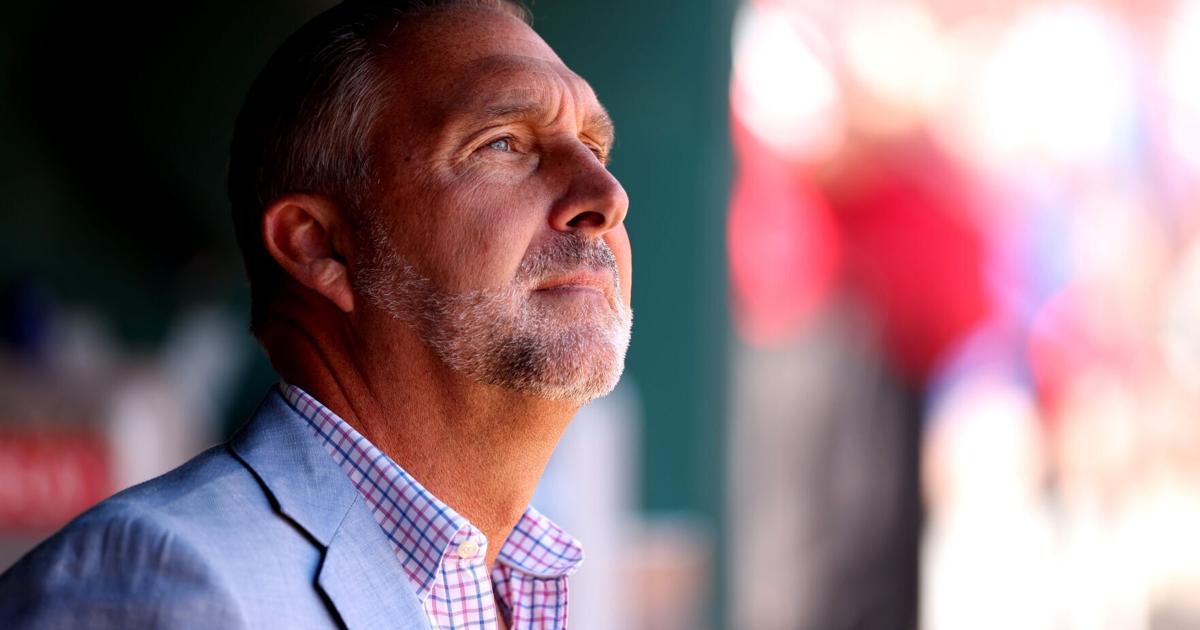
CHICAGO — During the New York Yankees’ visit to St. Louis this past August, Brian Cashman welcomed the coincidence of being at Busch Stadium in the waning weeks of his friend and longtime peer John Mozeliak’s tenure.

Mozeliak
David Carson, Post-Dispatch
Only Cashman has been active leading a major league club’s baseball operations department longer than Mozeliak, and only a few who sit in a “big chair” can relate to the weight of running one of the game’s most historic franchises. They have connected over that through the years, and as he rode to the ballpark, Cashman thought about how the schedule gave him a chance to deliver a message in person to Mozeliak, who everyone calls “Mo.”
“I’ve talked to him about this on the phone several times, but to get to be here in person to say, ‘Hey, man, that’s a hell of run,’” Cashman said, “it’s not why I came, but it’s almost like a homage to him. Here is the last time the Yankees will be here with Mo running the show, and I was like, ‘I’m glad I’ll be here to shake his hand.’ We all know in this role the day is coming. I’m glad I’m here for us. Proud to say I’m here for him.”
People are also reading…
When the Cardinals’ season concluded Sunday afternoon at Wrigley Field, so ceremonially did Mozeliak’s 18 years leading the club’s baseball operations. He attended the game in person with his wife, Julie.
Chaim Bloom will hold his first news conference as the new president of baseball operations Tuesday. A farewell event is scheduled for Mozeliak the day before, concluding what’s become a media tour week of hand-picked interviews. Mozeliak’s contract expires on Halloween night, and there remains the possibility he has some future advisory role with the Cardinals, the organization he’s been a part of for three decades.
Only Branch Rickey had a longer stint in charge of the Cardinals’ baseball operations than fellow bow tie aficionado Mozeliak.
‘It’s an achievement’
During his time as general manager and president of baseball operations, Mozeliak piloted the Cardinals through one of the most transformative eras in baseball history. His time in the front office stretches from the advent of “Moneyball” to the practice of tanking, the broadcast-fees bonanza (and bubble) to today’s tycoon teams.
Mozeliak was promoted to general manager on Halloween 2007, and since then, the Cardinals rank fourth in the majors and second in the NL in wins to the Dodgers. They’re fourth in playoff wins and lead the NL Central with six division titles. The Cardinals’ two NL pennants since 2007 rank behind the Phillies (three), Giants (three) and Dodgers (four).
This season is only the second losing season of Mozeliak’s time.
“They created a unique roster-building model that was all their own, and they did it in a time when it was as innovative as anything the A’s were doing 25 years ago or the Rays are doing in the current time,” said Jerry Dipoto, the Mariners’ president of baseball operations.
“Whatever you consider the Cardinal way — and I don’t know what the Cardinals reference as ‘The Cardinal Way’ — but that’s how I always saw it,” Dipoto continued. “It’s hard to be as consistent as they were for 20 years and to always be in the dance to win championships and to constantly be in the LCS year after year — it’s an achievement, man. I think in my time in baseball, it’s the Cardinals, the Braves in the 1990s-2000s, the Yankees in that same era and the current Dodgers. I can’t think of anybody else who has done it quite the way the Cardinals have.”
As Mozeliak’s final day approached, the Post-Dispatch talked with three baseball operations execs who have competed against Mozeliak and known him for decades — as rivals, as contemporaries, and as admirers.
Cashman, who became the Yankees’ general manager in 1998, has been able to remain with the same team like Mozeliak, with the same championship expectations that are as much a part of the fabric of the Yankees and Cardinals as pinstripes and feathers, respectively.
On Sunday, Dipoto marked his 10th anniversary leading the Mariners’ baseball operations, and in Mozeliak’s time as GM or POBO with the Cardinals, Dipoto has been with four different teams, in a GM or POBO role with three of them.
And this weekend, Jed Hoyer.
Emulating ‘consistency,’ culture
He’s led both the Padres and Cubs in his career and been a part of championship teams in Chicago and Boston. The Cubs promoted Hoyer to president of baseball operations in 2020, nine years after he and Theo Epstein came to the Cubs to break their second curse. They were hired in October 2011, and a few weeks later, the Cardinals raised the World Series trophy.
“Think of the timing,” Hoyer told the Post-Dispatch this weekend. “When we were trying to build up and get good, our standard had to be so high in order to get past the Cardinals. Same thing happened with the Yankees in Boston. Having this great organization that was doing everything the right way, it raised our standard, and that’s a testament to Mo and what he built. In order to get past them — I mean, we won 97 games in 2015 and they won 100 — we knew how high we had to get to be able to do that.”
The Cubs reached that height in 2016 with their first World Series championship since 1908. During batting practice before one of those World Series games, Hoyer talked to the Post-Dispatch about the next phase of the Cubs’ plan: sustaining success.
He said one way to do that would be learning from the Cardinals’ model for pitching development and the pipeline they once had for homegrown pitchers.
Out in the Pacific Northwest, Dipoto was already trying.
“Probably the most flattering thing I can say about Mo is that here in Seattle — especially in Seattle — a lot of what they did in St. Louis under Mo’s guidance we’ve tried to replicate,” Dipoto said. “I would say we stole some of the Cardinals’ script and some of the Rays’ script in trying to create our own thing. I know Mo did a marvelous job of taking a storied franchise from what is generally a middle-market type of team and turning it into a big-market player.
“The consistency that they established really during his time is something you typically only see of the big-market coastal teams, not the landlocked middle-market clubs.”
Dipoto went on to describe how “during their salad days,” the Cardinals made late-round draft choices that weren’t “sexy first-round picks” and developed them into “foundation players” like Matt Carpenter. A few times, they flipped those “sexy” first-round picks for trades like Mozeliak’s signature deal for Matt Holliday or his classic move for a reliever like Edward Mujica. The Cardinals also excelled at identifying small-college talent — a practice once spearheaded by Jeff Luhnow and Sig Mejdal that they also had success using in Houston.
The Cardinals lost that draft edge in large part because other teams mimicked it.
Another pillar of Mozeliak’s team-building was a continuation of what he learned and helped do while assistant GM for Walt Jocketty: acquire stars and let the Cardinals culture convince them to stay. Mozeliak did that with Holliday and Paul Goldschmidt, notably. Moves like those prompted perennial-contention-inspired Nolan Arenado to pursue a trade to the Cardinals.
“They had stars, and they retained their stars,” Dipoto said. “They put quality teams on the field over and over and over, and they did it on a budget.”
Dipoto did offer another compliment for Mozeliak.
“He’s polished,” the Mariners’ POBO said. “He’s sharp.”
“He projects as a really gifted executive who happens to also have the responsibility of running one of the most famous franchises in baseball for a long time,” Cashman said.
Leading with honor
Cashman joked that he’s a graduate of “Steinbrenner University,” and staying power isn’t all he and Mozeliak share. During an era when Ivy Leaguers spread through baseball front offices like the leaves along Wrigley’s outfield wall, the two longest-tenured leaders aren’t from the Ivies.
Mozeliak attended the University of Colorado, just down South Broadway from where he grew up in Boulder, Colorado. He worked at a pizza joint when he delivered a pie to the Rockies’ clubhouse — and, through a connection, got the chance to throw batting practice to the Rockies when the expansion club needed a lefty to do so. He never left the ballpark.
Within two years, Mozeliak impressed in baseball operations, and Jocketty invited him to help a turnaround in St. Louis. He served in multiple roles, including scouting and a leading role in the draft at the same time the Cardinals selected Yadier Molina and Albert Pujols. Jocketty and Chairman Bill DeWitt Jr. promoted Mozeliak to assistant general manager in 2003.
Dipoto recalled watching Mozeliak’s rise and seeing at the annual meetings his presence and influence grow. As Jocketty engineered the Cardinals’ robust and championships teams of 2004, 2005 and 2006, Mozeliak was involved in signings and trades.
Once, he reached out to Cashman about trading for All-Star second baseman Robinson Cano. Maybe, the Yankees replied, but it would have to involve Adam Wainwright. The conversation ended.
“He’s communicative, fair, and he’s the type that says — if you express interest in one of his players, he would say, ‘Duly noted, I’m not looking to do anything there,’ or, ‘Hey, man, if I do anything there I’ll make sure I won’t do anything without checking with you first,’” Cashman said. “He’ll put you on the list. A lot of times that’s lip service elsewhere. But he’s a man of honor. It’s just an easy conversation.”
When asked what it’s like to negotiate a trade with Mozeliak, Dipoto, who famously trades often, said: “He doesn’t mince words. He’s not really on the phone to go through this week’s gossip. He gets to the point of what he’s hoping to achieve: ‘This is what we’re open to right now, and this is the timing.’ Clarity is always spot on. You don’t have to wonder when you hang up the phone. He’s just telling you this is the thing they’ll consider and this is their timeline. If you’d like to play, let him know.”
Such calls with Hoyer had a different dynamic.
“We always joke about it when we did talk because we knew how unlikely it was that we would be able to do (a trade),” said Hoyer, whose wife is from St. Louis. “I feel like my relationship with Mo is a little bit unique because we’re never going to make trades. We’re always competing. He always asked me about my in-laws. We always had that personal connection. And yet ultimately we were competing, we’re trying for the same thing.”
Consistent effort
All three of the execs interviewed independently used the same adjective for Mo.
Hoyer elaborated upon why this week in the Cubs dugout at Wrigley.
“Consistent is the word,” he said. “Mo is unbelievably steady. And I think the organization has mirrored that. They block and tackle exceptionally well. Scouting and player development — they’ve done well through the years. That’s the word I would use. Their steadiness has been remarkable, and you see that in all those years when there have been no dips.”
There have been many speed bumps and sinkholes. A hacking scandal and federal investigation engulfed the Cardinals when an executive illegally accessed the Astros’ database. The Cardinals were penalized with the loss of draft picks.
There was the sudden firing of manager Mike Shildt due to internal clashes and personality conflicts with other Cardinals employees, which the team refused to detail. Several expensive signings and extensions went sour, and the Cardinals spent years looking for an impact outfielder but traded several to other teams.
And there was the erosion of the farm system and player development staff that happened slowly before its impact came fast.
Through the years, Mozeliak also expanded his influence to overseeing the purchase of Class AAA affiliate Memphis, the overhaul of the spring training facility and more beyond baseball operations. He became the organization’s first president of baseball operations in June 2017 and was often the spokesman for the club. That overextension increased his profile but also contributed to some of the delayed or scuttled projects the club wanted.
At the end, he’ll do what is rare in his industry and his role: He’ll complete his contract without being dismissed. And he’ll do so having spent most of his front office career with one team — a feat at which even Cashman marveled. In the dugout at Busch Stadium a month ago, Cashman said he never decorated his office at Yankee Stadium.
Longevity is unlikely and can never “be assumed,” Cashman said.
“The job that he’s doing is not easy; it is easy to second guess,” the Yankees GM concluded. “It’s not easy to navigate all of the different aspects of being a general manager of a sports team, let alone an iconic sports team. That’s also part of it. Part of a superpower he has is withstanding it and having staying power to continue to fight because a lot of people wouldn’t. Instead, he’s never wilted. He’s powered through it all — his success and his failure. Never sacrificed his character. Never cut a corner. And like the rest of us, he has to live with the results.”
St. Louis Post-Dispatch columnist Lynn Worthy joined Jeff Gordon to discuss the end of John Mozeliak’s regime and look forward to the challenges facing successor Chaim Bloom.
Get in the game with our Prep Sports Newsletter
Sent weekly directly to your inbox!