

During the final week of baseball’s regular season, the active members of the most expensive roster in Major League Baseball history strapped on ski goggles and shook up Champagne bottles as they surrounded Los Angeles Dodgers manager Dave Roberts. Despite a trying campaign, one that fell short of its lofty expectations, the Dodgers had captured the National League West yet again. Roberts spoke about the celebration as something approaching an inevitability.
“Everybody in the world knows,” Roberts said, “that this division goes through Los Angeles.”
Four days earlier, Milwaukee Brewers manager Pat Murphy had stood inside the visiting clubhouse at Busch Stadium and commemorated a similar achievement. His message to his club, the kings of the National League Central, sounded a tad different.
“You son-of-a-guns did the little things over and over, when no one — no one! — said that the Milwaukee Brewers would be in the running to win the division,” Murphy said.
The divergent tones belied the consistent accomplishments of each franchise. Both the Dodgers and the Brewers have won their respective divisions in four of the past five seasons. Though the Dodgers have appeared in 13 consecutive Octobers, the Brewers have missed the dance just once since 2018. The difference in perception comes down to dollars. The Dodgers spend lavishly on players, including a $1.4 billion offseason after 2023 and another $450 million spree after winning the World Series last fall. The Brewers do not; the team put together the best record in baseball in 2025 while ranked 23rd in payroll, according to Spotrac.
In this era, as the rest of the postseason field demonstrates, that makes Milwaukee one of the exceptions to the rule. Money, as big-league executives across the revenue spectrum like to say, does not buy championships. But it certainly increases the chances of reaching the postseason. When the wild-card round begins on Tuesday, six of the 12 spots will be occupied by teams with a top-10 payroll. The only participants from the bottom third in spending are the Brewers, with an estimated $117 million payroll; the Cincinnati Reds, ranked No. 22 with an estimated $119 million roster; and the Cleveland Guardians, ranked No. 25 with an estimated $101 million tab. Had things gone slightly differently in the season’s final days, the top-10 spending Mets and Astros could have made the Brewers the only entrant from that category.
The odds, on the eve of the tournament, favor the big spenders, as they did last October, when the Dodgers downed the New York Yankees in five games. There has not been a repeat champion in baseball since the Yankees completed a three-peat in 2000. But there has been a repeat economic class of champion: a team with a top-10 payroll has won the World Series in five of the past six seasons. The last club with a bottom-10 payroll to win a championship was the 2003 Florida Marlins.
At the outset of the year, MLB commissioner Rob Manfred said he placed revenue disparity “at the top of my list of concerns about what’s occurring in the sport.” This postseason will occur against the backdrop of another looming dispute between the 30 MLB owners and the Major League Baseball Players Association. Manfred has telegraphed the likelihood of the owners once again voting to lock out the players when the current collective bargaining agreement expires after next season. The lockout after the 2021 season lasted 99 days and bled into spring training, but no regular-season games were lost. Many team officials have voiced worry that the next labor stoppage could take longer and become more rancorous.
At the heart of the conflict will be whether the owners desire to implement a salary cap, the system utilized by other major American sports leagues. The drumbeat started during the offseason. “The only way to fix baseball is to do a salary cap and a floor,” Colorado Rockies owner Dick Monfort, the chair of MLB’s labor committee, told the Denver Gazette in March. Even Yankees owner Hal Steinbrenner lamented it is “difficult for most of us owners” to keep up with the Dodgers, who have become ravenous spenders in free agency since signing Shohei Ohtani to a $700 million contract after the 2023 season.
The union fiercely contests the necessity of a cap. “This is not about competitive balance,” MLBPA chief Tony Clark said at the All-Star Game. “This is institutionalized collusion.” The players prefer teams be rewarded for spending rather than punished through the loss of draft picks or the payment of competitive balance tax. The current CBA set this season’s luxury-tax threshold at $241 million; six of the eight teams that surpassed that number will compete in October, with only the Houston Astros and the New York Mets fading out of contention in the final days of the season.
No club will pay more in penalties than the Dodgers, who entered the season with an estimated $150.7 million tax bill, as calculated by MLB’s labor relations department. That figure trumped the actual payroll for every team in either Central division besides the Chicago Cubs, who have returned to the postseason for the first time in a full season since 2018.
But the Dodgers are not the only team to benefit from exceeding the tax threshold. When the Cubs felt compelled to dump former National League MVP Cody Bellinger this winter, the New York Yankees were one of the few clubs not worried about his $27.5 million salary. The Toronto Blue Jays are back in October after Rogers Communications authorized a franchise-record $254 million roster. Philadelphia Phillies owner John Middleton opened his wallet to revive his franchise. He has kept the wallet open as the club has reached the postseason in four consecutive seasons. “My great-great grandchildren might be angry at me,” he told Sports Illustrated last year. “But I’m not going to know them!”
Spending does not guarantee success. The Mets have averaged 82 victories during the past three seasons despite an average payroll of about $336 million. The club crashed out of contention on the final day of the regular season, unable to reach the postseason despite adding outfielder Juan Soto on a record-setting $765 million deal this past offseason.
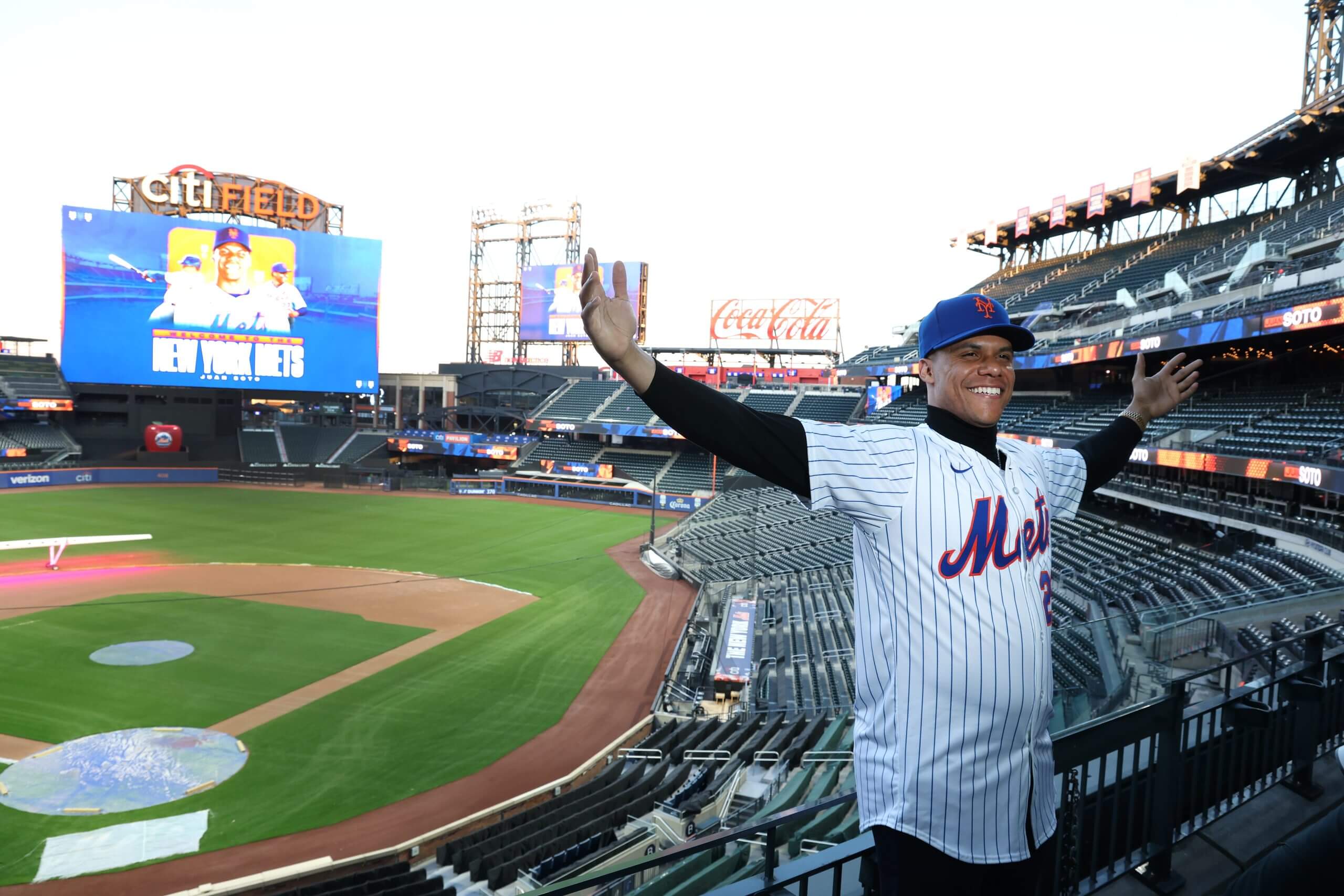
Juan Soto moved to Queens on a massive contract. His first season, however, didn’t result in a playoff berth. (Al Bello / Getty Images)
Both the Mets and the Reds finished with 83 victories, with the Reds earning the final Wild Card spot through a tiebreaker. For the Mets, the result represented a historic, slow-motion collapse. For the Reds, who have not participated in the postseason after a 162-game season since 2013, the postseason berth elicited joy.
Heading into this season, the Reds were one of nine teams — a list that also includes the Chicago White Sox, Colorado Rockies, Miami Marlins, Brewers, Minnesota Twins, Pittsburgh Pirates, Seattle Mariners and St. Louis Cardinals — who declined to sign any player to a multiyear contract this past offseason. Six of those teams will be postseason spectators.
The discrepancy can extend beyond the acquisition of players, as free-spending clubs like the Dodgers and Yankees also allocate resources towards research and technology. Some of the game’s most innovative franchises have lost their edge, at least for now. The Tampa Bay Rays finished with a losing record for the second consecutive year. The Athletics have not had a winning season since 2021.
Both the Athletics and the Rays, who are transitioning to new ownership under real estate developer Patrick Zalupski, have been hamstrung by their stadium situations. A variety of other mid-market franchises like the Twins, Cardinals and the Texas Rangers have been hurt by the collapse of the regional sports network model.
Part of Manfred’s agenda in the coming years involves convincing the owners to band together and offer consumers a 30-team package of local television rights. That will not be an easy sell for teams like the Dodgers and Yankees. And it also won’t occur until after the league’s national television rights expire in 2028. The uncertainty surrounding the media landscape makes the possibility of a season lost to labor strife in 2027 feel more remote. It is difficult to pitch a system based on shared revenue when the exact nature of the revenue is unclear.
On the surface, the argument for a cap was not strengthened by the 2025 regular season. The best team resides in Milwaukee, the sport’s smallest market. The Guardians and Reds generated hope across the state of Ohio. The Mets are already bound for the golf course. The Dodgers finished with their worst record since 2018. The Yankees did not win the American League East.
But at least the Dodgers and Yankees will play postseason baseball, as will the Phillies and the Blue Jays and the majority of clubs in the top 10. The cries to even the playing field, from both the players and the unions, are unlikely to cease between now and the expiration of the CBA.
(Top photo of Shohei Ohtani and Yoshinobu Yamamoto: Chris Coduto / Getty Images)