
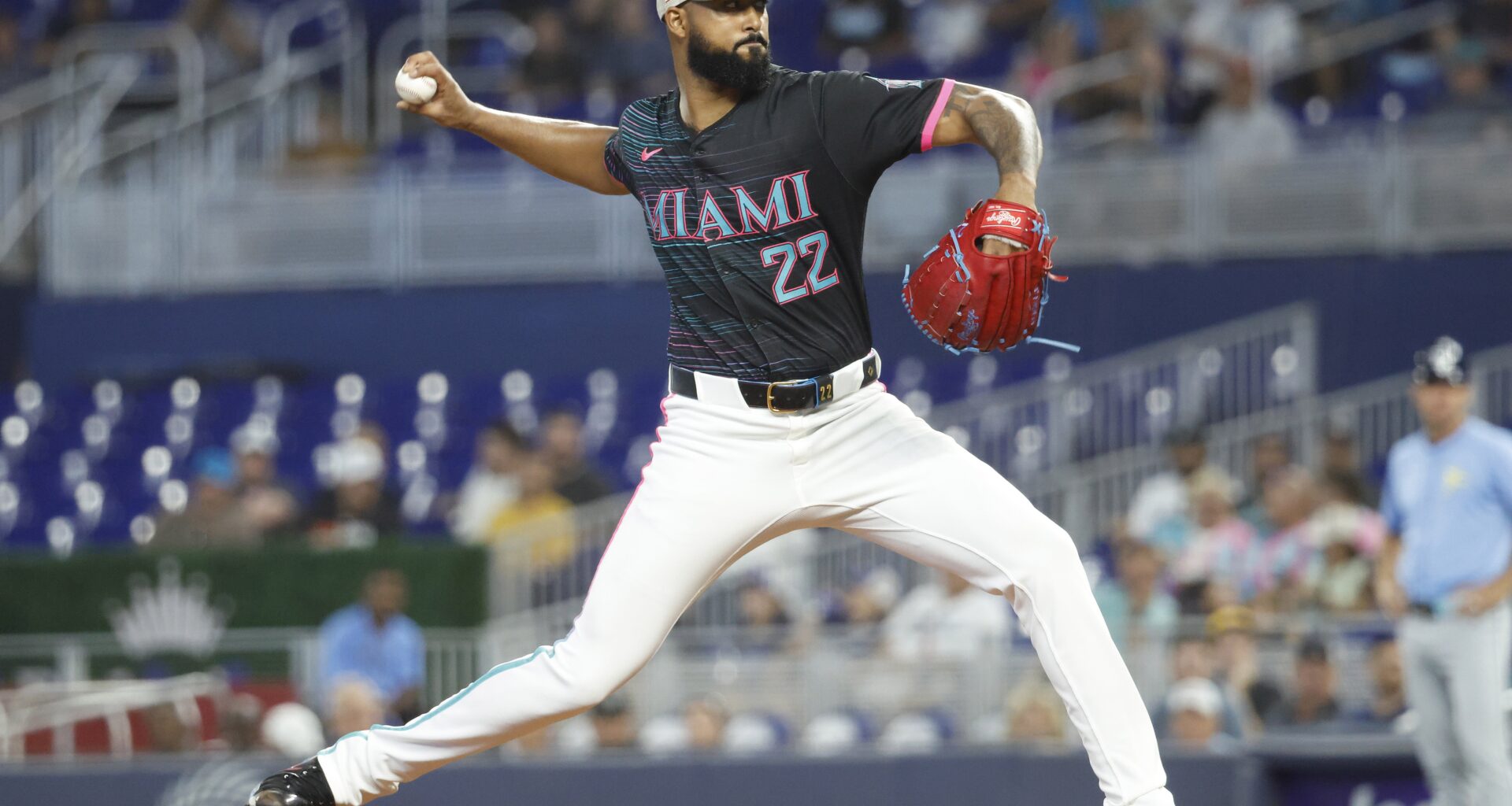
MIAMI—Sandy Alcantara was dealing. After shaking off a leadoff double and a walk from the first two Rays he faced, Alcantara retired twelve in a row heading into his fifth inning of work in game two of the Citrus Series. The former Cy Young winner was sitting high 90’s—including one pitch at 100 for the first time this season—rolling ground balls at a “Vintage Sandy” clip and spotting his pitches as well as he’s done all season. It appeared that after eight starts of knocking off the rust and uncharacteristic results, this was the light at the end of the tunnel. For the first time in nearly two years, the Marlins ace was going to deliver a gem.
In the blink of an eye, that light went out.
Three singles, a walk, a hit by pitch and an egregious three stolen bases later, Alcantara’s potential return to dominance vanished. Miami’s in-state rival pushed across four runs in the frame. Those were the only four runs in the game’s entirety as Miami’s offense struggled to muster anything all day long. With the 4-0 loss, Miami drops back to 10 games under .500.
In Alcantara’s defense, all four singles could have been outs as easily as they were hits. José Caballero‘s single to start the inning was hit a scorching 62.3 mph down the third base line, Chandler Simpson‘s rip was just past a diving Ronny Simon, Yandy Díaz‘s was through a drawn-in infield and Jonathan Aranda‘s was an awkward broken-bat dribbler. All of that in the equation arguably makes it tougher for Alcantara to swallow.
“Just no luck for me out there today,” Alcantara said to reporters postgame. “Fifth inning, you just hit the ball right there on the edge, maybe the hole, I don’t know, but it is what it is. You just gotta take it”.
“He looked sharp using the fastball to (the) top of the zone as well. And using the secondaries, he was in a really good rhythm there through the early part of the game.” said Marlins manager Clayton McCullough. “And then, they just kind of strung a few together, their ground balls that got through some holes to kind of keep the line moving a little bit…They’re gonna start getting hit at people, which would make the overall outing look different. But I think as far as how he threw the ball, and how the quality of the stuff how he’s utilizing it, it’s going to bode well as we keep moving forward.
The unlucky inning wouldn’t have held as much weight if Rays starter Drew Rasmussen didn’t shut Miami’s offense down for the better part of six innings. The Marlins were only able to put together four hits against him—two from the second inning onward—with no real opportunity for a rally. Rasmussen finished his day with five strikeouts on an efficient 81 pitches.
A trio of Rays relievers allowed just two hits combined in the final three innings.
As has been the case at various points of Alcantara’s career, the Marlins have been providing him with inadequate support. The club has lost six consecutive Alcantara starts, averaging only two runs in those games.
Kyle Stowers and Liam Hicks—who batted second for the first time in his young MLB career—were the only Marlins who recorded multiple hits, both recording a single and a double.
“He’s feeling confident, trusting in his bat-to-ball, his eye, to be able to go up there and then take some shots and some counts to try to impact,” noted McCullough on his rookie catcher.
Despite facing off annually, the Marlins have not swept the Rays in a series of any length since 2016 (a two-gamer played at Tropicana Field). That drought continues.
Looking ahead to Sunday afternoon’s 1:40 series finale, McCullough turns to Cal Quantrill, backpacking off another up-and-down start on the north side of Chicago. Eight starts into his 2025 campaign, Quantrill owns an ERA of 7.00 with opponents OPS’ing just north of .900. Standing in the way of Miami’s first series win in almost a month is Shane Baz, who made just one start against his in-state rival back in 2021. The former first-round pick has stumbled as of late, allowing three or more earned runs in each of his past three starts. Baz relies heavily on his four-seam and knuckle curve, with the latter seeing significantly more usage—20.5% in 2024 compared to 33.2% in 2025—than it did a season ago.