
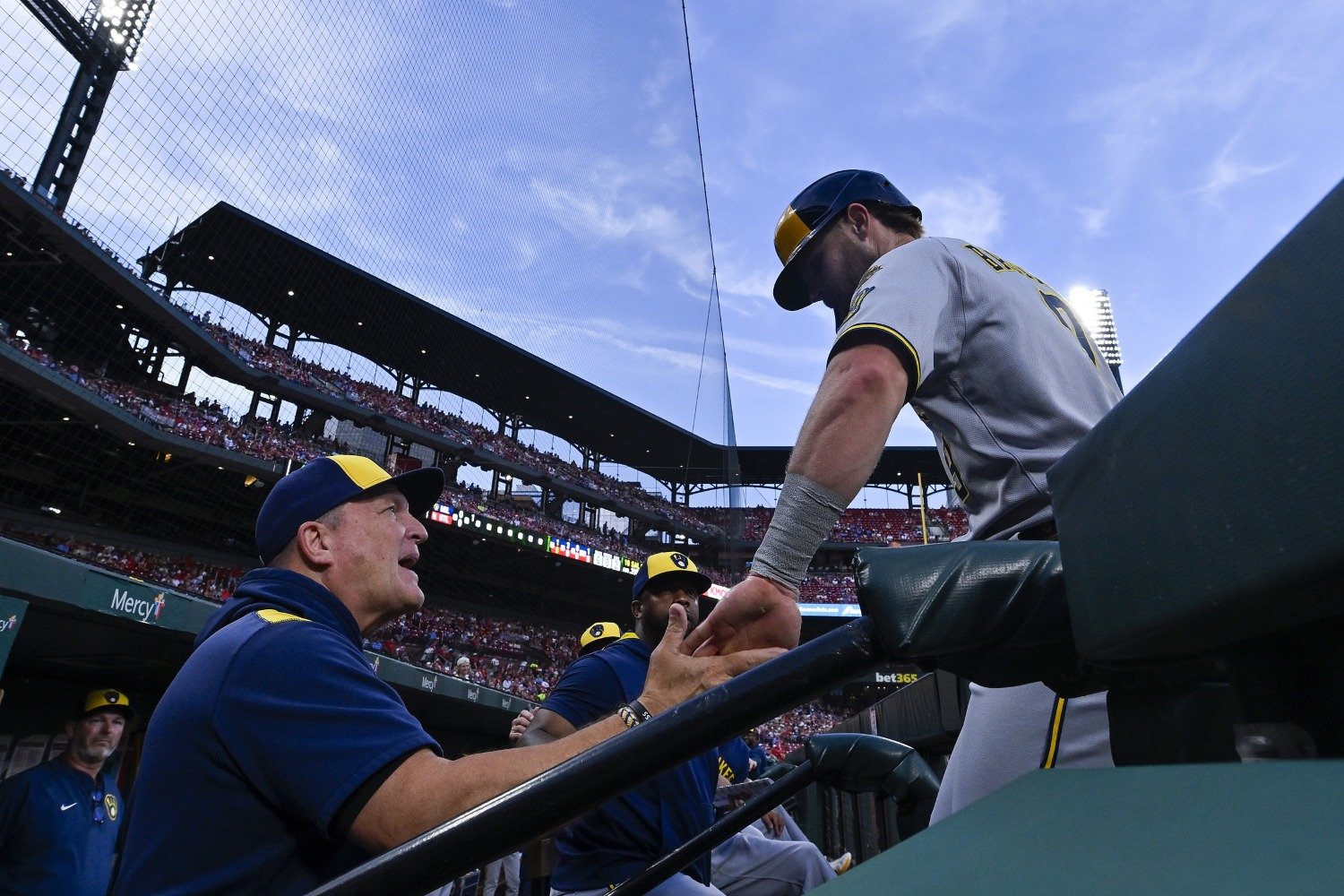
The best regular season in Brewers franchise history featured plenty of twists and turns, but once this year’s team found its identity, its formula for winning remained consistent, including roles throughout the roster. Outside of an injured Rhys Hoskins ceding his role to Andrew Vaughn, Pat Murphy‘s preferred starters stayed in the lineup when healthy, and his high-leverage relievers remained consistent.
Now the Brewers turn their attention to the postseason, which is often regarded as a different game than the regular season because each pitch carries added magnitude in smaller samples. It’s still the same sport at its core, though. Teams typically don’t abandon the brand of baseball that got them into the dance. That will be especially true for this group, whose relentless, pitch-by-pitch approach Murphy believes could give them an advantage over other clubs.
“You’re not looking to win a batting title in the postseason, you’re looking to win pitches,” Murphy said during the final series of the regular season. “So all the things we do all year kind of match up with how you’ve got to go about this. And I think that’s going to be—even though nobody believes it—I think that’s going to be a big plus for us, because we’re playing this type of baseball all year.”
The short-term nature of the playoffs does change the calculus of roster construction and in-game decisions, which is worth noting as Brewers decision-makers select 26 players for the NLDS; arrange lineups and pitching plans; and make moves during games.
Patience and a big-picture view are key during the regular season. Over 162 games, players receive opportunities in all kinds of situations against myriad opponents. Maneuvering matchups and situations to gain an edge each night is still a key part of the game, but for the most part, things tend to even out, so teams proactively rest some players and proactively involve others, even when doing so might not optimize the effort to win that game.
It’s a different story in the postseason. The smaller sample size makes the outcome of each pitch more impactful to a team’s fate, elevating the importance of strategy and the game within the game to an extreme. Instead of playing the probabilities that will bring you out on top at the end of 162, you must play the ones that will bring you out on top that night.
Specific situations—having the perfect pitcher to match up against a certain hitter, the right pinch-hitter against a certain pitcher, or the right pinch-runner for a particular game state—that are less consequential in a regular-season game could be the difference between advancing and going home. Players on hot or cold streaks may not have time for things to even out.
“You’re not playing for the psyche of the player, the longevity of the season, what you need out of them to help,” Murphy said. “You’re thinking [about] this seven-game series or this five-game series.”
That means players who filled a certain role throughout the regular season are sometimes used differently in October. If a regular position player does not match up well against an opponent, he may be relegated to a hyperspecific part-time role for a series. Conversely, other players might get more opportunities in the lineup or out of the bullpen in key spots.
“We’re going to play the way we play, but we’re going to be open-minded and flexible, because we are in a win tonight mode like never before,” Murphy said. “That doesn’t get you tomorrow, necessarily, so winning tonight could mean you’ve got to be a little more flexible. Yeah, you played left field for us all year, but you might just pinch-hit. But I need that one at-bat to be the same as when you were playing, and not get in your own head, because this is about the team.”
Left field could be among the positions to look different from much of the regular season. Isaac Collins held it down for most of the season and emerged as a Rookie of the Year candidate. But his recent defensive downturn, Jake Bauers‘s 1.018 OPS in September, and the need for Blake Perkins‘s glove sliding Jackson Chourio from center field to left all ate into his playing time down the stretch. On the bench, the Brewers must decide whether Hoskins can deliver a game-changing swing off the bench, after he went 1-for-10 in a limited pinch-hitting role. If not, there’s no room for him on the roster at all.
In the bullpen, Nick Mears‘s reliance on his slider could limit him to specific right-on-right matchups, rather than the general high-leverage role he filled for much of the year. Trevor Megill may not jump back into the ninth inning after a month-long absence. Will Grant Anderson‘s upshoot four-seam fastball and right-handed sweeper be effective against Padres or Cubs hitters, or would Tobias Myers stack up better for the most likely matchups? Chad Patrick‘s trio of fastballs looked great in limited relief work, making him a sneaky choice to get high-leverage outings despite his lack of bullpen experience.
These are the kinds of discussions the Brewers must resolve by the morning of October 4, when NLDS rosters are due before Game 1. They already started feeling things out after clinching the division, including giving Bauers more starts in left and using Patrick for three outs in the late innings with a two-run lead on Sunday.
This team’s on-field identity will not change. They will still try to beat opponents with constant action on the bases, forcing them to play clean baseball, and playing strong defense. Things will look a bit different on the management side, as the front office and coaching staff must adapt their roster usage to best fit the context of each plate appearance, game, and series. The rule of thumb in October is to expect surprises, and there will inevitably be several in the coming days.