
While they couldn’t quite surge into the playoffs with a September push, the Arizona Diamondbacks did play well in the second half despite their fire sale at the deadline.
A 51-58 record before the deadline was followed by a 29-24 record in August and September, but how the team reached each of these records looked very different.
While most of the roster changes happened at the end of July, more in-depth stats are available when looking at performance before and after the All-Star break. So, most of these numbers and rankings will be using mid-July as the dividing point.
Diamondbacks’ 2nd half offense fizzled despite individual standouts
Prior to the All-Star break, the Diamondbacks had one of the strongest offenses in baseball. The team was top five in MLB in runs scored (fourth), doubles (second), triples (second), home runs (fourth), walks (third), on base percentage (fifth), slugging percentage (fourth) and OPS (third).
Ketel Marte slowdown and trade deadline losses hurt the offense
Marte was an MVP candidate during the first half. Marte was in the NL’s top 10 for batting average (seventh), on base percentage (second), slugging percentage (second), OPS (second) and home runs (T-10th). While he didn’t play poorly in the second half, he was not top 10 in any of these categories.
The potent hitting wasn’t quite strong enough to make the team contenders by the end of July, and when Arizona sold at the deadline, the departures of Eugenio Suárez and Josh Naylor meant the offense was unable to sustain its pace.
Prior to being traded, Suárez was tied for fourth in MLB with 36 home runs in addition to hitting .248 with an .896 OPS. Naylor was the team leader in hits before he was sent to Seattle, holding a .292 batting average and .807 OPS.
The Diamondbacks saw themselves fall in all of the categories they were highly ranked in, besides triples. The only categories where the Diamondbacks ranked notably better in the second half were batting average, where the team went from 12th to seventh, and hits (14th to 10th).
Geraldo Perdomo and Corbin Carroll thrived, particularly in the 2nd half
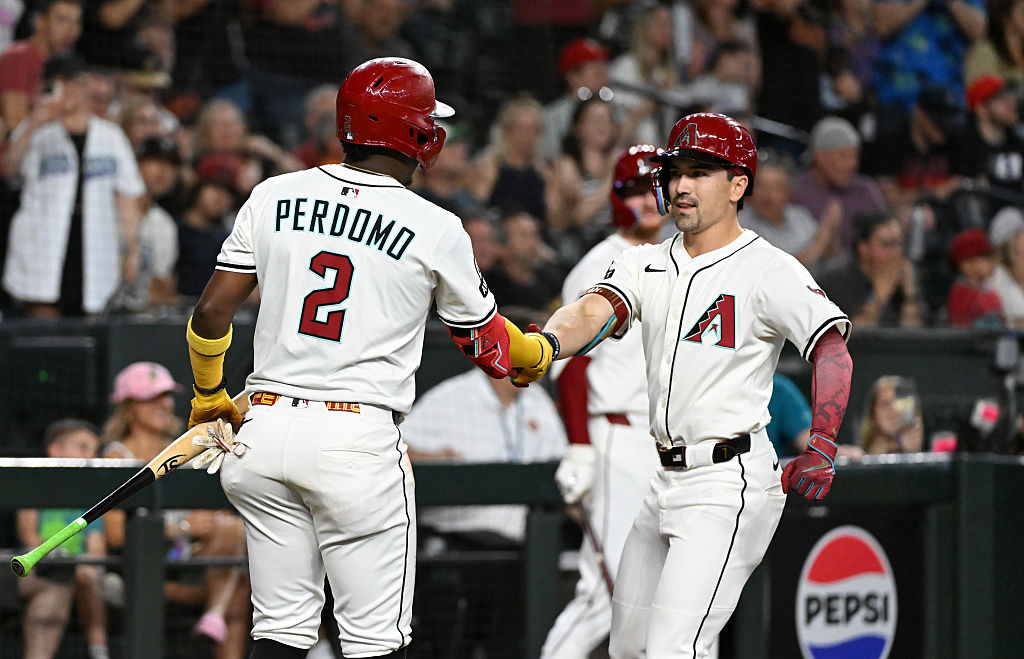
After signing his four-year extension, Perdomo had a solid first half, recording a .783 OPS. But in the second half he surged, landing in the top 10 during the half in National League runs (T-seventh), hits (first), triples (T-fourth), walks (T-ninth), stolen bases (T-fifth), batting average (second), on base percentage (first), slugging percentage (sixth) and OPS (second).
On the season as a whole, Perdomo led National League hitters in Wins Above Replacement with 7.0, more than his previous four seasons combined. Despite not being selected to the All-Star team, Perdomo’s second-half production has turned him into an MVP candidate.
Carroll was looking to return to his 2023 form when he won rookie of the year and finished fifth in MVP voting. He started the year hot and, after the first half, found himself seventh in NL OPS at .874.
Carroll was able not only to maintain his first-half success but build on it. Notably, he took more walks, going from 53rd in the NL in the first half to tied for ninth in the second. This also greatly increased his on-base percentage, which was 42nd in the first half and 13th after the All-Star break.
Pitching saw improvement after a rough first half
Throughout the first half of the season, the D-backs’ weakness was clear. The team was ranked poorly in nearly every pitching category, and while they didn’t become a top staff in the second half, they still saw vast growth on the individual and team levels.
As a team, Arizona saw improvement in their MLB ranks for ERA (26th in the first half to 19th in the second half), WHIP (23rd to 18th) and walks (18th to fifth).
Starters avoided fatigue, improved and pitched deeper
The team’s starting pitching in particular saw an increase in production. Zac Gallen and Eduardo Rodriguez both dropped their ERAs by more than a full point after the break.
Additionally, Gallen, Rodriguez, Brandon Pfaadt and Ryne Nelson all pitched more innings per start in the second half than in the first. This increase, when extrapolated to a full season, would potentially save the bullpen 53 innings of work.
The Diamondbacks would want to save the bullpen as much work as possible after they blew 29 saves this year, tied for the second most in baseball, and had the fourth-worst reliver ERA at 4.96.
