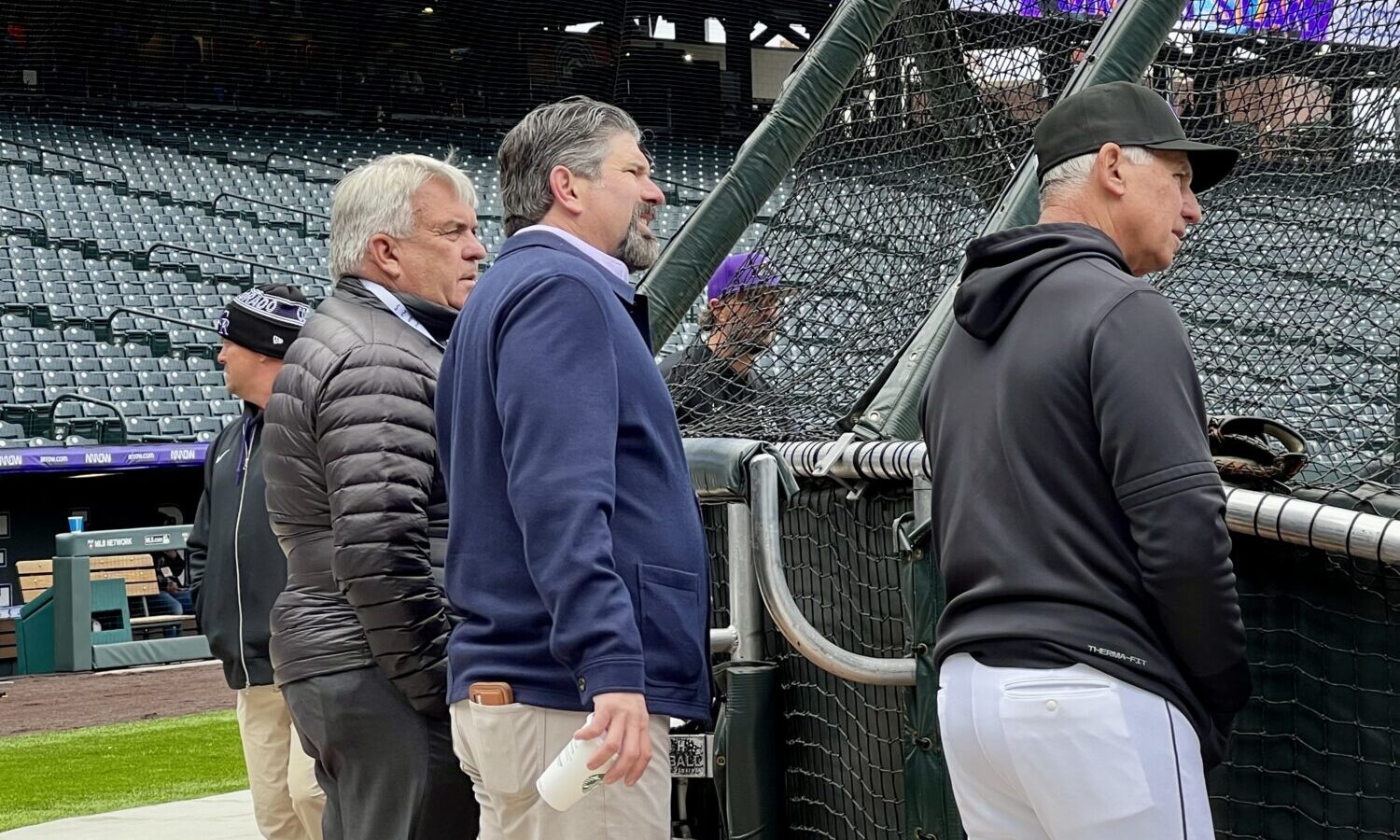
How will history recall the Bill Schmidt era?
In major-league annals, it will be little more than a blip. But in Rockies annals, his five-season hitch as the team’s general manager — which followed nearly five months in the interim role — will be remembered for the club’s continued plummet into the abyss and the organization’s lingering stasis.
The record, of course, isn’t entirely his doing, plenty of that falls on previous GM Jeff Bridich.
The Rockies’ further descent from mediocrity to the all-time depths of the sport is less about the individuals and more about the organization.
But it happened on Schmidt’s watch.
There was no coming back from a season like the one that just passed atop the previous two campaigns. To not have a change would have been organizational malpractice.
Nothing personal, but anything that says, “This is OK” would have been a middle finger to the fans who remained to watch and see supporters of the Cubs, Dodgers, Mets and other assorted clubs take over Coors Field on a nightly basis.
Three-hundred and twenty three losses over three years was a fireable offense. “Stepped down” certainly takes the edge off, but there could be no other conclusion than this.
But the fact that the Schmidt era even began symbolized all that went wrong with the Rockies.
A PHILOSOPHY ROOTED IN THE PAST
Schmidt’s ascent into the permanent role on Oct. 2, 2021 yielded eyerolls around the sport.
Although in possession of a CV that certainly possessed the requisite qualifications dating back to his years as a scout for three other teams and MLB’s scouting bureau, the decision to make an internal promotion after sub-.500 finishes in the previous three seasons and nine of the prior 11 campaigns did not inspire confidence of any change in direction.
Philosophically, the Rockies remained stagnant, rooted in thinking of a bygone age. Never was this more apparent than within six months of the removal of the “interim” tag, when the team signed Kris Bryant to a seven-year, $182-million contract.
The first major free-agent acquisition of the Schmidt era remains the last. And it bombed spectacularly.
In four seasons, Bryant’s total WAR — per Baseball Reference — is minus-1.5, with a minus-2.9 wins-above-average figure. Only in 2022 did he make a positive contribution to the Rockies.
Of a possible 648 games, Bryant has played in just 170 — barely one full season of four with the Rockies. In those, his OPS dropped each year, from .851 in 2022 to .680 in 2023, .623 in 2024 and .400 in 11 games this year.
Schmidt did owner Dick Monfort’s bidding, to be certain.
But he is also a product of the club’s insular structure, having worked for the Rockies since 1999. Like Jeff Bridich before him, he was an internal promotion to the general manager’s role. And thus, the results were the same.
The Rockies need to be a “draft-and-develop” organization, and while the draft judgment won’t be fully known for some time, the Rockies remain a club whose scattered hits outweighed by a parade of misses.
Take Schmidt’s first draft in 2021 as an example. It yielded Hunter Goodman from the fourth round, a catcher who just finished 2025 with the first 30-homer season by a National League catcher in two decades.
But first-round pick Benny Montgomery’s development stalled. He endured a miserable season at AA Hartford this year, posting a .537 OPS while barely nudging his average over the Mendoza line.
The only balm on the wound is that the 2021 first round has yet to truly break through; only San Diego’s Jackson Merrill, Milwaukee’s Sal Frelick, Cincinnati’s Matt McLain and Cleveland’s Gavin Williams have career WARs above 3.5 from that round.
But all were taken after Montgomery. And the cycle continued.
POST-SCHMIDT, ROCKIES JOB CAN BE A PLUM — IF OWNERSHIP GIVES FREE REIN
The fact that Walker Monfort specifically noted finding a new GM “outside our organization” is the first sign of hope.
But that new leader must be given complete latitude to take the HAZMAT approach to baseball operations if so desired. Treat the Rockies like an expansion franchise. Frankly, expansion teams — at least every one of them since the 1962 New York Mets — are better these Rockies, anyway.
And no one should be considered untouchable.
After all, that has been a problem at the trade deadline — which was another manifestation of how Schmidt’s era continued the patterns that have long plagued the Rockies.
When they made trades — such as this year’s swap of third baseman Ryan McMahon to the New York Yankees — they did so a year or two too late, a Rockies malady going back to the days of Ubaldo Jiménez and Troy Tulowitzki, thus slicing into the value received.
Their reputation is as a club that overvalues its own talent. They prioritized keeping players, seeing value in grabbing a few more meaningless wins at the end of the season and a few more butts in the seats — when the last three years have proven that even being a calamitously bad club won’t prevent the turnstiles from spinning, anyway.
At every trade deadline in recent years, you’d have buyers and sellers, all on the highway moving in one direction or the other. Twenty-nine clubs who could be counted in one of those two piles. But too often you’d have the Rockies, standing there outside their battered jalopy at the side of the road watching the sport roar by.
And that sums up the Rockies as a whole. Stalled. Broken down. Not merely in need of repair — in need of a complete rebuild.
If ownership stays out of the way, the job of running Rockies baseball operations offers the ultimate freedom for a creative baseball executive.
After all, if you swing and miss, so what? It’s not like you’ll do any worse.
And that, ultimately, will likely be the legacy of the Schmidt era. He might be salvaged a bit by his final two drafts if Holliday and Charlie Condon hit.
But his years saw the final stages of a drop into the sport’s nether regions. Schmidt wasn’t entirely responsible, but he did nothing to stop it.