
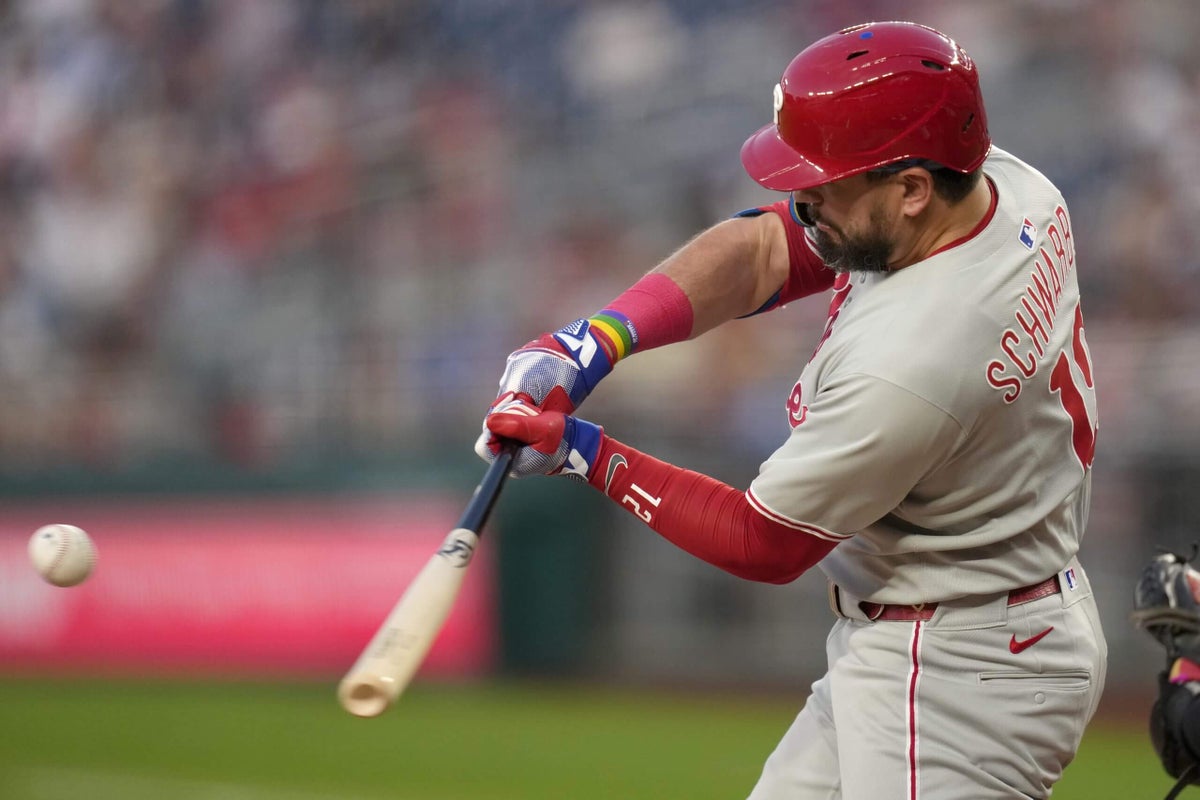
PHILADELPHIA — Every January, several weeks before quiet mornings in Florida backfields and raucous games at Citizens Bank Park, Kyle Schwarber convenes his hitting coaches in Middletown, Ohio.
Schwarber’s personal coach, Aaron Capista, and Phillies hitting coach Kevin Long trade notes. They pick apart his previous season. They set the tone for the year.
Then comes the hard part: five days in the cages each week until spring training. Capista’s goal for the sessions is to be like sandpaper, finding what Schwarber can improve on and constantly pointing it out. He is unafraid to pull up film on an iPad and show it to Schwarber, saying, “What in the world were you thinking? Why would you do this?”
Schwarber does not back away. It would be easy for him to walk out of the cage feeling good every day during the offseason, Capista said. But that would not reflect reality.
“Even when you’re not doing the quote, unquote super-hard drills, everything’s still done with purpose,” Schwarber said. “Even if I’m hitting off the tee, I’m challenging myself off the tee to hit the ball where I want to hit. I don’t want to sky-fly it, I don’t want it on the ground, I don’t want to rope it. I want an excellent drive. And I know exactly where I want the ball to go. So, that could be 20 swings off the tee, and 18 out of 20 should be where I want. If I’m getting 10 out of 20, I’m doing something wrong.”
Schwarber is obsessed with the minutia of hitting, with figuring out what to fix and how to challenge himself. It is what has enabled him to have the best season of his life at 32. He homered 56 times, just short of Ryan Howard’s Phillies franchise record 58, and his 23 homers against lefties were the most left-on-left homers in MLB history.
Once pinch hit for and platooned against lefties, Schwarber has cemented his standing as perhaps the best left-on-left hitter in the sport.
As the Phillies await a showdown with the Los Angeles Dodgers in the National League Division Series, Schwarber — who has a .906 OPS in 69 postseason games — will undoubtedly be a factor. Schwarber has been lauded for his power for years, but this season, while carrying the Phillies to a 96-66 record, he’s ascended to a higher tier.
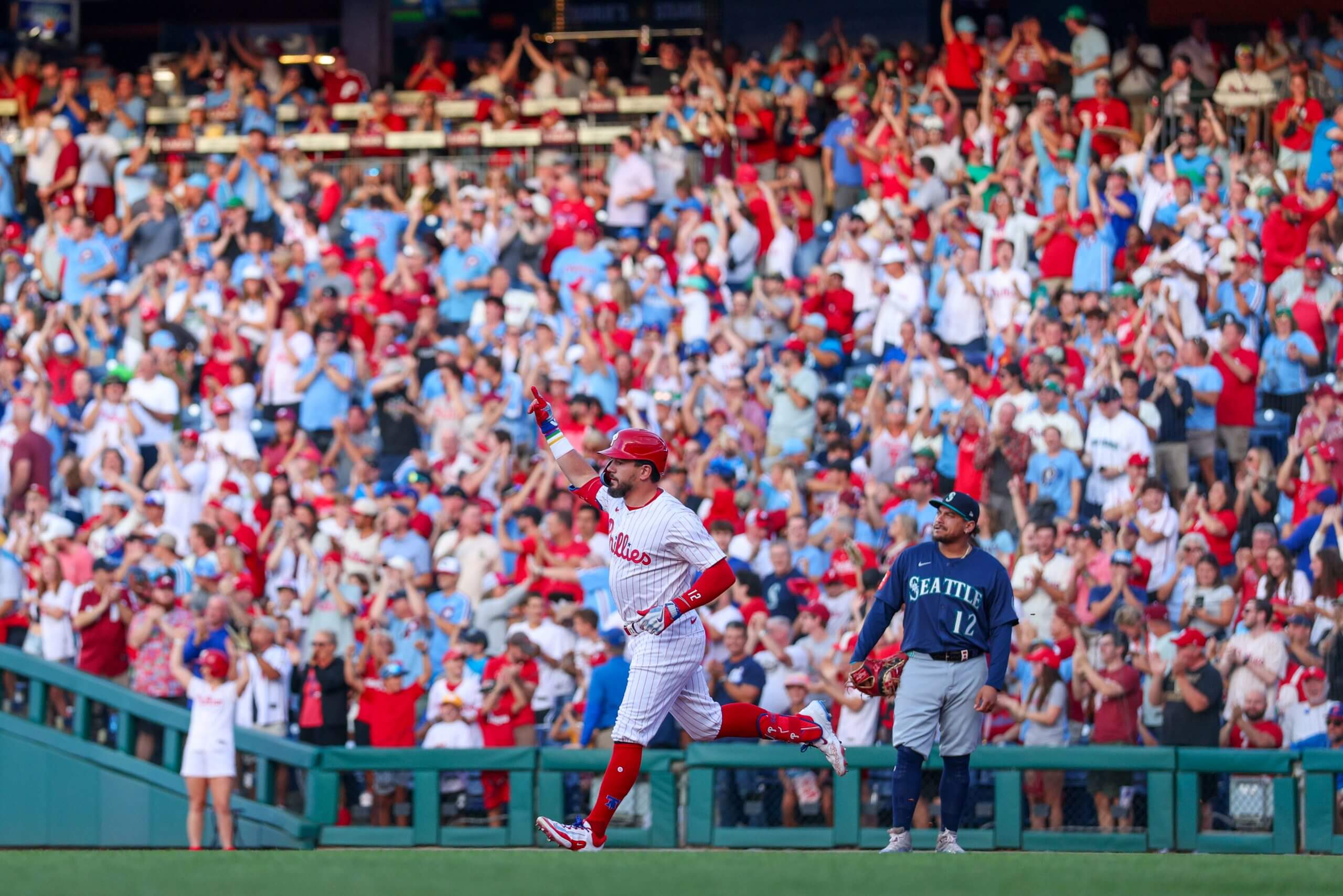
Kyle Schwarber has made 56 home run trots this season, including 23 against left-handed pitchers. (Heather Barry / Getty Images)
Schwarber heard “MVP” chants in several ballparks during the second half — partly because he was the All-Star MVP, partly because the fans would really like him to win the award.
Crowds at Nationals Park were among those who yelled it during Schwarber’s at-bats. It is rather fitting. Schwarber resurrected his career there after the Chicago Cubs non-tendered him in December 2020. There he began working with Long, then with the Washington Nationals, and embracing drills that would make him an elite left-on-left hitter.
It came after a difficult 2020. Schwarber felt his hitting position was bad. He wasn’t using the ground well. He was traveling forward. His contact point was way in front. He finished the shortened pandemic season hitting .188 with an OPS of .701.
When Schwarber signed with the Nationals in 2021, Long came to Tampa, where Schwarber was training, to see him three days later. It was the first time Schwarber, Long and Capista huddled. Their goals for 2021: using the ground the right way, getting Schwarber to move his head less, adjusting his contact point. It started with a “squatty” batting stance in the offseason, creeping up as the season progressed and he felt like he was using the ground the right way.
“Then that June came, and just kind of everything clicked,” Schwarber said. “It was one of those rare times where the stars align and you’re getting pitches to hit. You’re not missing pitches. Like, that’s what it was supposed to feel like.”
He hit 16 home runs that month before hitting the injured list in early July, and was traded to the Boston Red Sox at the deadline. In 41 regular-season games with the Red Sox, Schwarber hit .291/.435/.522 for a .957 OPS and helped the club to an American League Championship Series appearance.
During that time, hitting lefties was one focus among many. Schwarber did not want to be platooned in Washington. But it was a real possibility.
“Well, there’s one of two things you can do,” Long recalled telling Schwarber. “You can really work hard at this, and you can probably play against lefties. Or we can just stay status quo.”
Schwarber replied: “I’m ready to work.”
So began the groundwork that helped Schwarber become one of the best left-on-left hitters. He and Long talked about angles, and worked on getting in line with a lefty slot and doing breaking ball work against left-handed pitching. If the Nationals played an intrasquad game against a lefty, Schwarber was in the lineup. Long pushed Schwarber. He responded.
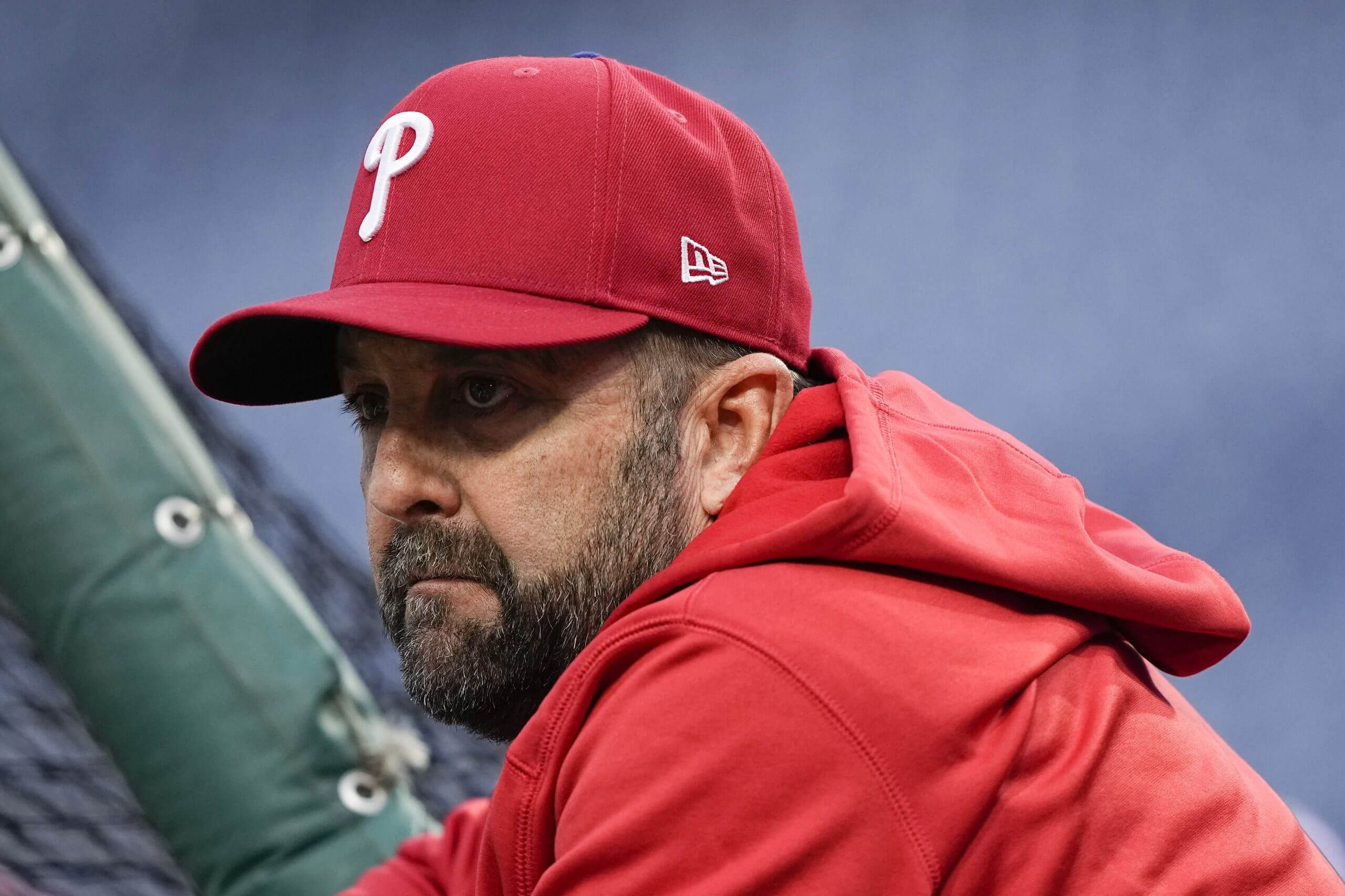
Kevin Long has worked with Kyle Schwarber since 2021, when they were with the Nationals. (David J. Phillip / Associated Press)
As Schwarber sought to improve against lefties, Capista told him: It was not that big of a deal. It was 60 to 70 at-bats over the course of the year. It was still a ball coming across the plate — just from a different angle. He did not want Schwarber buying into those outside his circle who felt he couldn’t hit lefties.
Belief is one thing. But there is something to be said for producing results. That was when Schwarber began to feel things shift in 2021. He hit .268 against lefties and .264 against righties — his best-ever average against southpaws at the time.
“The damage was mostly done against righties,” Schwarber said, “but it was a lot of hits against lefties. And it got my confidence up. And it was just kind of telling me, ‘OK, I can do this.’ Once you start getting the confidence within it, then all of a sudden, now you just view it as a pitcher versus, ‘I’m facing a lefty.’”
He continued to dig in after signing a four-year, $79 million deal with the Phillies in March 2022. Schwarber, at the end of the regular season in 2023, prepared to face now-teammate Jesús Luzardo in Game 1 of the Wild Card Series against the Miami Marlins. With Luzardo, Schwarber knew he’d see a slider that would start at him. If he backed away, it would be called a strike. And he didn’t want to worry about a sinker coming in and whacking him. So, he wore a C-flap helmet.
“He stays in well, and he has really fast hands,” said Luzardo, who struck him out twice. “It almost felt like you couldn’t sneak any fastballs by him. For me, it was always like, try to keep him off-balance as much as possible and try to surprise him and keep him on his toes.”
It is a difficult task. Schwarber spends so much time in the batting cage trying to recreate what he might see in a game. His pre-game routine in the cage is lengthy: low tee, high tee, flips, simulating lefty or righty pitchers depending on who the Phillies are facing, using the machine to recreate the shapes of pitches he’ll face that day. He starts four-seam, then two-seam, before seeing sliders, cutters and curveballs.
The work pays off. He does not chase. He adjusts quickly during at-bats. His bat speed is among the best in the sport. He battles with the best lefties.
“I can’t really tell what he’s thinking up there because he always seems to be on it,” Luzardo said. “When it’s off-speed, he sits on it. When it’s a fastball, he sits on it. He’s obviously a very intelligent hitter.”
Atlanta Braves pitcher Chris Sale, a teammate of Schwarber’s in Boston, agreed. “I remember seeing some fastballs — he’s hitting fastballs up here (demonstrates shoulder-high), and being able to get the barrel to the slider,” the 2024 NL Cy Young Award winner said.
But there is always something to work on. That is why Long, Capista and Schwarber meet each winter. This January, improving Schwarber’s zone swing rate and avoiding deep counts were the biggest focuses.
Not chasing is typically a good quality. But if there is a downside to Schwarber’s decision-making, Capista said, it is that he does not swing enough. His zone swing rate in 2024 was 60.6 percent. Aaron Judge’s was 67.4. Shohei Ohtani’s was 69.7.
“I equate it to like, if Steph Curry just didn’t shoot a lot of 3-pointers, he wouldn’t average 80 points a game,” Capista said. “If he took six or seven less 3-point attempts in a game, his average would not be 30 points a game. It would be 17, 18, 19. It wouldn’t take away from the fact that he’s one of the best shooters in the game, but his production wouldn’t match up with how skilled he is. If you’re taking more attempts in the zone, you’re going to get more balls in play. And balls in play, for Kyle, with how hard he hits the ball, is going to equal damage.”
Schwarber’s zone swing rate is up to 64.1 percent, the highest it’s been since 2021. And being more aggressive has not led to a greater strikeout rate — the result of swinging as fast as ever, but with a swing that’s 4 inches shorter. His decision-making against lefties has also improved, as he’s chasing less out of the zone.
Long found Schwarber’s early success this season telling. Schwarber homered nine times with a .245/.398/.538 slash line and a .936 OPS in 30 games across March and April. Early months have typically been a struggle for him. In 31 games across those months in 2024, Schwarber’s OPS was .718. It was .751 during that stretch in 2023 (29 games), and .720 in 2022 (20 games).
Capista had a good feeling when Schwarber, who had primarily hit leadoff in his three previous seasons in Philadelphia, was moved down in the lineup.
“It was a changing of the variables,” Capista said. “And he’s an expert at that because we’re always changing the variables in our training. He’s really good at — ‘no situation is too much for me.’ He’s a high-leverage performer.”
Well done @kschwarb12. Star of Stars. Onward. pic.twitter.com/HJUlIrZ79A
— Aaron Capista (@cappyscage) July 17, 2025
Schwarber has long said that he will reflect upon this season when the dust has settled. Same goes for contract negotiations for the soon-to-be free agent, though the Phillies would love to keep him. This much is clear: He put together one of the best seasons by a Phillies hitter ever, and, along with Trea Turner, helped the Phillies win a combined batting Triple Crown (batting average, home runs, RBIs).
The work that started in a batting cage in Middletown, Ohio, in January continued at Citizens Bank Park in September. At 9:08 p.m. after Game 161 against the Minnesota Twins, Schwarber appeared in the clubhouse holding two bats. The game had ended 24 minutes earlier. But he didn’t like his swing. In the final games, he said, he was getting around balls he would normally swing through. So, he returned to the cages.
The postseason is a clean slate, he said. The only focus is winning.
“And then, as soon as it’s done,” Schwarber said, “and hopefully we’re holding a trophy, now it’s time to look at yourself in the mirror again and be like, ‘OK. What else can I improve on?’ What else can I get better at?’ Because, obviously, a .240 batting average — how can I improve that?”
— The Athletic’s Matt Gelb, David O’Brien and Eno Sarris contributed to this report.
(Top photo: Jess Rapfogel / Getty Images)