
What is a “good” baseball player? It’s difficult to answer that concisely because a player’s production can be shaped in various ways and still yield significant positive value to their respective team.
For instance, we know Adam Dunn—the hulking slugger who played 14 years in the big leagues—was a poor defender, amassing 168 runs below average, according to Rfield. We also know that Dunn was a force in the middle of the order, offsetting his 28.6-percent strikeout rate with a 15.8-percent walk rate to go with his 462 home runs. He was 24-percent above average at the plate, according to OPS+. In totality, Dunn was a “good” player, though nowhere near as impactful as his power numbers would suggest. Only one of nearly 400 BBWAA voters endorsed him during his lone year on the Hall of Fame ballot.
Through the lens of advanced metrics, we aim to refine our understanding of what makes a player either good or bad by objectively quantifying their impact in different facets of the game.
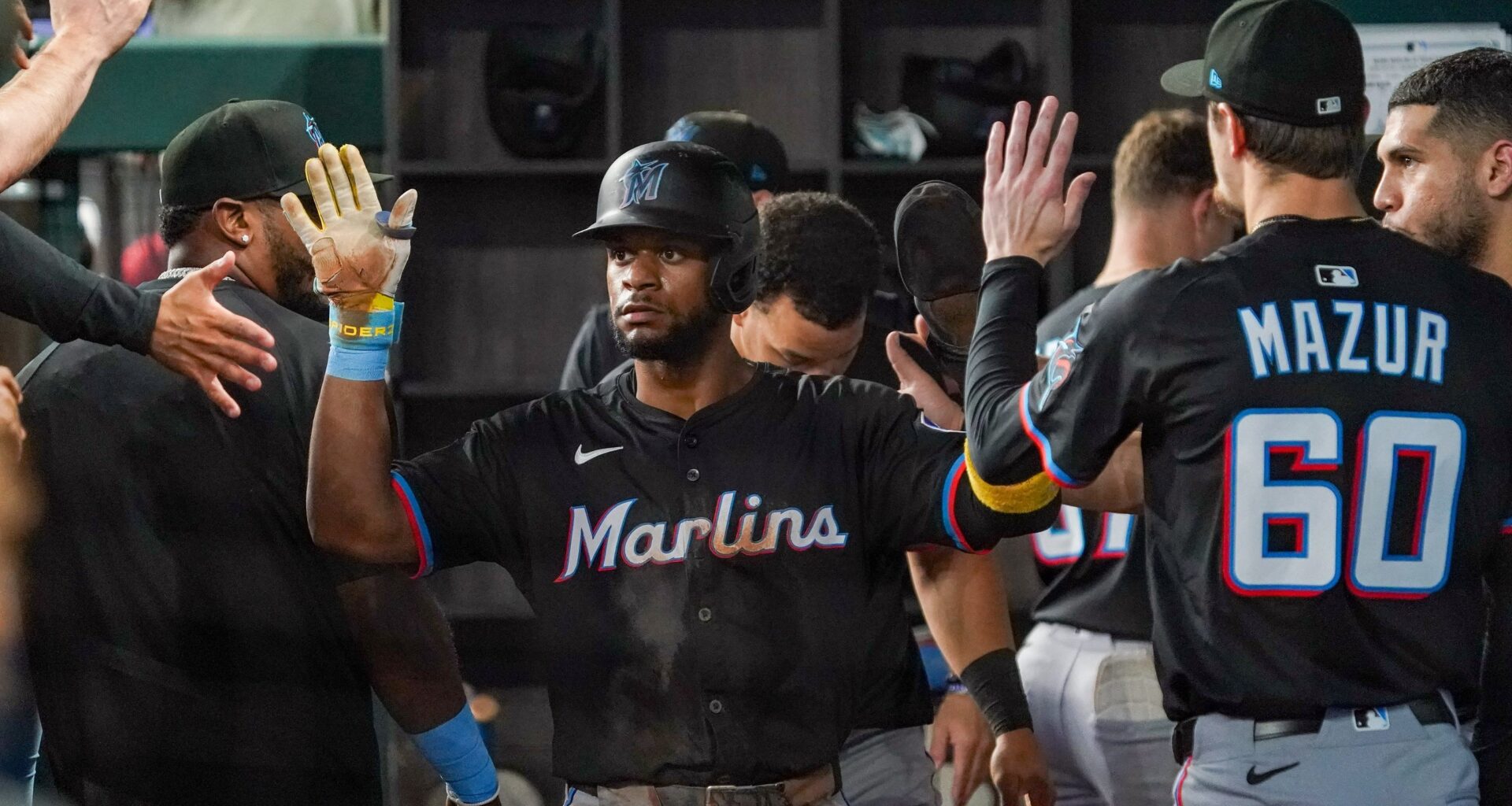
Contrast the aforementioned Dunn with the Miami Marlins’ own Otto Lopez. The former waiver claim has been 12-percent below average in terms of OPS+, and he did not sniff Rookie of the Year votes nor All-Star selections during his first two seasons of regular MLB playing time (both of which Dunn received). Yet, Lopez has comfortably outdone Dunn in Baseball-Reference wins above replacement over those equivalent periods of their careers, 6.1 bWAR to 4.5 bWAR.
In 2025, Lopez’s 3.5 bWAR trailed only Kyle Stowers (3.6) for the Marlins team lead. Miami may not have been playing meaningful baseball late into September without Lopez solidifying their shortstop position.
A versatile player coming up through the Toronto Blue Jays system, Lopez quickly established himself at second base upon arriving in Miami in 2024, grading out at plus-9 defensive runs saved. While starting 95 of his 106 games at second, he flashed positional dexterity when asked, logging 52 innings at second, 38 at third, and 10 in the outfield.
Lopez assumed full-time shortstop duties on May 21 of this year when the struggling Xavier Edwards suffered a minor injury. By season’s end, not only was he seen as competent there, but Lopez had joined the company of MLB’s elite shortstop defenders, grading out at plus-7 defensive runs saved to go along with the 6 DRS he put up in just 32 games at second prior to transitioning.
Former teammate Cal Quantrill even had this to say about Lopez’s sure-handedness: “Otto can pick it…It’s such a boost on the mound when you get an out that you may not have deserved. It’s exciting…Sometimes, I think I’m more pumped up out there than they are when they make the play.”
There’s also the baserunning aspect of his game. Lopez is 35-for-45 (77.8%) on stolen base attempts since coming over to Miami, right around the league average 78.4 percent success rate over that span. It’s one way of explaining why he’s been worth five runs on the bases, according to Rbaser—tops among all Marlins players since 2024.
Beyond proving himself as a difference-making fielder at a premium position, Lopez also experienced an uptick in power this season. He is one of just 14 players since the start of 2024 with 20-plus home runs and three-plus dWAR.

Lopez is a good player who would fit on any team. The well-roundedness of his skill set gives him the opportunity to contribute in practically any game situation.
The presence of Lopez should not preclude the Marlins from exploring all avenues to improve their roster this offseason, even at shortstop. However, let this be a reminder that the 27-year-old is one of the organization’s most valuable assets moving forward.