
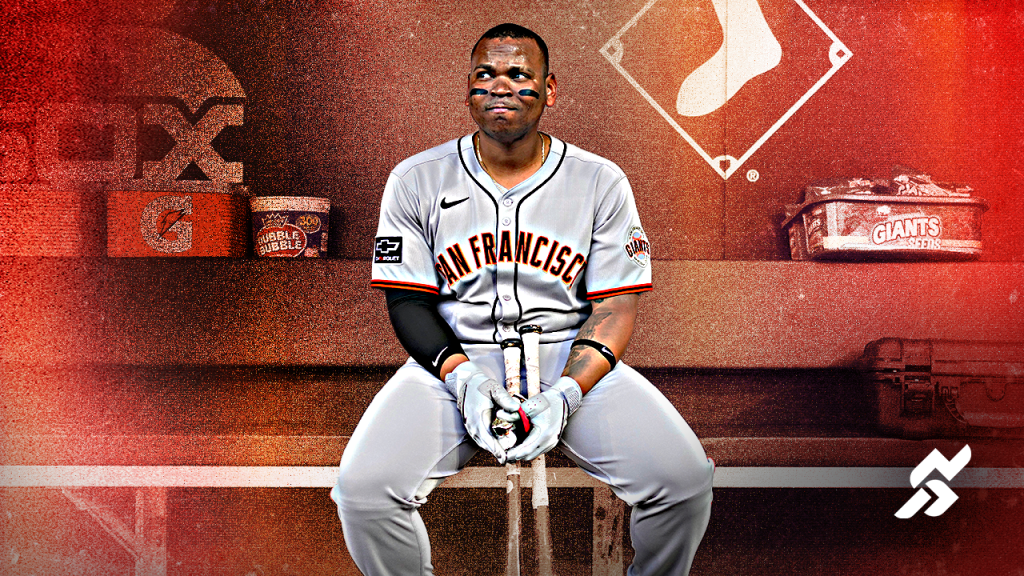
PHOENIX – The Rafael Devers era in San Francisco hasn’t opened with a big bang.
The Giants entered June 14 tied with the Los Angeles Dodgers in the National League West. The next day, they stunned the baseball world by trading for the Boston Red Sox slugger. But since the big move, the Giants have gone 5-11 and plummeted in the standings, where they now sit eight games back of LA.
The deal was meant to shift division power away from the Dodgers, but since then they’ve only created more distance between themselves and all three of the other contenders in their own division: San Diego, San Francisco and Arizona.
No question, Devers has had problems settling in with the Giants, as a recent run of seven strikeouts in a row across three games can attest.
“I wouldn’t say he’s been a disruption,” Buster Posey, the club’s president of baseball operations, said in a dugout interview at Chase Field on Monday. “I do think it takes a player like him time to get used to new teammates, time to adjust to playing in a new home city. He was in Boston since he was 20. So, it will take a period for him to get comfortable.”
It was the biggest trade Posey has made since taking over for the dispatched Farhan Zaidi as head of baseball operations last September. But manager Bob Melvin revealed in a chat with reporters that Devers, whom the Giants landed in exchange for pitchers Kyle Harrison, Jordan Hicks and two minor leaguers, arrived from the Red Sox with groin and back injuries that have limited his ability to play in the field, restricting him only to hitting duties.
That’s the problem, Melvin said, not his comfort level.
“He enjoys being here,” Devers’ new manager said. “He’s hit a couple of homers and he’s done some good things, but as a group we haven’t been as good offensively as we should. We know he’s going to go on a hot streak.”
Not yet, although Devers added a couple of hits and four RBIs as the Giants split the four-game series with the D-backs. To Melvin’s point, the Giants are in the lower third of the league in runs scored and thus far Devers hasn’t been able to rectify that.
In a lopsided loss to the D-backs on Tuesday, Devers snapped the strikeout streak with a double but looked pretty gimpy as he headed into second base. A moment later he was thrown out at the plate as he lumbered home looking like a truck with a flat tire. He whiffed again later in the game.
In his first 14 games in San Francisco—10 of them losses—Devers had 11 hits, two homers, five RBIs and a 95 OPS+, below the league mean of 100. In his eight-plus Boston years he hit 217 homers and had a 129 OPS+.
Devers admitted that the injuries are bothering him.
“Things aren’t going the way I want for me or the team, but I know I’m eventually going to get out of it and the team is going to get out of it,” Devers told a veteran reporter from the San Francisco Standard the other day.
Despite the losing streak, Posey opted to exercise an option for 2026 on Melvin’s contract. Posey said during the interview that the veteran manager is not the problem.
“Bob has done a great job managing the bullpen. He’s a great motivator,” Posey said. “He’s got trust from the guys in the room in there.”
Those traits are essential and similar to Bruce Bochy, the current Texas Rangers manager and the guy who led the Giants to the three World Series titles from 2010 to 2014, when Posey was his catcher.
On Tuesday, Posey took responsibility for his club’s languid play, a stark departure from most general managers who decline to stick their heads in front of notebook or tape recorder to respond to anything.
“If anybody deserves any blame from the top it should be on me,” Posey said. “It shouldn’t be on the manager or coaching staff. I’m the one who sets the roster.”
It doesn’t mean the situation is going to remain that way. Devers should get healthier and adjust to his environment. Third baseman Matt Chapman returned Saturday night against the A’s in West Sacramento from a hand injury he suffered sliding headfirst into a base. There’s still a little under half a season to go, and the Giants are neck and neck with San Diego for the third NL Wild-Card spot.
Posey is well aware there must be a sense of urgency as Major League Baseball nears the July 15 All-Star Game in Atlanta.
“We have to play good baseball,” Posey said. “Having said that, there’s a lot of season left. If we get on some good runs we feel like we can still be in it.”
Then there’s the long view. Posey is building the team in his own image, which was the point late last year when he was given the job.
With the Devers trade and offseason free-agent signing of Willy Adames, the Giants are tied to $493.5 million in long-term contracts of Posey’s doing through 2033. Adames has six years left on the seven-year, $180 million deal, and Devers has eight years remaining on the 10-year, $313.5 million contract the Giants inherited from Boston.
Add Chapman, who was extended under Zaidi for six years at $151 million, and Posey must look beyond the remainder of this season.
Adames, for example, has been struggling along with a low .200s batting average in his first months with the Giants, a departure from his .244 lifetime mark with the Milwaukee Brewers and Tampa Bay Rays. And after a career-high 32 home runs last season, the shortstop has just 10 so far in 2025.
Financially, the Giants are set with the core of this team. Posey will have to live with it.
“We’re still a work in progress,” Posey said. “We have to play the good and consistent fundamental baseball we need to win games.”