
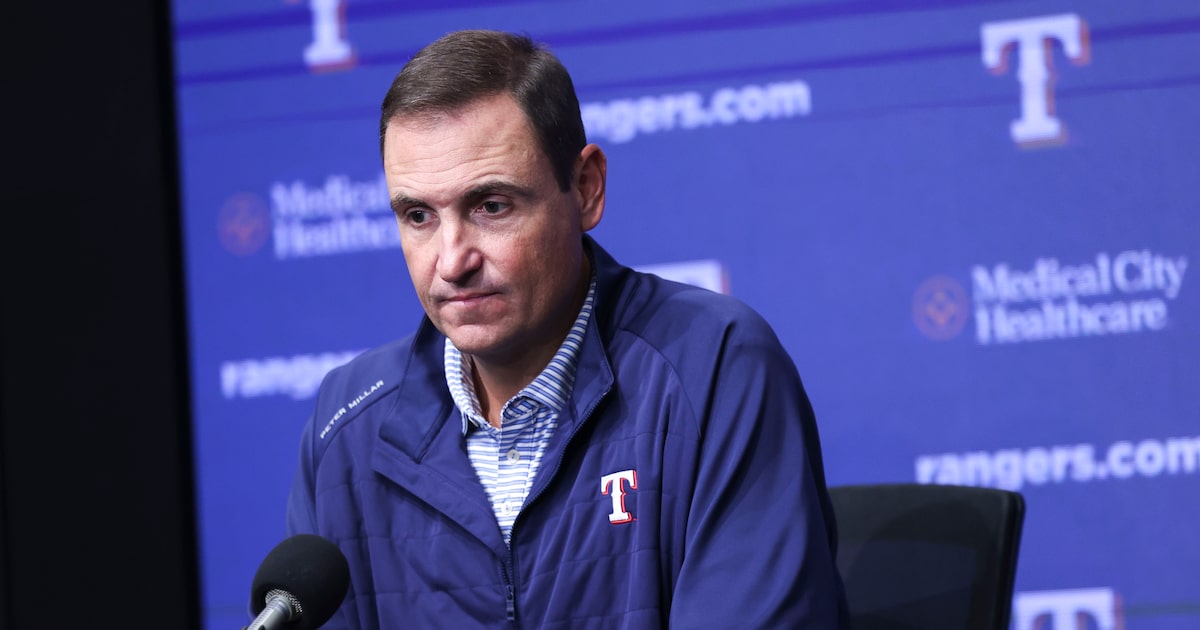
ARLINGTON — The Texas Rangers were five days into their offseason Friday when the club’s brain trust spoke to reporters at the annual season debrief to unpack, effectively, what went wrong this year and how it can be avoided in the future.
The managerial vacancy dominated the discussion. The payroll chat was unavoidable. The team’s culture and personality were examined. The pitchers were applauded.
But, in true form to these Rangers, no discussion is complete without an autopsy of a flawed offense that’s now underperformed in consecutive seasons.
Rangers President of Baseball Operations Chris Young — among those tasked with fixing it — has theories. He spelled out his to-do list over the course of a nearly hour-long session.
Rangers
Related
 The internals
This time last fall, at the club’s end-of-year news conference that followed their World Series hangover season, Young emphasized the importance of internal improvement and bounce-backs from the team’s incumbent stars.
About that….
Six of the seven position players who spent each of the last two full seasons with the Rangers regressed offensively year to year. Outfielder Wyatt Langford, whose .740 OPS in his rookie season climbed to .775 in year two, is the only hitter who did not take a step backward.

Texas Rangers president of baseball, Chris Young (left) and general manager Ross Fenstermaker listen during a post season press conference, on Friday, Oct. 3, 2025, at Globe Life Field in Arlington.
Shafkat Anowar / Staff Photographer
The rest did. Some slid further than others. Second baseman Marcus Semien’s .669 OPS was a career low and represented a 30-point drop from the season prior. Right fielder Adolis García‘s fell by nearly 20 points. Catcher Jonah Heim’s .602 OPS remained the same year-over-year and is the third-worst of any batter that’s taken 800 or more plate appearances leaguewide in that span. Third baseman Josh Jung’s .684 OPS is nearly 100 points worse than his rookie season two years ago.
Young shot down any notion of “physical decline” despite the fact that Semien, at 35 years old, is the second-oldest everyday second baseman in baseball. Young believes that Semien is in a “physical spot” that will allow him to make necessary adjustments to counter his age, but also acknowledged that there may be a need for mechanical changes.
“The reality is, for Adolis and Marcus, we saw flashes,” Young said. “For Marcus, it was more sustainable. Marcus had a period where he was really, really good and it looked like normal Marcus.”
Semien slashed .324/.383/.549 in June and shook his brutal slow start. He’s also due $26 million next season and has consecutive seasons of regression on his ledger. Young, when asked directly Friday if the club would trade one of its higher-priced players to aid roster construction, said that “our job is to make the best decisions possible to build the strongest roster … that’s how we’ll approach it.”
García, 32, and Heim, 30, are both eligible for arbitration this winter. The Rangers could choose to non-tender both and effectively end their tenures with the club. The two combined to earn more than $15 million this year. A player’s salary cannot be reduced by more than 20% in arbitration.
Young insisted Friday that there is a “great core in place” and that the organization’s health is strong. The next step will be to determine how the front office can successfully build around the current iteration of this team.
“We do have decision to make as to what the future looks like,” Young said. “We haven’t determined anything as it relates to anyone arbitration eligible. The reality is we’ll have to evaluate everything.”
The philosophy
The issue with the club’s lack of internal improvement is one thing. The early-season approach to continue “with the same offensive philosophy” that didn’t match the personnel’s capabilities, according to Young, is another.
The Rangers were built to slug with a host of free-swingers that, ideally, could accumulate enough extra base hits to overcome a penchant for swings-and-misses. The power never turned on at a consistent clip, though, and the Rangers were at times left with a lineup that featured the negative profile of a slug-happy team without the rewards of one.
Young believes that a philosophical shift toward contact over power — which settled into place two months into the season and one month after offensive coordinator Donnie Ecker was dismissed — helped allow the Rangers to score the fifth-most runs in the American League from June 1-Sept. 28.
He listed three areas in which he believed the Rangers meaningfully improved — and can continue to improve — this season.
Strike zone control: The Rangers swung at 32.9% of pitches outside of the strike zone (the fifth most in baseball) before June 1; they swung at 31.6% (league average) afterward. It’s a simple formula: A high chase rate means that pitchers will throw in the zone less. Fewer pitches in the zone create fewer opportunities to see pitches that a hitter can do damage against. Their improved strike zone control led to both fewer whiffs and a greater contact rate.Lower launch angles: High launch angles can lead to home runs when power hitters are in form. They can lead to pop-outs and fly-outs when they’re not. The Rangers had baseball’s highest average launch angle (16%), the highest fly ball percentage (43%), the lowest batting average on balls in play (.263) and the second-most pop-ups (138) before June 1. After June 1, when the Rangers became “more line drive focused,” per Young, their launch angle (14%), fly ball percentage (39.9%) and BABIP (.283), total pop-ups (195) each neared league average. Situational hitting: Among pure counting stats, save for possibly total runs scored, a team’s performance in high-leverage or critical moments might have the largest direct correlation to wins and losses. The two aforementioned areas of focus can directly play into the effectiveness here, too. The Rangers ranked bottom-five in both batting average with runners in scoring position (.219) and in two-strike counts (.152) before June 1. It called for more patience, shorter swings and an emphasis on balls in play versus strikeouts. They hit .254 with runners in scoring position (15th in baseball) and .166 with two strikes (22nd in baseball) after June 1.
The easiest way to lean into this approach is to acquire hitters who’ve built a track record that can match. The club’s finances — including more than $140 million committed to just a half-dozen players and a likely reduced payroll — make that a harder needle to thread. Young believes that the winter and spring training will be “critical” to indoctrinate the roster as it stands.
“The philosophy did shift,” Young said. “The players have not had an offseason to adjust. I think they’ll be asked to do different things in the offseason in terms of their training, and not just simply working on one specific swing, but being able to do multiple things that may allow them to be more successful and contribute to a team-type of approach that is necessary.”
The ballpark
Globe Life Field profiled as a pitcher’s park this season. Its park factor — an advanced metric which effectively measures how conducive a stadium is to offense — was the third-lowest in baseball. Fly balls did not carry the same way they had in years past and it became a problematic situation for a team that’d hoped to hit a lot of them.
“I think one of the challenges for us as a front office,” Young said, “is to determine what types of players will have offensive success in this ballpark to build a roster accordingly.”
General manager Ross Fenstermaker said that “stable skills, on-base percentage, the ability to make contact, [and] execute situationally” will be traits that the Rangers could prioritize in external additions. He also cautioned that the stadium’s park factor has been inconsistent in recent years. It was statistically a hitter’s park in the two seasons prior to this one. In 2022, the first season in which StatCast carried data for Globe Life Field, it was neutral.
“We don’t want to [over-correct] one way and have to make an adjustment in season,” Fenstermaker said. “We do need to do a deeper examination on this and have some thoughtful conversations.”
There’s plenty to be had about this offense.
Twitter/X: @McFarland_Shawn
If Skip Schumaker is Rangers’ next manager, club has already laid foundation for success
Few incoming managers get the ability to audit the system like Schumaker has had in Texas.
 Texas Rangers injury report: Expected offseason timelines for Seager, Eovaldi, others
The Rangers ended the year with multiple prominent names on the injured list.
 SportsDay Rangers Episode 21: The one with Robbie Grossman
Grossman, a member of the 2023 World Series champion Rangers, joins Evan and John his experience playing for Bruce Bochy and more.
 Aside from an ailing offense, will Texas Rangers’ next manager have to fix clubhouse too?
Whether its Skip Schumaker or someone else, Texas’ next manager will have a long to-do list when they take over.
Find more Rangers coverage from The Dallas Morning News here.
Click or tap here to sign up for our Rangers newsletter.