
Whenever the 2025 Chicago Cubs season comes to an end, be it to the hands of the Milwaukee Brewers this upcoming week, or someone else further down the road (or perhaps lifting the Commissioner’s Trophy), one of the high-water-marks will undoubtedly be their Wild Card Round victory over the San Diego Padres. In those memories will likely be Dansby Swanson‘s sterling defense, the back-to-back home runs hit by Seiya Suzuki and Carson Kelly, Daniel Palencia lighting up the radar gun, and that controversial call in the ninth against Xander Bogaerts. What likely won’t conjure warm memories was much of Game 2; instead, memories will be filled with frustrating plate appearances and a long home run hit by the other team, I also highly doubt many, if any, will think of the innings provided by Colin Rea, Mike Soroka, and Taylor Rogers. However, those innings mattered and showed the importance of what I’ll dub the “Art of the Loss”.
Let’s set the stage: The Chicago Cubs are down 3-0 on the scoreboard as the game sits in the fifth inning. The Padres have already pulled Dylan Cease, the Cubs have pulled Shota Imanaga, and it’s now an attrition of the bullpen. The day before, the Padres used three of their four “top-end” bullpen arms in a loss, with Adrian Morejon, Mason Miller and Jeremiah Estrada all seeing action, and these arms will be relied upon today if the game remains close. In other words, it’s an uphill battle for the Cubs. Conversely, the Cubs will show today that they want to avoid doing what the Padres’ did yesterday—they want to preserve their pitching for tomorrow.
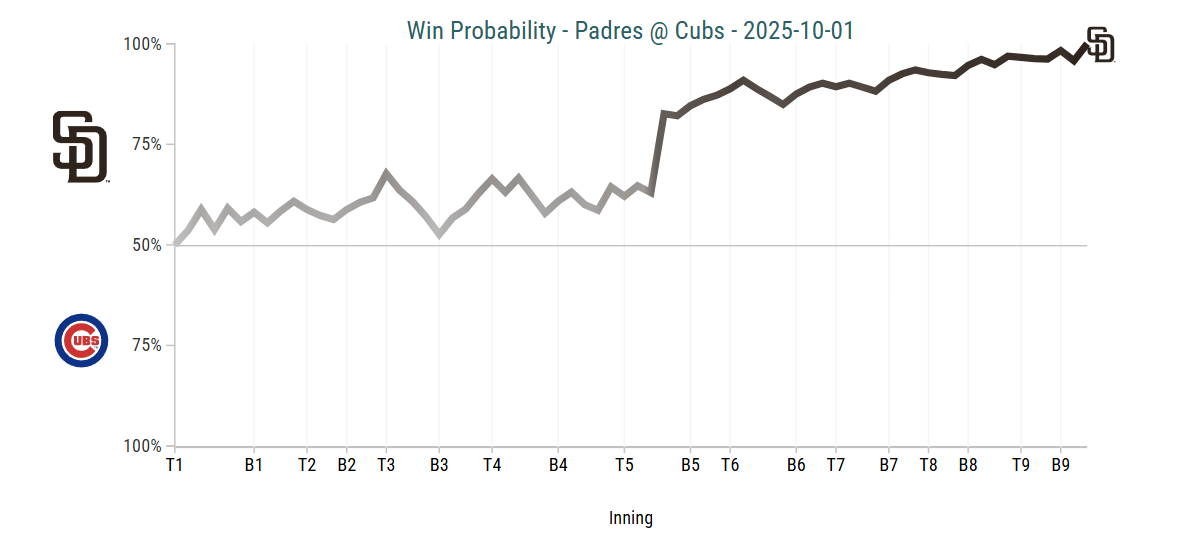
Baseball Savant’s win probability has the game 83/17 in favor of the Padres, so while the Cubs would never say this publicly, they know they’re going to more than likely lose this game. But, while they’re likely to lose the battle, with one win in hand, they can help themselves win the war by keeping the score within three from here on out. By keeping the game within three, the Padres will have to continue to exhaust their bullpen as they head toward Game 3. This job will fall to the Cubs’ bullpen’s underbelly; “designated losers”. This name may feel like I’m mocking them. but I’m not. I think the “designated loser” is one of the more underrated and least understood roles in a bullpen.
A “designated loser” has an important job; hold the opposition and keep the score close. By keeping the score close, you give your offense a chance to drag yourself back into the game. Every big comeback in major league history has had some form a “designated loser” holding the opposition close. You also force the other team to continue to use their best relievers if the game is close enough. This is their job today more than anything.
With 10 outs to go, the Cubs make the transition: they remove Caleb Thielbar, one of their most trusted arms, and insert fifth-starter Colin Rea. Rea was not on the Wild Card Roster to make a start; in a short three-game set, he’s here to eat outs if called upon. As the righty enters in the bottom of the sixth with two out already, he’s greeted to Freddy Fermin, a light-hitting catcher who sports a 77 wRC+. The Padres’ catcher puts forth little resistance and is put down without much worry. This was a soft landing, but life will get much more difficult in the the game as the inning ticks over to the seventh and the Padres get to roll their lineup over to the top. A bad seventh inning and the Padres could break the game open, tack on two or three insurance runs, and put the game well out of reach. Mike Schildt has been aggressive all series, but I don’t think he’d be so aggressive as to use Miller and Suarez in a six-run lead. Instead, he’d look to rest their bullpen a bit, a pure luxury in the postseason. A close game will force the assertive manager to use these players in a second straight game. How the Cubs’ pitchers react will play a roll tomorrow.
First to the plate comes Fernando Tatis Jr, who, despite a poor series, is a great hitter. The eccentric outfielder has a career wRC+ of 137, is having another fantastic year at the plate, and is always a threat to hit a home run or cause chaos on the bases. And yet, Rea takes just two pitches and ends any fear of what a leadoff runner would do, getting Tatis out to start.
Next, Luis Arraez was up. Not much to this one: as in classic Luis Arraez fashion, the professional hitter muscled an inside pitch to his pull side and successfully dropped the ball in front of Sieya Suzuki. The hit wasn’t so much the issue, but who was next: fifth-inning hero Manny Machado.
Machado has already terrorized Cubs pitching today, as he previously homered off of Shota Imanaga to open the game up from 1-0 to 3-0 with a single swing of the bat. Now, with a runner on again, he can really begin to put this game to bed. Rea gets ahead of the third baseman using a combination of fastballs and cutters, leading to a 1-2 count. If he hangs his pitch, it could be ugly. Instead, the Cubs’ pitcher executes a great slider off the plate, and gets out number two.
Rea isn’t entirely out of the woods, as Padres’ outfielder Jackson Merrill strides to the plate. Merrill crushes right-handed pitching, carrying a 135 wRC+ and 14 of his 16 home runs against them. The hitter is also feeling it, as he had a 160 wRC+ in September. This may be more dangerous than Manny Machado on paper. Rea is still just one pitch away from turning a three-run deficit into a five-run deficit, even after he got the last out. This wouldn’t really change the Cubs’ chances to win, as Savant now had the game with an 89% San Diego win probability, but would force the Padres to keep the A-team in on their end. In that regard, this is a huge plate appearance.
Danger is averted again, as Rea uses his cutter effectively, jamming Merrill a bit, forcing him to harmlessly fly out to Seiya Suzuki. A job well done, indeed.
In a perfect world, the Cubs’ offense would have added a run in the prior inning. While it would still be unlikely for the Cubs to pull out a win, it would give the Cubs’ bullpen a little wiggle room. Sadly, in the real world, the Padres brought in all-world reliever Mason Miller, and Miller quickly struck out all three batters he faced. The Cubs remain perceptibly close to falling further behind.
The top of the next frame starts with right-handed-hitting Xander Bogaerts leading off, whom the Cubs leave Rea into deal with. On an 0-1 pitch, the Cubs’ hurler gets a harmless flyout from the Padres’ shortstop. What seems like an entire parade’s worth of left-handed hitters await the Cubs, who quickly decide that Rea’s day was over, and outside of a single given to Arraez, the pitcher has done his job. Next up? Trade deadline acquisition and, importantly, left-handed reliever, Taylor Rogers. Another pitcher in the “designated loser” portion of the Cubs’ playoff pecking order.
With left-handed hitters Ryan O’Hearn, Gavin Sheets and Jake Cronenworth due up, the Cubs decide to play the numbers and go with Rogers. The Cubs’ lefty has been much better against LHH, with a 3.81 xFIP and far better strikeout numbers than against righties. The deadline acquisition gets O’Hearn to ground out, at which point Mike Schildt throws a wrench into the equation, pinch-hitting Bryce Johnson (who has a 105 wRC+ in roughly 30 PA’s against LHP in 2025) for Gavin Sheets (89 wRC+ against LHP). Rogers has surrendered seven home runs on the year, four of them to right-handed hitters. That 3.81 xFIP against LHH jumps to 4.54 against the opposite platoon. As has been the state since Colin Rea entered the game, one bad pitch and the the lead will grow to a near-insurmountable margin.
New hitter? No sweat, apparently, as the Cubs’ pitcher navigates the switch well, getting Johnson to fly out to Pete Crow-Armstrong. The score remains 3-0.
The eighth inning is much like the seventh in that the Cubs still cannot push across any offense, but an important development occurs: Robert Suarez entered the game to record the final out. Suarez is a heck of an arm, and was unused in Game 1. The Padres are now fairly committed to Suarez pitching the ninth; as long as the Cubs’ bullpen doesn’t implode, it’s likely now that even in a four-run game, Suarez is handling the final frame. Rogers comes back out to face left-handed hitter Jake Cronenworth, whom he deals with quickly, and then Michael Soroka finishes he top of the ninth, getting both of the aforementioned Padres’ hitters, Fermin and Tatis, to ground out to finish the job. Ten outs, one hit, one strikeout, and most importantly, no runs.
As the Cubs’ last out on offense was recorded, the scoreboard still read Padres: 3, Cubs: 0. Fans walked out of Wrigley watching a loss. People were miffed that the Cubs couldn’t get to Dylan Cease, or in awe of how good Mason Miller was. There were nerves about the winner-takes-all Game 3 on deck. What they may not have realized, though, is that the Cubs’ “designated losers” had just laid groundwork for later.
Game 3 would end in a win for the Cubs. One of the most important moments was when Cubs’ first baseman Michael Busch hit a rocket off of Padres’ closer Robert Suarez in the bottom of the seventh inning. The pitch Busch hit is notable for a few reasons. First, it was the 47th pitch Suarez had thrown in around a 24-hour period. Next, it was only 97.6mph, This is notable because the slowest fastball Suarez threw the night before was 98.1mph, a pitch he averaged 98.6mph on the full year. Lastly, the location: center cut. On the night, Suarez has only thrown 42% of his pitches in the zone, down from 56% the day before. This was as “get-me-over” of a fastball as you’d get from Suarez, and Busch hit it 400 feet.
This is what the Art of Losing looks like. It’s not really very pretty; I outlined a single strikeout over 10 outs. It came in a three-run loss in which the offense did next-to-nothing. Colin Rea, Taylor Rogers and Michael Soroka didn’t wow anyone with overwhelming stuff, and they didn’t will the team back to a win; they just did their job. They did yeoman’s work. There was no standing ovation as Michael Soroka induced a second ground ball in the ninth, but instead a crowd full of nervous energy and a bit of feeling “here we go again”, despite the job that they had done. They didn’t steal the show, but they lost with purpose and forced the Padres’ hand.
I can’t promise that the exact reason Suarez’s fastball got smashed by Busch was because of our unsung heroes, the “designated losers”, but I can’t believe that it didn’t in some way play into it. And while it wasn’t a game-winner, getting the lead up to three just felt good. It’s the kind of moment that changed the energy at 1600 W. Addison and around the team as they head into Milwaukee.
So, ultimately, while the “designated losers” may not be the obvious heroes who win games (in fact, it’s in this nature that they will almost never be capable of that), it’s these little moments they handle with aplomb that can pay dividends for others. They’re the glue that allows for a historic comeback, and can sometimes effects games in the future for simply losing well. They’re easily forgotten, but today, we should probably all say a big “thank you” to our misunderstood, and often overlooked, “designated losers”.
What do you think caused Robert Saurez’s fastball to land 400 feet away? Do you think the “designated loser” is an important role? Let us know in the comment section below!