
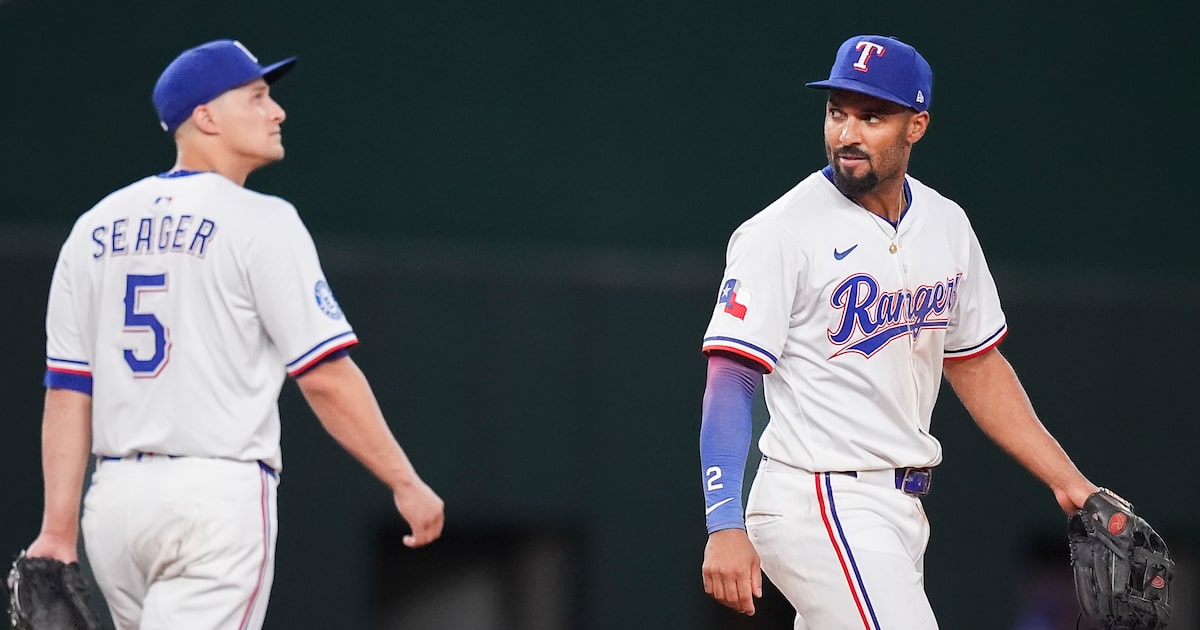
While the Rangers prepare to introduce Skip Schumaker as their next manager some time in the coming days, all week, we’ll glance around the roster at what happened, what solutions might be on hand and what questions might need to be answered. There are a lot. We’ll even grade it all out for the new skipper because we are always here to help.
Today will move on to the riddle wrapped inside and enigma: The infield. There is a lot of talent there. But there are a lot of questions, too, complicated even more by the uncertainty over the Rangers’ financial resources for 2026.
So with that: The Rangers’ infield.
Primary cast: 1B Jake Burger, 2B Marcus Semien, SS Corey Seager, 3B Josh Jung, UTL Josh Smith, UTL Ezequiel Duran, 1B Rowdy Tellez, UTL Cody Freeman
Rangers
What went right: According to Baseball-Reference’s Wins Above Average measurement, the Rangers infield had the fourth highest number in the majors behind only the Cubs, Dodgers and New York Mets. Much of that was due to defense. On the way to an MLB record for team fielding percentage, Rangers infielders were charged with only 29 errors and were responsible for 21 Defensive Runs Saved.
What went wrong: The Rangers traded for Jake Burger and jettisoned Nathaniel Lowe to give them more slugging ability against fastballs. It didn’t happen. An aggressive hitter by nature, Burger got too antsy at the plate, perhaps in an effort to justify the Rangers’ decision to add him. And every time he started to dig out of a hole, he seemed to run into another injury. Over four seasons before joining the Rangers, he had a .789 OPS; with the Rangers it fell to .687. His .269 OBP was the sixth-lowest in the majors among hitters with at least 300 plate appearances.
It didn’t end there. On the other corner, the Rangers finally got what they most wanted for Josh Jung: Full health. They got it, but it wasn’t pretty. Across every compartment of his slash line, Jung slid, ending with a .684 OPS marked by too much chase and a low walk rate. Along the way, the Rangers sent him to the minors for a brief spell.
What needs answering: If the Rangers need to significantly trim payroll, it’s going to be impossible not to consider breaking up the Marcus Semien-Corey Seager duo. The Rangers owe the two of them $57.5 million for 2026. Seager, owed $32.5 million and under contract through 2030, missed 60 games due to injury and, on average, has missed 40 games a season in his four years with the Rangers. He’s had a problem staying on the field. Semien, owed $25 million in 2026 and signed through 2028, has a .686 OPS over the last two seasons. It ranks 113th of 123 qualifiers in the majors. To move him at age 35 would likely require the Rangers to significantly buy down the remainder of the contract, which wouldn’t yield a ton of savings.
One number says it all: .578 – Josh Smith’s second half OPS over the last two years when he’s essentially been an everyday player. It suggests that he can’t hold up to the wear and tear of everyday play all year long, which should give the Rangers a long pause about any thoughts they’d move on from one of their starters and insult Smith there. Smith is a championship-level utility player, but might need to have playing time capped somewhere between 350-450 plate appearances.
Prospects: The Rangers best prospect – and ranked among the top five in baseball – is infielder Sebastian Walcott. If the Rangers do make any changes to the personnel in the infield, it might be tempting to think about promoting Walcott. But he doesn’t turn 20 until March and while he held his own at Double-A Frisco in 2025, he probably won’t be ready to be an everyday starter by opening day. Rushing him isn’t the answer. Though, if they do make changes, maybe Walcott could be a factor by mid-season.
Also, Cody Freeman is not a top prospect in terms of baseball skills, but there is no question he’s a “winning player.” He may only have a role as a utility player, but he should have a role.
After that, though, the system is thin.
Summary: Maybe this is why we shouldn’t believe every stat at face value. Despite the Baseball-Reference calculation, it’s hard to consider this group’s performance as above average. The defense was great; the offense was mostly dreadful. There are a lot of questions to tackle here financially, considering the contracts of Semien and Seager and the pending arbitration eligibility of Burger, Jung, Smith and Ezequiel Duran (who managed not to homer in 219 plate appearances).
Grade: C – There is a lot of talent here, but it under-performed. It’s expensive and about to get moreso. If the Rangers are going to overhaul the roster, it probably starts in some fashion here.
Texas Rangers won’t retain longtime coach Bobby Wilson as Skip Schumaker era beginsIn Skip Schumaker, Rangers have manager who fits shift in offensive approach Texas needs
Find more Rangers coverage from The Dallas Morning News here.
Click or tap here to sign up for our Rangers newsletter.