
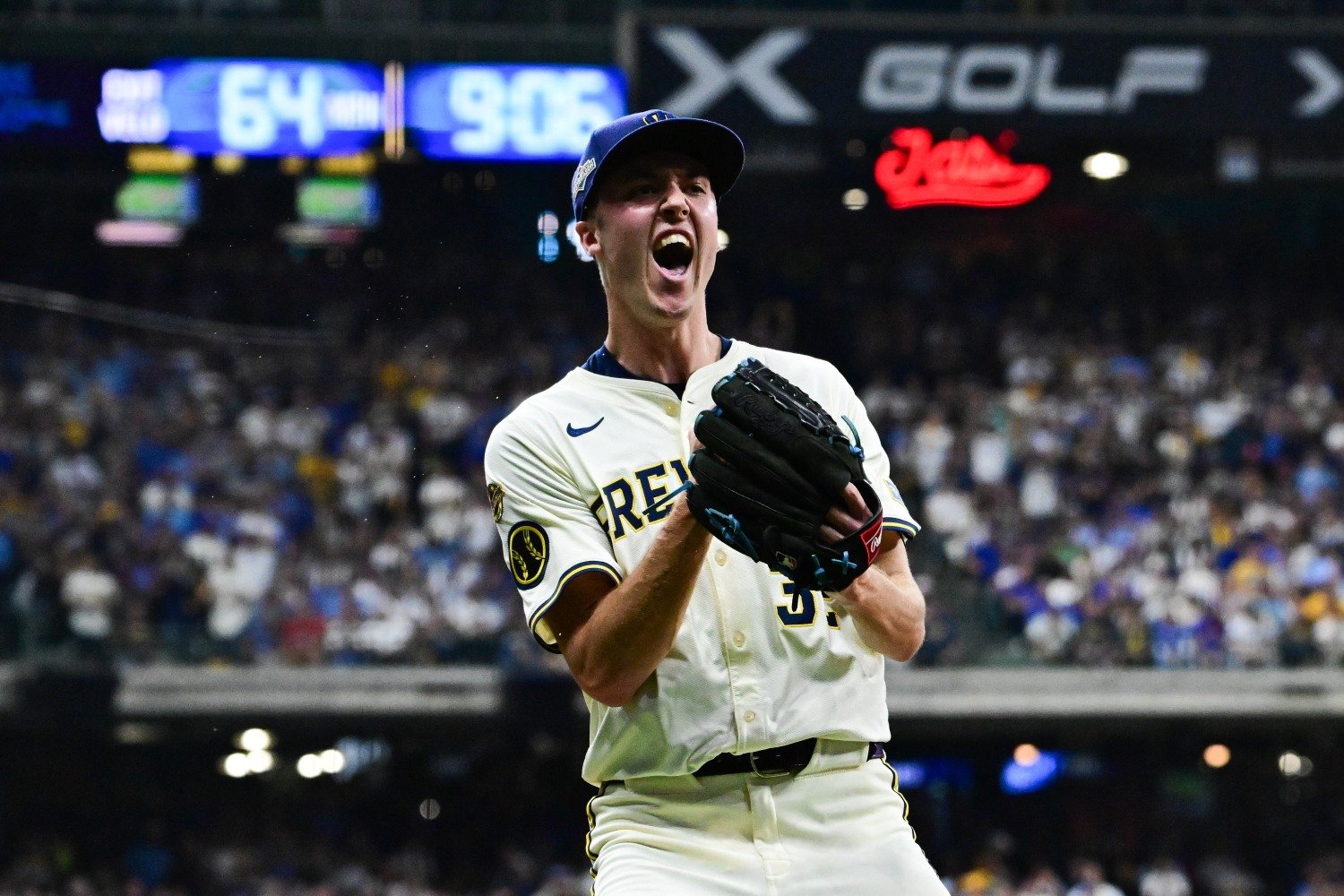
Jacob Misiorowski threw fewer than half of his pitches on Monday night in the strike zone, including just over a third of them in his first inning. He issued two walks. He wasn’t particularly efficient.
It didn’t matter. He made enough competitive pitches, and the outcomes of those pitches mattered most. Misiorowski induced 20 swings. Eight were swings and misses, six were foul balls, and the remaining six were balls in play—with an average exit velocity of 83.3 mph. In other words, he overpowered the Cubs, who never came especially close to barreling up his stuff during his three scoreless innings.
It demonstrated why the Brewers included Misiorowski on their NLDS roster over fellow multi-inning relievers Tobias Myers and DL Hall, both of whom enjoyed more surface-level success and have previous playoff experience. Myers pitched to a 1.91 ERA out of the bullpen in the regular season, but struck out just 18.2% of opponents in that role. Hall posted a 3.49 ERA and excelled at missing barrels, but he benefited from an unsustainably low .202 BABIP to overcome poor strikeout (17.4%) and walk (11.0%) rates.
Misiorowski, meanwhile, limped to an unsightly 6.06 ERA over his final eight appearances, but he was closer to his more dominant form than the results indicated. His stuff was still playing well in the strike zone. Whereas Myers and Hall don’t blow anyone away, Misiorowski’s electric right arm is matchup-proof, and can dismantle even the best hitters. That matters in the playoffs, where having swing-and-miss bullpen arms becomes even more critical.
“I think he will help us,” Murphy said at the onset of the series. “He’s not going to start, but he’ll come in the game. He’s got great stuff, and I think he’ll hone it in and pitch well.”
The Brewers were right, and the payoff for their belief came quickly. Misiorowski delivered precisely the outing they needed in what Murphy previewed as an “all-hands-on-deck” pitching effort for Game 2.
Over the weekend, the club was coy on its plans behind Aaron Ashby, whom it tabbed as a short-range starter to neutralize the best left-handed bats in the top half of the Chicago order. Afterward, though, Murphy revealed that the intention was for Misiorowski to play a role.
“We were thinking somewhere between 30 and 50 pitches, and we were thinking that he’d let us know when he was gassed,” Murphy said. “He was very emotional, and you guys know what he’s been through, but he responded. I think that’s a really good sign.”
Postseason adrenaline seemed to unlock an extra tick of velocity for the flamethrowing rookie. His signature fastball averaged 101.5 mph, up from his regular-season average of 99.3. Only four of the 35 heaters he threw clocked in below triple digits. He hit 104.2 and 104.3 with his third and fourth pitches of the night.
“In the postseason, the atmosphere, coming out of the bullpen, and all the energy he brings—I probably could have told you he was going to throw 104 today,” Ashby said.
“When he was warming up, actually, I was talking to our infielders and I go, ‘He’s going to throw 104 right here,’ and he did,” Andrew Vaughn said. “So it was kind of funny.”
“There was so much adrenaline, and I wasn’t really feeling anything,” Misiorowski said. “I was just kind of doing it.”
The main difference between the two versions of Misiorowski has been his response when things start to go sideways. On Monday, he bent in each inning, but did not break. He issued a one-out walk to Seiya Suzuki in the third, during a stretch of six straight balls thrown, but he came back from a 2-0 count to strike out Ian Happ and coaxed a groundout to the mound from Carson Kelly. He also rebounded from a two-out walk in the fourth and retired three hitters in order after a leadoff single in the fifth.
“You guys get all enthralled with MPH,” Murphy said. “I’m enthralled that he wasn’t giving up free bases, kept his composure with runners on, that type of thing.”
“Proud of him, for sure,” Ashby said. “Like every pitcher in this game, you go through ups and downs. Guys make adjustments. He made an adjustment today, and he executed really well.”
If the Brewers make a deep postseason run, it will not be the last time they task Misiorowski with recording key outs. It may not always look smooth, but in this role, it doesn’t need to. When he makes enough competitive pitches, his rare combination of raw stuff and deception is a nightmare for any hitter. He may be an all-or-nothing wild card, but you can’t benefit from the all if you’re unwilling to risk getting the nothing.