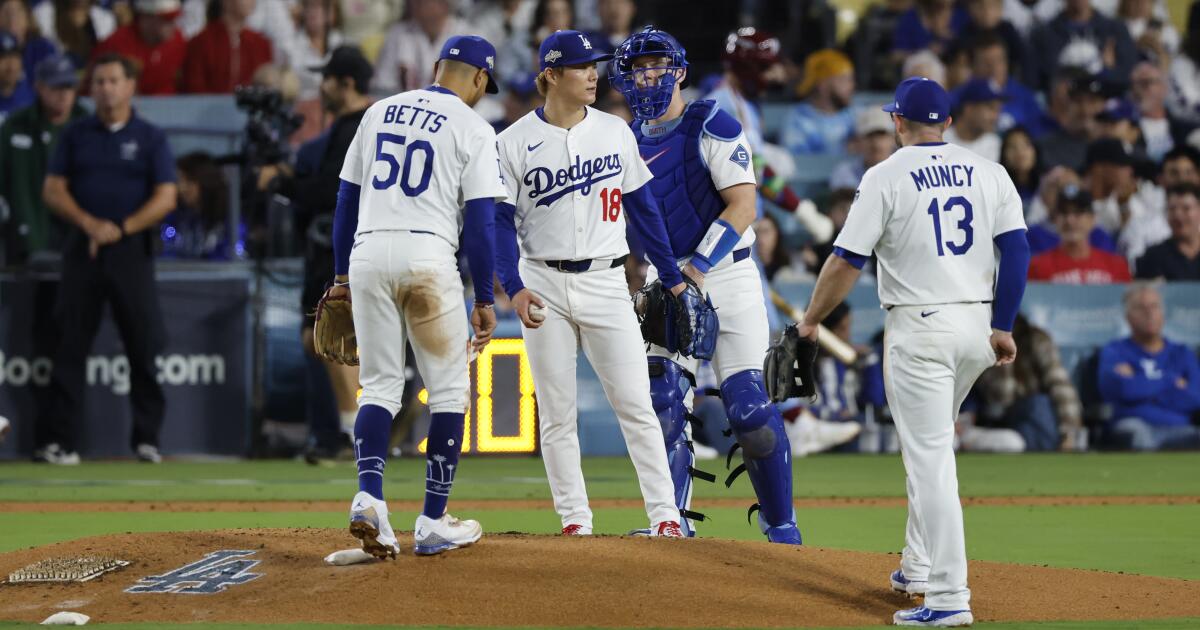
The Phillies seemed rattled. The Dodgers looked confident. And the Chavez Ravine crowd was excitedly smelling blood.
Early in Game 3 of the National League Division Series on Wednesday, the Dodgers had all the momentum. They’d already taken each of the first two games of this best-of-five set in Philadelphia. Their best pitcher this season, Yoshinobu Yamamoto, had started his night with three scoreless innings. The Phillies, most of all, appeared to be pressing, with Trea Turner leading the game off with a curious bunt and Brandon Marsh misplaying a ball in the bottom of the first with an over-aggressive dive that gifted Mookie Betts a triple.
Then, after a questionable pitching change from Phillies manager Rob Thomson in the bottom of the third, Tommy Edman greeted newly inserted left-hander Ranger Suárez with a leadoff home run to open the scoring.
As Edman rounded the bases, and Dodger Stadium erupted around him, the Dodgers looked well on their way to an NL Championship Series berth.
In postseason baseball, however, momentum can be a fickle thing. Every new inning brings the potential for a plot twist. Every at-bat carries the threat of a turning point. And every single pitch can prove to be the difference.
“You never know in the playoffs,” Kiké Hernández said before the game, “which pitch is going to win you a game.”
On Wednesday, in the Phillies’ come-from-behind, elimination-staving 8-2 victory, the pitch that swung the Dodgers’ loss came with no outs in the fourth.

Just moments after Edman had put the Dodgers in front, slumping Phillies slugger Kyle Schwarber answered with a statement — clobbering an elevated Yamamoto fastball for a staggering 455-foot home run that went bouncing off the roof of the right-field pavilion.
“It’s ridiculous how far that ball went,” Turner said.
“[It] just sort of woke everybody up and got a lot of energy going in the dugout,” Thomson added.
With one titanic swing, Schwarber had given the flat-lining Phillies a breath of new life.
And with the score tied 1-1, their previously dormant offense quickly opened the floodgates.
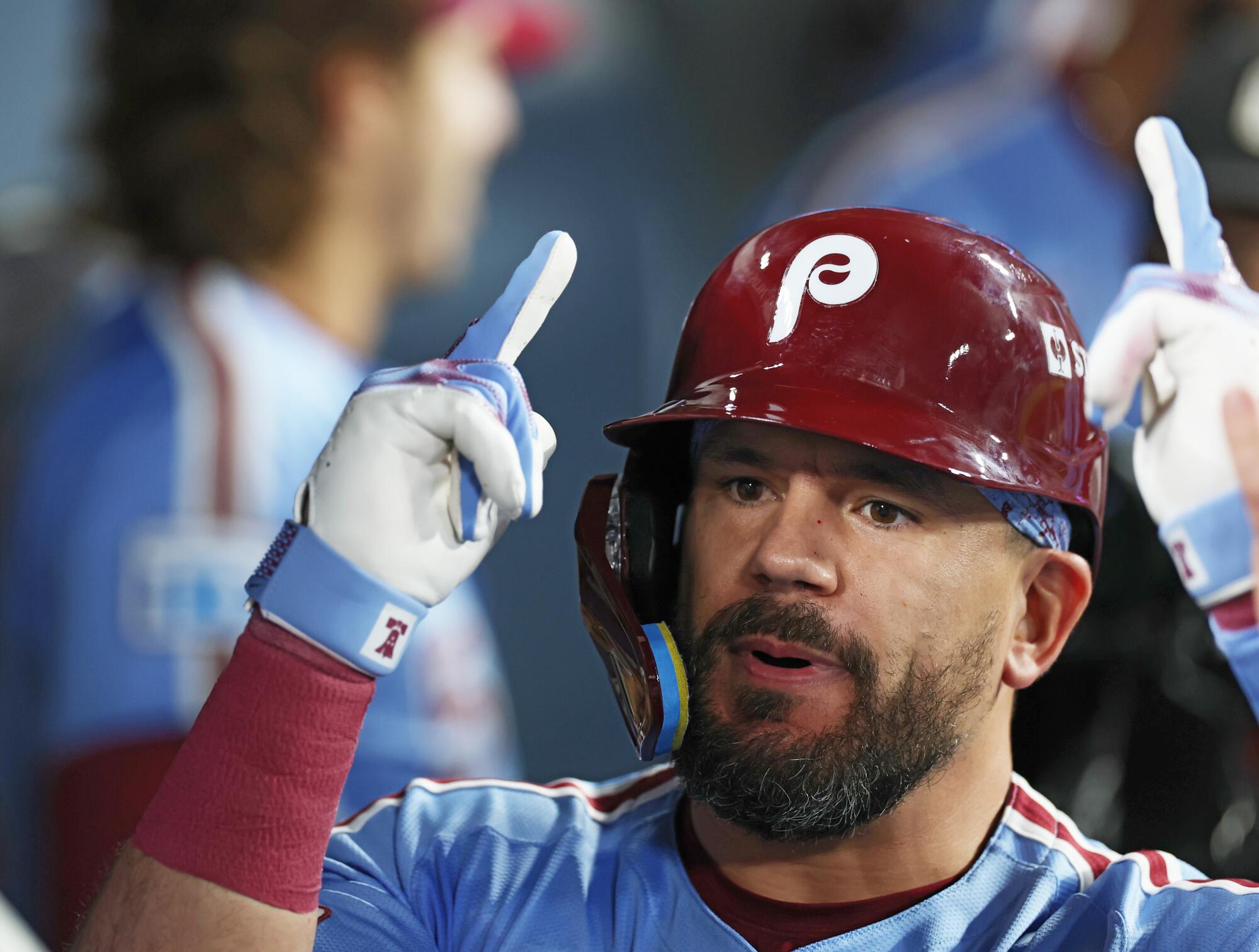
Philadelphia slugger Kyle Schwarber celebrates after hitting a home run in the fourth inning against the Dodgers in Game 3 of the NLDS on Wednesday night.
(Robert Gauthier / Los Angeles Times)
The Phillies scored twice more off Yamamoto in the fourth, then ambushed Clayton Kershaw in a five-run eighth inning that put the game away.
The Dodgers, meanwhile, could never mount a response offensively, failing to even get Phillies closer Jhoan Durán into the game.
Now, the dynamics of this series have shifted, with the Phillies — who will start their ace, Cristopher Sánchez, in Game 4 on Thursday — needing just one more win to get the NLDS back to home soil for a decisive Game 5.
“Obviously there’s still a lot of pressure on us, but pressure is a privilege,” Betts said. “We’re going to do what we always do. Tomorrow is a new day.”
Wednesday was certainly a new kind of day in the context of this series, serving as a complete reversal from Games 1 and 2.
For the first time in the matchup, the Phillies’ star hitters outshone their Dodger counterparts.
Schwarber’s game-altering blast was his first hit of the series (snapping an 0-for-9 skid), and his first of two home runs on the night. Turner tripled his NLDS hit total in a three-for-five, two-RBI showing. Bryce Harper also reached base twice while drawing a walk.
Ohtani, meanwhile, went hitless in five at-bats to fall to one for 14 in the series with seven strikeouts. And while Betts had two hits, including his first-inning triple, the duo behind him couldn’t take advantage, with Teoscar Hernández and Freddie Freeman going a combined 0 for 7.
“We definitely had a chance and we didn’t capitalize on it,” said third baseman Max Muncy, who had two hits but also rolled into a double play that ended one of the Dodgers’ best threats in the sixth inning. “That was kind of the story of the night — we had a lot of chances, and we didn’t get the big hit to come through.”
In an unexpected development, the Phillies’ pitching plan also proved to be better; silencing the pregame criticisms of their decision to start Aaron Nola (who had a career-worst 6.01 ERA this season) and use Suárez in relief.
Nola pitched two scoreless innings, striking out Hernández and Will Smith (who made his first start of the playoffs after recovering from a hand fracture) to strand Betts at third in the bottom of the first.
And though Suárez’s night started with the home run by Edman (the switch-hitter who was able to flip to his stronger right-handed side with the southpaw on the mound), he settled down for 15 scoreless outs after that, working around four more hits and a walk to get through the seventh.
Yamamoto, on the other hand, lost control following Schwarber’s mammoth home run to lead off the fourth — which came in a 2-and-0 count that forced Yamamoto to throw a fastball over the plate.
“My plan was to stay away, outside, but I fell behind,” Yamamoto, who lacked feel for his secondary pitches Wednesday, said through interpreter Yoshihiro Sonoda. “So I went in a little bit, and then I paid the price.”
Harper immediately followed with a single on a hanging splitter. Alec Bohm did the same on an inside sinker, sending a grounder up the middle that got through the infield. Andy Pages fielded the ball in center, but short-hopped his throw to third base in an effort to gun down Harper. When Muncy couldn’t block it, the ball bounced into the dugout to allow Harper to score and Bohm to advance to third. Marsh added insult to injury with a sacrifice fly in the next at-bat.
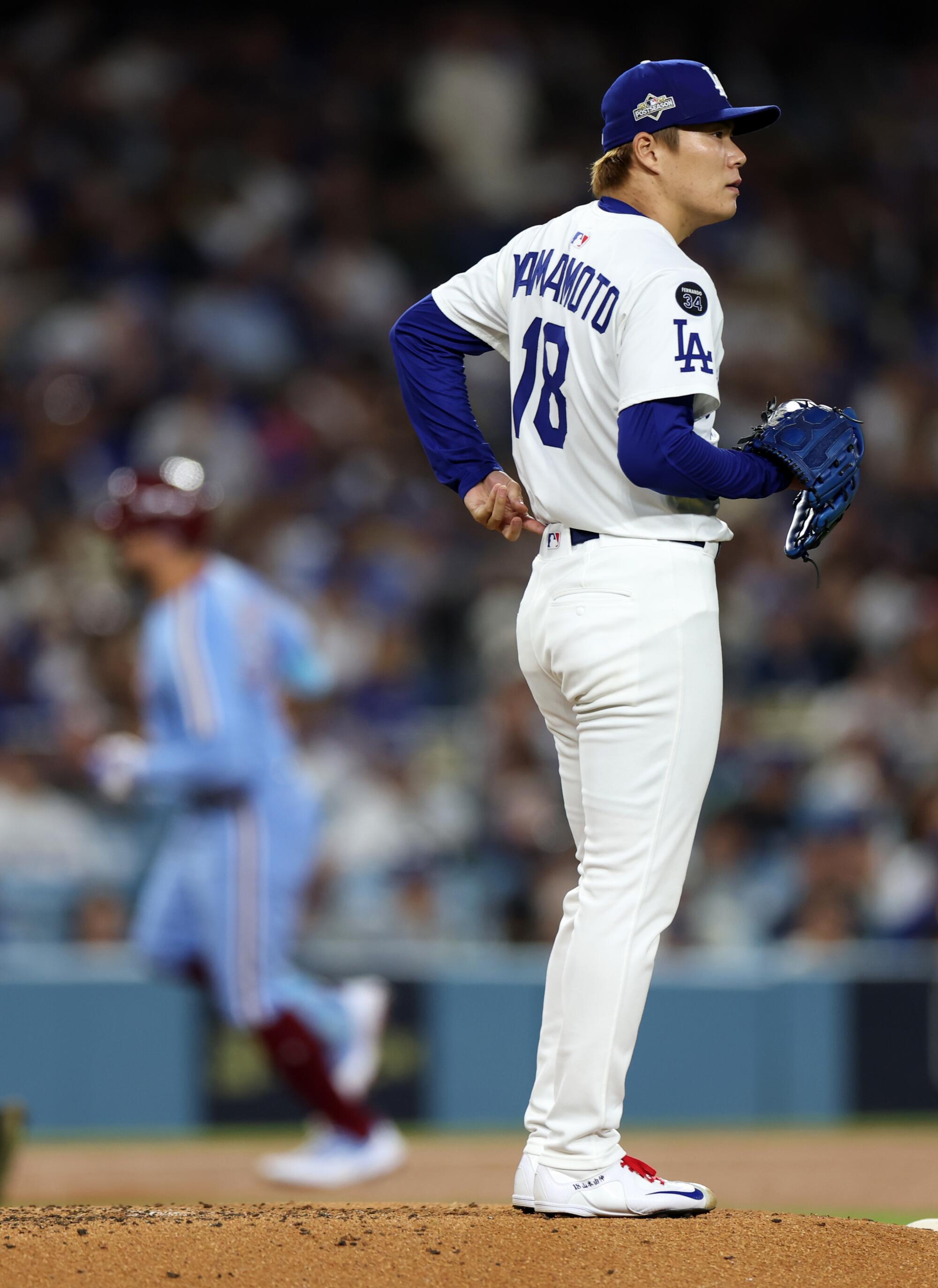
Dodgers starting pitcher Yoshinobu Yamamoto stands on the mound after giving up a home run to Kyle Schwarber in the fourth inning.
(Robert Gauthier / Los Angeles Times)
Things didn’t get much better for Yamamoto from there. He gave up a double to J.T. Realmuto later in the fourth. Back-to-back singles to begin the fifth chased him from the game.
Yamamoto’s final line: Four-plus innings, three runs, six hits, one walk and only two strikeouts. It was the shortest start from the Dodgers’ rotation this postseason, tied Ohtani’s Game 1 outing in this series for the unit’s most runs allowed, and was Yamamoto’s first time with more hits allowed than strikeouts since July 7.
“If I could have minimized the damage in that [fourth] inning,” Yamamoto said, ”I think maybe the result might have been a little bit different.”
Instead, the Dodgers’ slim hopes of a comeback were dashed with Kershaw on the mound in the eighth.
Making his first appearance of the postseason, Kershaw had skirted trouble in the seventh before being sent back out for a second inning of work (in part because the Dodgers were without left-hander Tanner Scott, who was not at the ballpark Wednesday because of a personal situation, Roberts said).
Hoping to keep the game close, and force the Phillies to use the warming Durán for a six-out save, Kershaw was instead pummeled, giving up a leadoff home run to Realmuto, a two-run single to Turner and another two-run homer to Schwarber that bounced off the top of the right-field wall.
With that, a crowd that was anticipating a sweep in the early innings of Wednesday’s game somberly filed to the exits — trudging toward Game 4 with the Dodgers still leading this series, but knowing all their momentum had suddenly evaporated.
“Going into tomorrow, we want to keep pressure on any way possible,” Schwarber said. “Go out there, play great defense, take great at-bats, [play] 27 outs, and go from there.”