
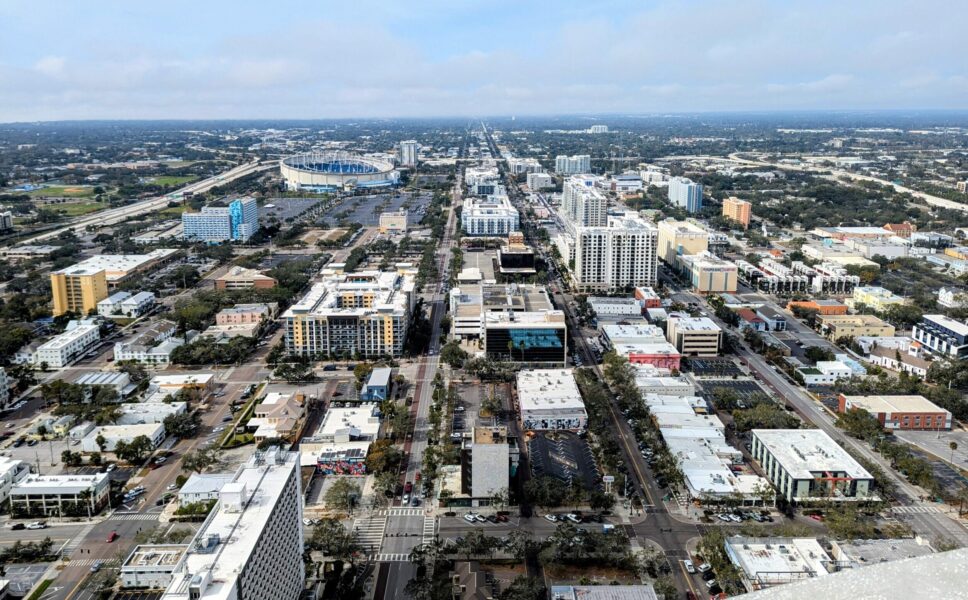
St. Petersburg extended a financing district’s lifespan to help fund a massive redevelopment project anchored by a new Tampa Bay Rays stadium. Some officials would like a mulligan.
A City Council committee agreed Thursday to begin exploring the Intown Community Redevelopment Area’s (CRA) early termination. In June 2024, council members voted 5-3 to extend it a decade, until 2042, and increase its budget from an estimated $232.35 million to $574.85 million.
Councilmember Richie Floyd has led efforts to undo the extension since former Rays owner Stuart Sternberg exited the Historic Gas Plant District’s redevelopment deal in March. He, his colleagues and administrators did not address a new proposal and team ownership group, which is aggressively seeking a new stadium, at Thursday’s meeting.
“Just rolling it back to 2032 is already a compromise, because I have some real moral qualms with it existing anymore – like past today,” Floyd said. “So, I would like to see us move something forward.”
Local governments establish CRAs to revitalize blighted areas by diverting property tax increases within the district to redevelopment and infrastructure projects. The money would otherwise go toward citywide expenses.
The Intown CRA, established in 1982, runs east from Tropicana Field to the St. Pete Pier. Floyd has called it a “large subsidy for downtown” that “locks tons of wealth” into a now-thriving area.
No one spoke in opposition to unraveling the extension Thursday. City Administrator Rob Gerdes said the mayor’s office is “generally comfortable with rolling it back,” although he also suggested ending it in 2034.
“I think this is a very simple conversation at this point,” said Councilmember Brandi Gabbard. “It’s a prioritization of funding that is being held hostage in one area. We are going to need additional funding to meet the needs of residents citywide.
“It made sense at the time for that specific project. I don’t believe it makes sense anymore.”
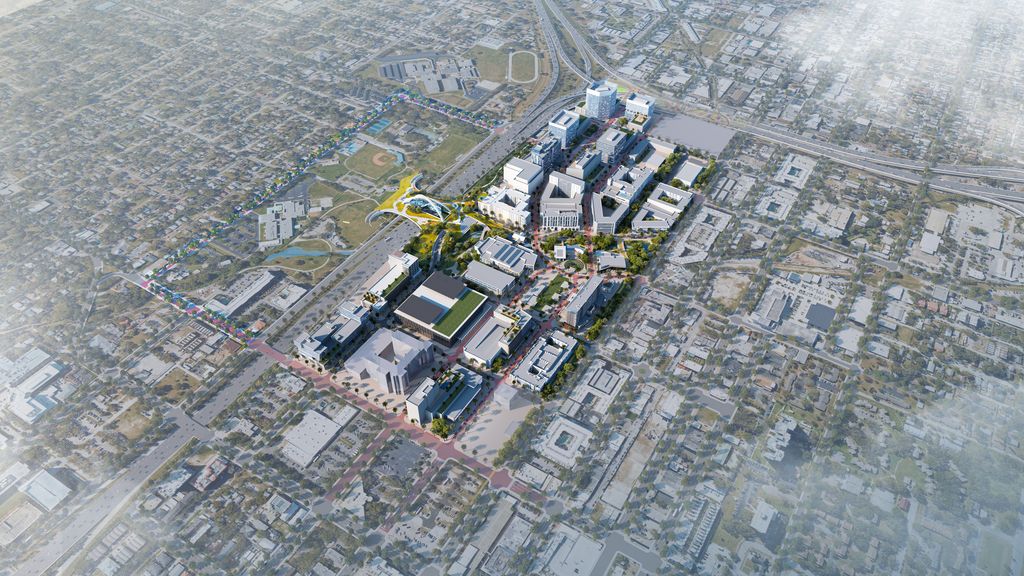
Mayor Ken Welch is now reviewing a new proposal to reimagine the area around Tropicana Field. Rendering provided.
City officials agreed to contribute $212.5 million to a new Rays stadium. They also planned to complete $130 million in infrastructure upgrades.
Intown CRA coffers will collect an estimated $223.2 million by 2032. That number soars to $515.6 million in 2042.
While previous plans to redevelop the Gas Plant and Trop site have withered, Welch is now reviewing a new $6.8 billion proposal “in detail.” Some version of the generational project “remains a top priority of my administration,” he said Oct. 3.
Ark Ellison Horus expects infrastructure costs to total $239 million, according to the proposal. The development team plans to use tax increment financing (TIF) funding provided by the Intown CRA to help foot the bill.
The Rays will also ask the City of Tampa or St. Petersburg to help pay for a new ballpark surrounded by a massive mixed-use development. Controlling owner Patrick Zalupski made that clear Tuesday.
“I think it’s critical to have a public-private partnership,” Zalupski said. “There’s so many nuances to how a deal could come together. We’re confident that Tampa Bay wants to see us be successful. Everybody wants to deliver a championship team, and so this is going to be critical in doing that.”
Welch, in a prepared statement sent Thursday, said he had a “productive introductory meeting” with Zalupski’s group following Tuesday’s press conference. He anticipates “ongoing conversations about the future of Major League Baseball in St. Petersburg.”
However, officials refrained from discussing the Gas Plant or Rays during the committee meeting, despite both previously leading to the Intown CRA’s extension.
“I was very hesitant to do this,” said Council Chair Copley Gerdes. “More and more, I’m becoming open to it.”
Gerdes and Councilmember Gina Driscoll stressed the importance of reviewing an updated downtown project list with administrators before agreeing to a termination date. Pinellas County commissioners, who previously voted to exit the joint initiative and start spending their share elsewhere in 2032, must also approve another change.
“I do see Council Chair Gerdes’ point that we want the project list to match the anticipated funding, so that it all evens out,” Driscoll said. “And something isn’t left out.”
Councilmember Lisset Hanewicz called it “mind-boggling” to continue the CRA after 2032, “because it’s your money.” She said city officials could decide if downtown property taxes fund specific projects or citywide initiatives.
“From a financing perspective, it is much cleaner to show a transfer from a TIF district to pay debt service than using the core general fund,” replied Assistant City Administrator Tom Greene.
Floyd noted that keeping the extension would, essentially, allow the city to allocate funding for a future project. “But I don’t think we should do that,” he said.
Floyd motioned for administrators to begin discussing the change with their county counterparts “to shorten the length of the interlocal agreement’s existence.” His request passed unanimously.