
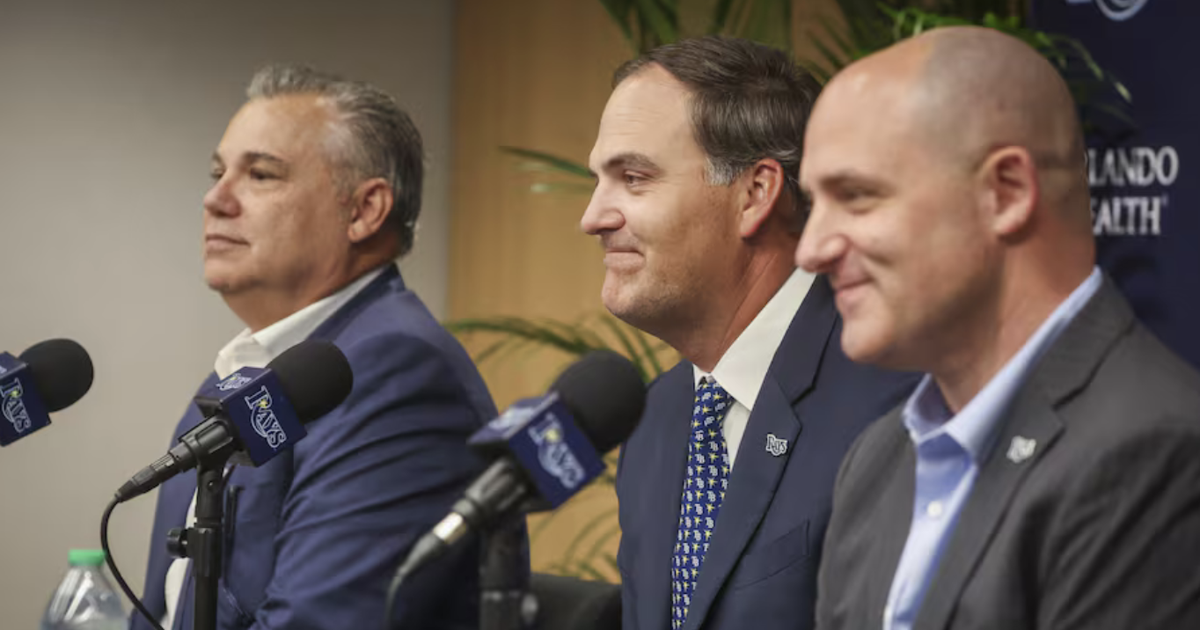
TAMPA — The first 30 minutes went well. The next 30 years will be trickier.
Yes, the new owners of the Rays made a positive first impression on Tampa Bay at an Oct. 7 news conference. They were affable, self-deprecating and seemed sincere. They said all the right things about being stewards of a community asset and vowed to solve the stadium problem that has cursed the market for decades.
There were no missteps, but there was also very little in the way of details.
And that speaks to the challenge that lies ahead.
It’s not just a matter of firing up the bulldozers after agreeing to a 30-year mortgage. This is a multilayered riddle that needs to be solved in the next few months if the Rays intend to be in a new ballpark by 2029, as was suggested on Tuesday.
They said the stadium process begins today, but I’ve got to believe that was a small fib. With a timetable this aggressive, managing partner Patrick Zalupski and his crew surely have a favored site already in mind.
And early indications are they might be focused on the Hillsborough College campus across from Raymond James Stadium.
It checks off many of the necessary boxes. The campus is 108 acres with the possibility of added land that could boost it closer to 125 for the mixed-use component that Zalupski suggested would be necessary for MLB to succeed here.
It’s in a favorable location that already has infrastructure in place for an NFL stadium and the Yankees spring training facility. It’s a state-owned facility, which means Zalupski might be able to leverage a relationship with Gov. Ron DeSantis to ease the land acquisition.
Slam dunk, right?
Except for all of those missing details.
• There would need to be a plan in place for the displaced campus. It’s entirely possible Hillsborough College could keep some sort of footprint on the site — perhaps keeping some of the newer structures and adding more space by building vertically — with hotels, businesses and restaurants going up around a smaller version of the campus.
• It’s likely they would need some type of approval from the state Legislature for either the land or infrastructure costs, which makes it convenient that former House Speaker Will Weatherford is now part of the ownership group.
• There might be some resistance from the Bucs, who will be seeking public funds for renovation plans of their own that involve the possibility of a mixed-use development either north or south of Raymond James Stadium. Maybe the Bucs would see a baseball stadium as complementary, or maybe they’ll view it as competition. Long ago, the Bucs nixed the idea of building an arena for the Lightning on Tampa Sports Authority land on Dale Mabry Highway, and so Benchmark International Arena ended up in downtown.
• Keeping a positive relationship with St. Petersburg officials could also be critical if a new stadium is not built in time. In that case, the Rays would need to talk St. Pete into extending the lease at Tropicana Field, even as the city moves forward with its own redevelopment plans.
• And then there’s the biggest hurdle of all — who pays for stadium construction?
Hillsborough County Commissioner Joshua Wostal said he has not yet spoken to anyone from the new ownership group but has heard from others that the Rays are seeking $1.1 billion in public subsidies. The stadium deal that previous owner Stuart Sternberg walked away from in St. Petersburg this spring included $600 million in contributions from the city and Pinellas County, as well as another $150 million or so in infrastructure, with the Rays paying $700 million.
“I pray for the new owner’s success, just like I do anybody’s success,” Wostal said Tuesday. “But I am adamantly opposed to poor people subsidizing the stadiums of millionaires and billionaires. There is simply no quantifiable justification.”
Zalupski avoided a direct question about the possibility of splitting ballpark costs, but his explanation of a public-private partnership sounds as if the Rays are banking on public funds. There are various ways a public contribution could be configured, but Mayor Jane Castor made it clear money would not come from the city’s budget.
“What we’ve said is that we’re not going to spend tax dollars on building a sports facility,” Castor said. “We put in an offer — Hillsborough County, the city of Tampa, the Sports Authority — (to the Rays) a couple of years ago. Well, actually, we put in several plans. We’re going to be right in there working with the new owners to see if Tampa is the best place for the Tampa Bay Rays.”
The Rays first began looking at the possibility of building in Tampa in 2016 and, over the years, had various plans in and around Ybor City and the outskirts of downtown Tampa. Zalupski’s desire for 100 acres of mixed-use development likely rules out Ybor and downtown, but some of the funding mechanisms could be revised.
When Hillsborough officials first talked to the Rays in the 2016-18 negotiations, the plan was to provide less up-front money for stadium construction than Pinellas was offering but that special taxing districts in a mixed-used development would potentially mean more money for the Rays in the long run. That type of funding would give cover to politicians, because it would involve new funds that would not have existed without the development around the stadium.
Hillsborough County Chair Ken Hagan said he was confident a creative deal could be made and said he was impressed by early impressions of the new group.
“I’m extremely encouraged,” Hagan said. “They are demonstrating a distinctively different approach and mindset from their predecessor. Their transparency and sense of urgency certainly jump out. And there’s also some smaller things. They’ve already engaged a lobbying firm to help. (CEO) Ken Babby has already moved here.”
Introductory news conferences are typically upbeat affairs, and Zalupski’s group did not disappoint on Tuesday.
“Our focus has always been to make baseball a fun and unforgettable experience, accessible, affordable, creating lifelong memories for families, for friends, to take moments away from life’s busy paces,” Babby said of his previous experiences as an owner of minor-league teams in Akron and Jacksonville.
“Baseball provides the perfect platform in life to do that. It’s exactly why we’re here. We will create a world-class fan experience here in Tampa Bay for our fans, and we will do it one at a time in incredibly unique ways.”
It was 30 minutes of ambitious expectations and good vibes. You might say they hit it out of the park.
But there are a lot of curveballs yet to come.