
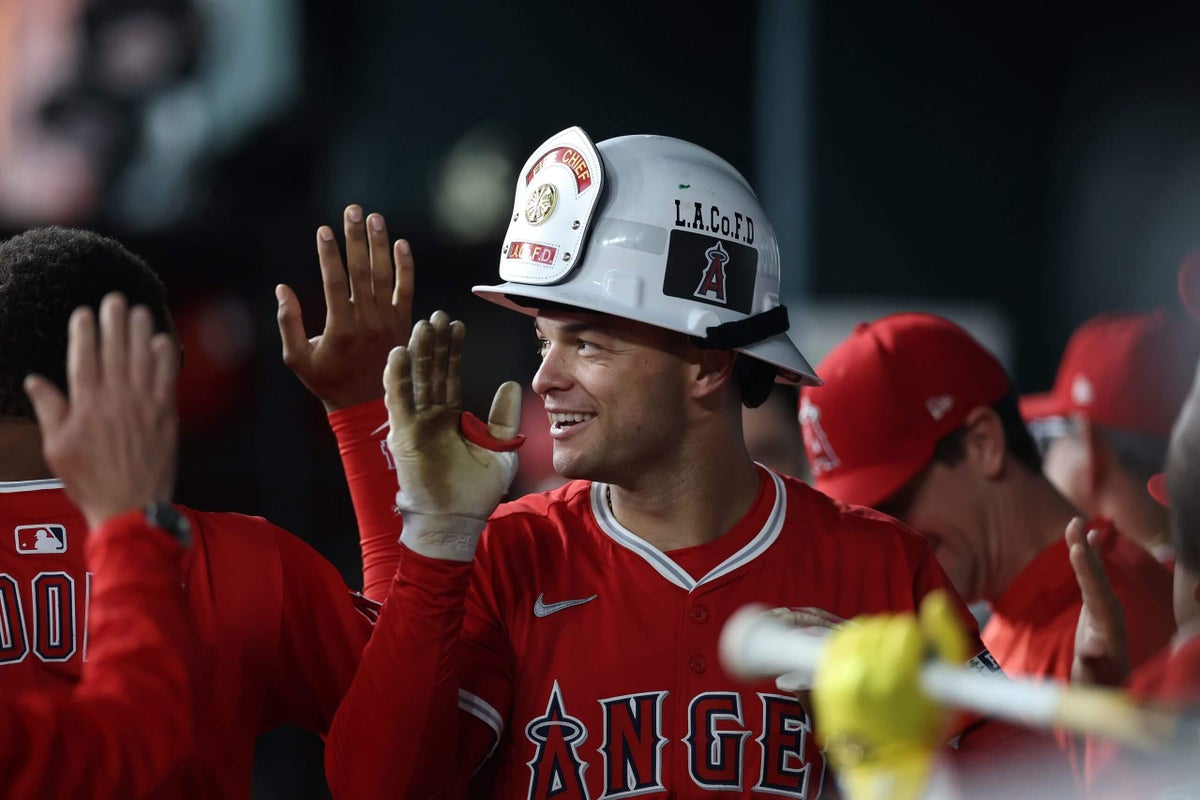
On the penultimate day of the season, then-Angels interim manager Ray Montgomery was asked about Logan O’Hoppe.
It’d been a very difficult year for the catcher. After hitting his 14th homer on May 22 — his 161st plate appearance of the season — he connected on just five more long balls over his final 290 chances.
Behind the plate, he struggled with blocking, framing, throwing and, at times, pitch-calling, with the staff accumulating a 5.04 ERA with O’Hoppe catching. A flawed metric, but still a poor number.
“The year was tough,” O’Hoppe said in a phone call with The Athletic on Thursday. “And it seemed to be in, in every aspect, a career worst. I want fans to know that I’m just as frustrated, and I’m more frustrated than anybody.”
The question posed to Montgomery on that Sept. 27 afternoon was aimed at diagnosing O’Hoppe’s steep and surprising regression.
O’Hoppe’s face is plastered on the billboards outside Angel Stadium’s home plate gate. He entered the season with the hopes and expectations of taking a huge leap forward. The plan was to cement himself as a significant part of an Angels core, and the budding face of their franchise.
For the first six weeks this year, he looked the part. For the final 4 1/2 months, however, he was really bad, particularly on defense.
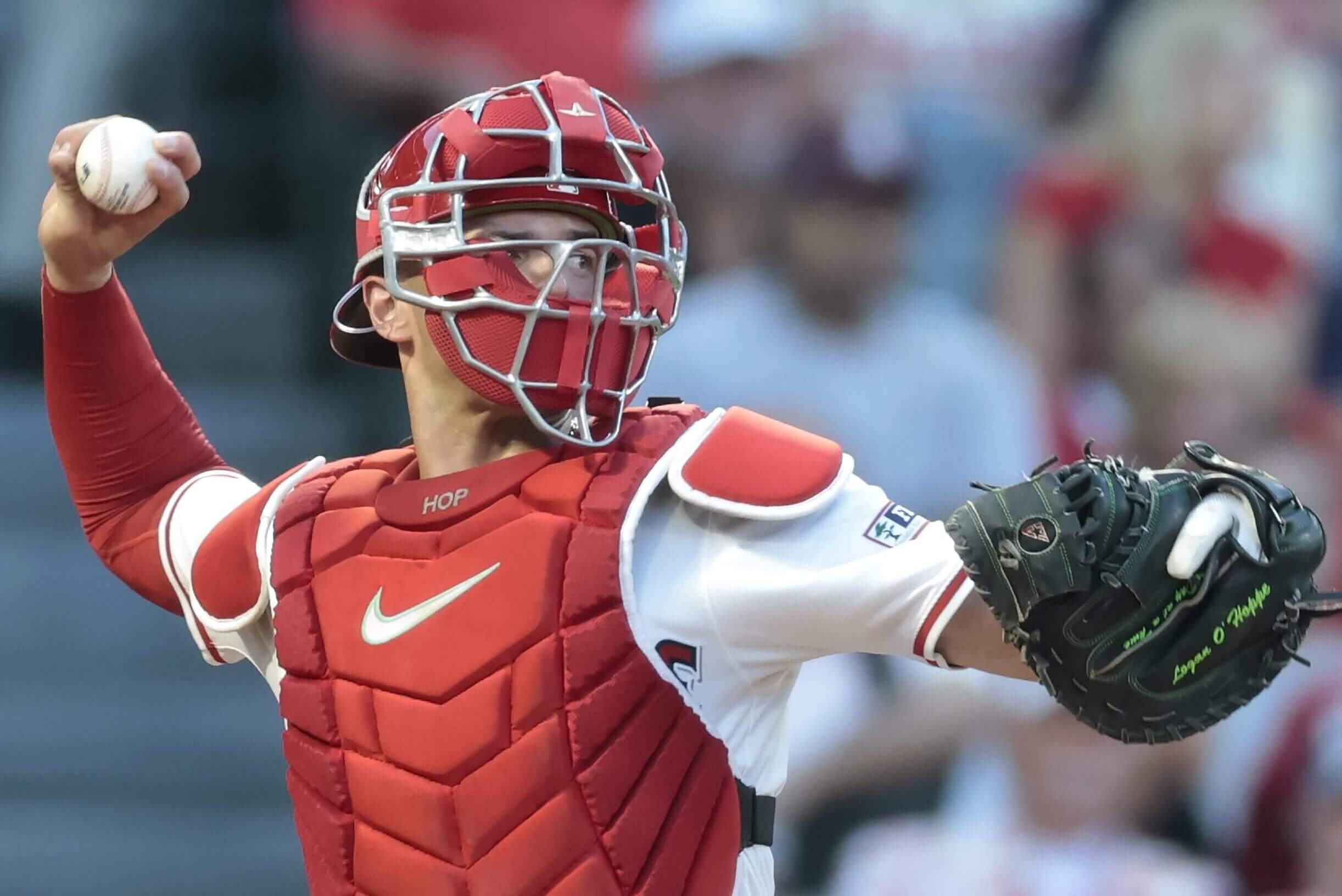
O’Hoppe’s defensive statistics nosedived from 2024 to 2025, and the Angels’ interim manager questioned his relationship with the pitching staff. (Ronald Martinez / Getty Images)
So, Montgomery was asked, does the 25-year-old catcher need to improve his relationships with the pitching staff?
“Listen, you don’t have to go to dinner with each other, and you don’t have to be best friends,” Montgomery said. “But when you step out of the dugout, when you cross the lines, there has to be a trust. There doesn’t have to be a love. … And he’s probably got to earn a little bit of that back.”
O’Hoppe is as honest as anyone about his calamitous season. He felt he lacked an identity behind the plate. He swung at everything and missed a lot more than he’d like. He readily admits he lost his way, in all facets of the game.
But the catcher took time out from his offseason, because he wanted to respond to what his former manager said about him.
“As far as Ray’s comments about me having to earn things back, there has not been one instance this year with any of my pitchers where I butted heads, got into it, caused any reason for them not to trust me. Not one,” O’Hoppe said.
“A lot of perspectives on my relationship with different pitchers has come from people that aren’t me, and aren’t my pitchers either. If you ask any of the pitchers about it, I am sure that they would say our relationship is great.
“I certainly don’t feel like I have to earn anybody’s trust.”
O’Hoppe acknowledged that wallowing in the emotions of his struggles, at times, could have gotten in the way of continuing to build those relationships. He said he’s stumbled in finding a way to rein in those frustrations, calling it “the umbrella over my big league career so far.”
He alluded, somewhat vaguely, to “living my life on other people’s terms” both when it comes to his professional and personal lives, and that he’s going to limit whose guidance he listens to moving forward.
“I’m still going to keep an open ear to the people whose opinions I value most,” O’Hoppe said. “But as far as suggestions that go against who I am as a person, that’s not stuff I’m going to be listening to anymore.”
The results make clear that O’Hoppe needs to make some changes. Backup catcher Travis d’Arnaud’s catcher ERA was 4.45, slightly better than O’Hoppe’s. But notably, d’Arnaud’s pitchers also posted a substantively higher 2.56 strikeout-to-walk ratio than O’Hoppe’s 1.85.
Across the board, all his defensive metrics were down — particularly surprising given his statistically above-average defensive metrics in 2024. His blocks above average went from plus-1 to minus-6. His caught stealing above average went from zero to minus-3. His framing above average went from plus-1 to minus-8.
“I completely lost that foundation I had behind the plate,” O’Hoppe said. “Second-guessed everything.”
As a hitter, O’Hoppe’s 30.8 percent strikeout rate ranked in the bottom 4 percentile of qualified batters. He whiffed on 44 percent of the sliders he swung at, and pitchers consistently threw it out of the zone as a weapon against him.
There were many days this summer that O’Hoppe showed up to the ballpark worried about his standing on the roster.
“Especially when it got really bad in the second half, you’re coming in thinking you’re gonna get pulled in the office and shipped out to Utah,” O’Hoppe said, referring to the Angels’ Triple-A affiliate in Salt Lake City. “Those thoughts go through your head.
“If anyone who struggles like I did and says it doesn’t go through their head, they’re lying to you. I 100 percent thought that, and that was tough.”
At times, the team did consider that option, but the Angels ultimately decided that O’Hoppe didn’t need any sort of wake-up call, and that a break-glass option like that wasn’t the correct route.
To this day, the Angels view O’Hoppe as their guy, said Angels GM Perry Minasian. When he comes into spring training next season, he won’t need to earn the job.
“Logan had a tough year, there’s no sugarcoating that,” Minasian said. “But yes, we believe Logan can catch. It’s a really tough position. To break in a young catcher takes time. I’m expecting a better Logan O’Hoppe.”
He’s appreciative for the vote of confidence, he said, particularly after a tough year. But the catcher knows it’s incumbent on him to do something with that faith.
Throughout the season, he said that opposing players from across the game made a point to talk to him. A consistent theme from the messages he heard emerged: Every player goes through a time where they question everything that got them to the big leagues.
In the throes of facing those demons, O’Hoppe tried to internalize that advice, embracing any little win that he could. He cited a mound visit where he successfully convinced 10-year veteran pitcher Tyler Anderson to throw a specific pitch, which paid off.
Small, but to O’Hoppe, meaningful.
For the Angels catcher, even as he plans to shrink his inner circle, he knows how important it is to have more moments like that. To grow and build those relationships with pitchers. Since that’s the key to everything else.
“When I go about my life and my career that way, everything gets taken care of,” he said. “I’m the catcher I want to be. I’m the person in the clubhouse that I want to be. I’m the teammate I want to be. I’m the son I want to be.
“I’m no longer chasing this void that I’m constantly trying to achieve.”