
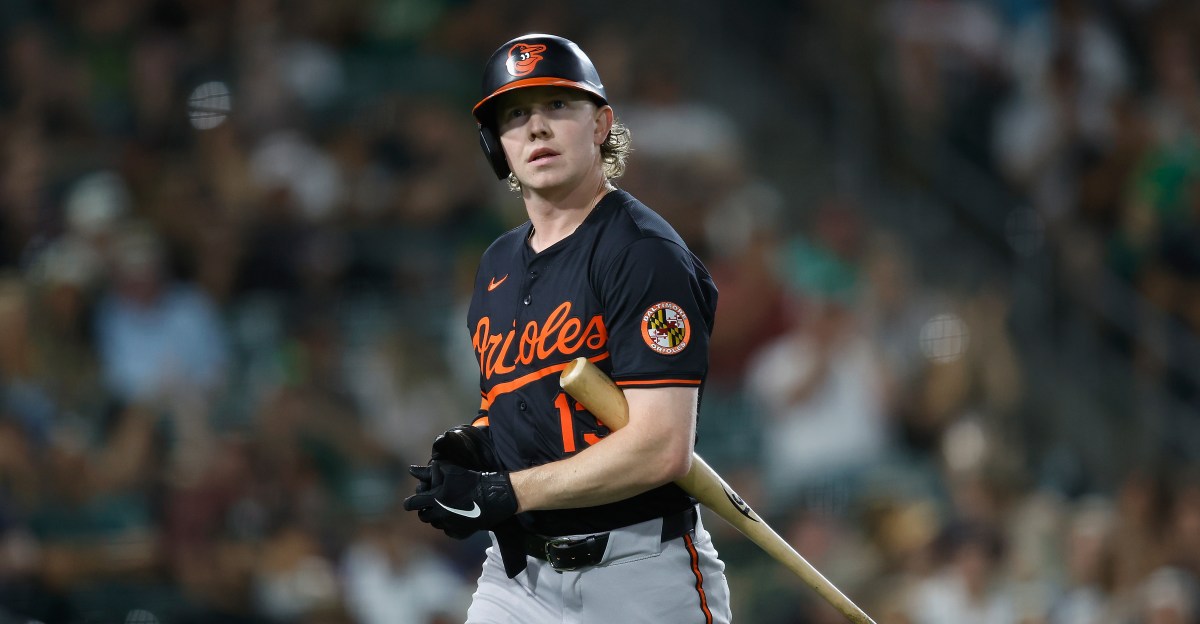
This was supposed to be the year that Heston Kjerstad finally broke out on the big league stage. He made the Orioles’ Opening Day roster for the first time in his career, and although the team’s outfield was packed with options, he was still poised to get plenty of opportunities. Instead, the 26-year-old struggled mightily and now his entire future is up in the air.
Kjerstad has not had an easy path to this point. Drafted in 2020, his professional debut was delayed until 2022 due to a battle with myocarditis. Despite that, he would eventually show why he was once the second overall pick, rocketing through the Orioles farm system and making his big league debut late in 2023. He entered 2024 as a Top 50 prospect in all of baseball, and finally got an extended opportunity in late June. The next month he was hit in the head by a Clay Holmes pitch that derailed his season, giving him a concussion and forcing him into an extended IL stint.
The plan with Kjerstad coming into 2025 seemed to be putting him in situations where he could excel. He was going to be on the big league roster (his .209/.346/.326 line in the spring was underwhelming, but clearly not a dealbreaker). But he was never pegged as an everyday starter. Instead, he almost exclusively faced right-handed pitching, rotating into the corner outfield spots with Tyler O’Neill and Ramón Laureano. An early-season injury to Colton Cowser created even more chances for Kjerstad to prove he belonged.
It just never really clicked. Over 54 games, Kjerstad hit .192/.240/.327 with four home runs, five doubles, six walks, and 45 strikeouts. His 3.6% walk rate was near the bottom of the league, and many more of his numbers were well below league average.
All of Kjerstad’s physical skills seemed to regress in 2025. His average exit velocity dropped from 90.2 mph in 2024 to 88.8 mph in ‘25. His arm strength dipped from 91.4 mph to 86 mph. And his sprint speed sunk from 28.5 feet per second to 27.7. A regression in these outputs is normal as a player ages, but such a drastic change for a player from their age 25 to age 26 seasons is alarming.
In early June, Kjerstad was demoted to Triple-A. The theory at the time had to be that he needed a mental reset, so he would go play in Norfolk, where he was comfortable and had a history of dominance. But it didn’t work out that way. He never made it back to Baltimore.
Kjerstad played 27 games in Triple-A and put up even worse numbers. He hit .149/.225/.248 with two home runs, one double, 10 walks, and 30 strikeouts. He played his final game of the season on July 25. He was placed on the IL on July 29. The exact injury was unclear.
Orioles president of baseball operations Mike Elias provided an update on Kjerstad during his end-of-season press conference, but was light on specifics:
“Heston has been working with our doctors and other doctors on a medical condition. He’s responded favorably to some treatment and some different treatments that they’ve done recently and he’s in a good spot right now and pointed in the right direction. We’re going to see him in spring training and I’m really looking forward to that, because we missed the real Heston Kjerstad this year. I don’t want to go into any more detail.”
Whatever the medical condition may be, the Orioles seem to think that it had a significant impact on Kjerstad this season. It’s hard to argue otherwise. His career trajectory took such a severe downturn this season, the kind that is usually precipitated by significant injury.
Clearly, the Orioles aren’t giving up on Kjerstad, and they shouldn’t. He has flashed plenty of ability, especially at the plate, in his relatively brief big league career. The potential for a middle-of-the-order bat with 25+ home run power remains. It’s just a matter of tapping into it. Kjerstad will have one more option remaining in 2026 and will still be pre-arbitation. There is no risk to hanging onto him and hoping that his talent finally translates into big league output.
What the Orioles cannot do is assume that Kjerstad is going to be a significant contributor in 2026. The health issues are not his fault, but they are the reality of the situation. He has not been reliable enough for a team with supposed playoff ambitions to hand him a role as even a platoon solution at right field, DH, or first base.
It is entirely possible that Kjerstad may grow into that major role for the Orioles in 2026. The team obviously needs more offensive contributions up and down the roster, and a healthy Kjerstad has as good a chance as anyone of being a source of improvement. But contingencies should be built into the process.
According to Elias, Kjerstad is going to be ready for spring training. But it seems unlikely that a spot on the Opening Day roster is going to be earmarked for him this time around. The team should look to add a veteran bat to the lineup this offseason, and the outfield feels like the spot that could use it the most. That might mean that Kjerstad begins 2026 back in Triple-A, either on a rehab assignment or just for his own development.