
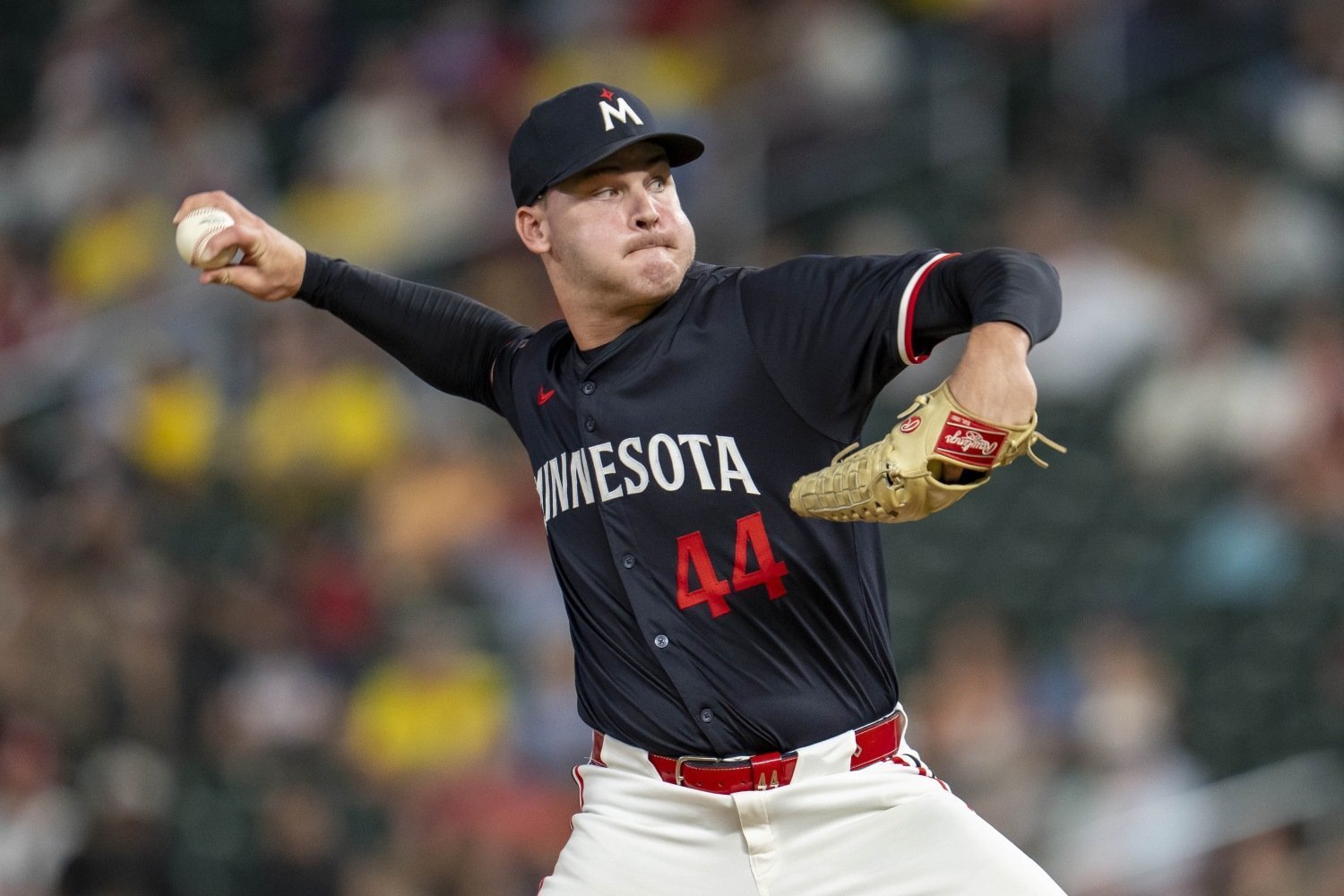
RHP Cole Sands
Age on Opening Day 2026: 28 years old
Service Time: Three years, 17 days
2023 Salary: $723,650
2024 Salary: $749,450
2025 Salary: $778,000
2026 MLB Trade Rumor Estimate: $1.3 million
Background: The Minnesota Twins selected Sands in the fifth round of the 2018 MLB Draft out of Florida State University, banking on his mix of polish and pitchability translating to professional success. During his time in the minors, Sands developed a reputation as a steady, mid-tier starting pitching prospect. He was never a top name, but consistently productive. His strong numbers in the low minors kept him on the organization’s radar as a potential back-end starter at the big-league level.
That projection came into focus when Sands made his MLB debut in 2022, splitting time between the rotation and bullpen. The results were uneven: a 5.87 ERA, 1.57 WHIP, 8.2 K/9, and 3.8 BB/9 across his rookie campaign. While the numbers didn’t jump off the page, his stuff looked sharper in shorter bursts, prompting the Twins to transition him into a full-time relief role the following season.
The move paid off. From 2023-24, Sands emerged as one of Minnesota’s most trusted bullpen arms, compiling a 3.39 ERA, 1.12 WHIP, and 10.8 K/9 with only 2.4 BB/9. He excelled at limiting hard contact and pounding the strike zone, traits that earned him a consistent spot in high-leverage situations. By the end of the 2024 season, he had accumulated 1.3 rWAR and solidified his reputation as a stabilizing force in an otherwise unpredictable relief corps. The 2025 season, however, told two very different stories.
Sands opened the season as one of the most trusted members of the Twins bullpen. As the year wore on, and especially following the team’s trade deadline selloff, he became one of the few arms manager Rocco Baldelli could reliably turn to. From August 1 through the end of the season, Sands posted a 3.25 FIP with a 28-to-5 strikeout-to-walk ratio across 26 innings.
Unfortunately, a brutal five-game stretch in September, during which he allowed ten earned runs in just 5 1/3 innings, skewed his overall numbers. By season’s end, he carried a 4.50 ERA despite peripherals that suggested he was far better than that headline figure.
Even with the inflated ERA, Sands remained an above-average strike thrower and continued to suppress hard contact. His FIP, walk rate, and WHIP all remained in line with his breakout 2023–24 seasons, hinting that his downturn was more about poor luck and small sample volatility than real regression.
2025 Stats: 69 G, 4.50 ERA, 3.58 FIP, 1.17 WHIP, 72 IP, 64 K, 21.4 K%, 19 BB, 6.4 BB%
Twins Depth at His Position (RH Relievers)
40-Man Roster: Justin Topa, Cody Laweryson, Michael Tonkin, Pierson Ohl, Thomas Hatch
Triple-A: Kyle Bischoff, Mike Paredes, Jarret Whorff, John Stankiewicz, Jaylen Nowlin
Double-A: Jacob Kisting, Paulshawn Pasqualotto, Xander Hamilton, Logan Whitaker, Matt Gabbert, Ruddy Gomez
Summary: Minnesota’s relief depth is functional but not particularly inspiring. Several arms on the 40-man roster could be designated for assignment this winter. While a few intriguing pitchers are developing in the minors, none appear ready to seize a bullpen role on Opening Day 2026. With the bullpen’s instability and lack of proven performers, the Twins can’t afford to part with one of their few dependable right-handers.
Why the Twins Should Offer Him Arbitration
Over the last two seasons, Sands has provided $18.6 million in value according to FanGraphs WAR, all while earning the league minimum. Even if his first arbitration salary lands slightly north of $1 million, he remains one of the biggest bargains on the roster relative to his production.
Sands has proven that he can handle high-leverage innings, and the Twins desperately need reliable arms to stabilize a bullpen that’s been overhauled multiple times in recent seasons. With his strike-throwing ability, late-inning experience, and affordable cost, Sands should be viewed as a potential setup man or even closer candidate for 2026. If Minnesota is serious about staying competitive, retaining Sands is a must.
Why the Twins Should Non-Tender Him
There’s only one reason to non-tender Sands: if the team knows something we don’t. Perhaps the Twins have internal concerns about his health or declining metrics that aren’t visible in surface stats. To be clear, there is no sign of this from the Twins. Otherwise, moving on from him would make little sense.
He’s young, cost-controlled, and capable of handling leverage innings, which are traits the Twins bullpen sorely lacks. Unless there’s a hidden red flag, Sands should be viewed as part of the solution, not a problem to cut loose.
Projection: This feels like one of the easiest arbitration decisions the Twins will make this offseason. Tendering Sands a contract is a no-brainer. He’s underpaid relative to his production, still improving, and represents the type of steady, affordable bullpen arm every contending team needs. With few proven right-handers behind him, Minnesota can’t afford to let one of its most dependable relievers go.
What should the Twins do with Sands? Is he an easy arbitration decision? Leave a comment and start the discussion.