
Game 4 of the NLDS, in Chicago, was cathartic for the Cubs from the get-go for many reasons—be it Matthew Boyd‘s playoff redemption; the crowd’s sing-song chorus of “Freddy … Freddy … Freddy” as the pitcher struggled to find the zone; or Ian Happ putting the Cubs up yet again in the first inning by depositing one of those fastballs Peralta is so well-known for out to the bleachers. While the game still had its nervy moments, by the final pitch, a wave of relief (if only for a night) had washed over the North Side.
The Cubs, however, cannot afford that sense of relief to linger. It’s great to climb out of the hole you dug for yourself, but you are only remembered if you complete the comeback. Thankfully for the Cubs, history is on their side. Ten of the 17 teams to force a decisive Game 5 after falling down 2-0 have come back to etch their names in the winner’s column. For the Cubs to make it 11, they will have to go through the Brewers’ rookie pitcher, Jacob Misiorowski—in one way or another. We do not yet know if he will start or pitch in relief, but there is no doubt that at some point in the game, he will toe the rubber and the team will have to find more success against him than they did in Game 2.
If there is one word to describe the Brewers’ youngster, it would be: volatile. He is explosive, both in good and bad ways. In over half of his appearances, he has surrendered at least five runs, yet he has struck out nearly one of every three hitters he’s faced. For my film buffs, he may remind you of Bull Durham‘s Ebby Calvin “Nuke” LaLoosh, liable to hit Bernie the Brewer or paint a corner at any moment, but for me, he reminds me of someone else: Pete Crow-Armstrong. Yes, they play different positions, but both are roller coasters of emotion, using 80-grade skills (for Pete, it’s his glove, and for Jacob, his fastball) to hide flaws and emotions. Both are just beginning their journey through Major League Baseball.
The Cubs have seen Misorowski two times this year outside of Game 2, and each time, it has been a mixed bag. In both games, the Cubs had the pitcher on the ropes, taking their walks when given and punishing a few mistakes—but in both games, the Cubs just couldn’t provide the straw to break the camel’s back The first time they saw him, instead of knocking him out right away, they allowed him to right the ship after a very shaky three-run first frame, and the Brewers would go on to win. When they faced him again, they would once again find three runs in an early frame (this time the third), but would once again be unable to provide a killing blow, stranding a runner in scoring position. Thankfully, this time, the three-run foundation would provide just enough offense, as they would go on to win the game. Either way, a lesson learned here should be: when you have a chance to put the kid away, take it.
Looking at Misiorowski’s profile, the clear standout pitch is his fastball. He ran the pitch up to 104 mph in his relief appearance earlier this week, and from the velocity alone, it’d be blatantly clear to anyone that it is a special offering. It may not just be special. It may be a true one-of-one, when we look beyond just how fast it goes. The hurler uses every bit of his 6-foot-7 frame to his advantage, sitting at the very top of the league in terms of extension, meaning not only is it fast, but he makes it ever more dangerous with how close to the hitter he throws the thing. On top of it, it has a disgusting 121 Stuff+ rating, meaning its shape is excellent too. It’s truly an 80-grade pitch, and he knows it, as he throws it 55% of the time.
There is a bit of a hope, however, against this devastating pitch; catch it in the middle of the zone and you can do damage on it. On the season, the league averages a .293 wOBA (and a .312 xwOBA) on fastballs thrown 100 mph or faster in the “heart” of the zone, proving it’s really hard to hit fastballs if you throw them that hard. However, despite the amazing shape and velocity, hitters had a .424 wOBA on Misiorowski when he came over the heart at the same speed. You can absolutely get to his fastball if he leaves it here. What you cannot do is expect to do anything with his fastball if he instead locates the pitch on the shadows at the edges; the space between the “heart” of the zone and the outlands. While it’s always hard to hit pitches in this area, it’s impossible to hit Misiorowski here; hitters have a wOBA of .just .110 when he hits those spots. For comparison’s sake, all-world reliever Mason Miller has a .164 wOBA in this region. That’s truly amazing.
Saturday is going to test the Cubs’ ability in pitch recognition. Not only will they need to hunt fastballs over the heart and avoid fastballs on the shadow (a scary proposition for something moving as fast as a Jacob Misiorowski fastball), but they cannot give him any help. The fireballer sits just in the 50th percentile in chase rate, which on the surface feels strange considering how good his fastball is, and likely, even more strange with how good his slider should be. Ay, but therein lies the rub: the slider is the issue.
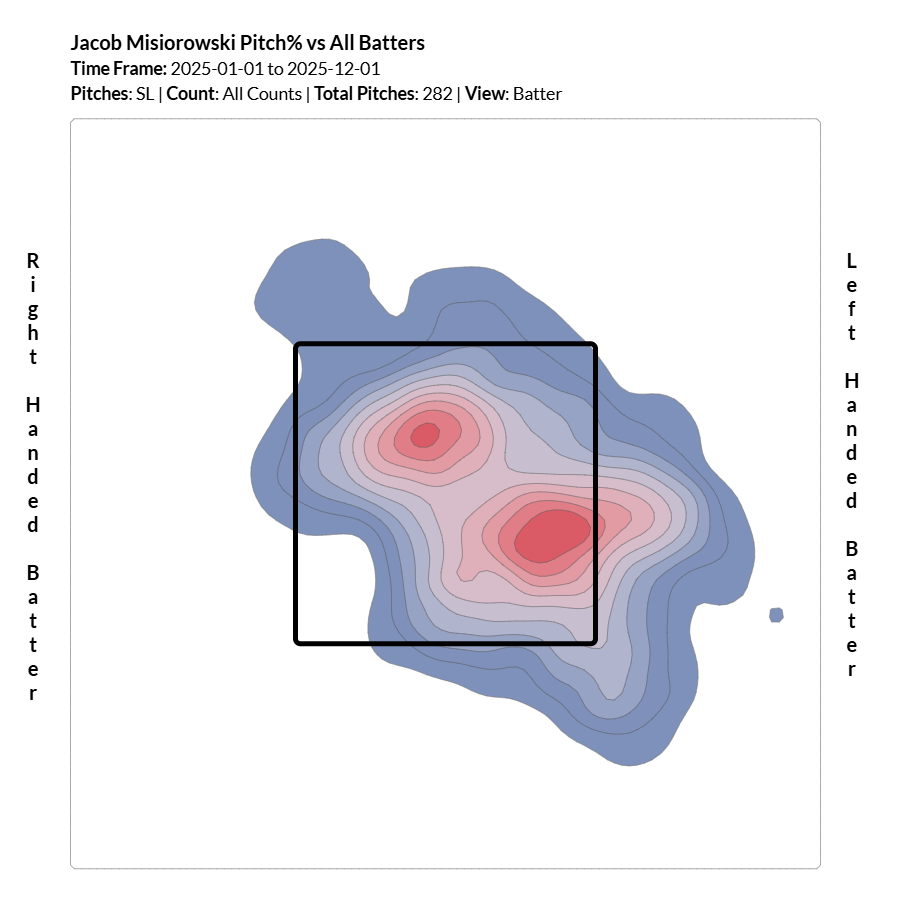
Misiorowski’s slider is truly a good pitch on first glance, which makes all of this is a bit perplexing if you don’t know where to look. Shape-wise, it grades out as a 118 on FanGraphs’s Stuff+ rating, suggesting it should be a devastating offering. He has the highest average velocity on a slider in the entire league, sitting at 94.1 mph. Despite elite shape and velocity, hitters have teed off on it, slugging over .500 and running an xwOBA of .341. What gives here is that the feel for location waxes and wanes. Sometimes, he’s able to bury it low, and other times, he leaves it up—a massive mistake when throwing this pitch. He has just a 14.3% put-away rate on the pitch and a strikeout rate of 15% on it. His slider should be a chase pitch, and it is simply not a chase pitch right now. This is your opportunity; when he makes a mistake with that pitch, you have to make it hurt.
Stringing hits together probably isn’t going to happen on Saturday when the fastball merchant is in the game, but you can score in bunches because of his propensity to walk hitters. Misiorowski in the 11th percentile in terms of walk rate, so while you may not be able to put together an inning where you pick up multiple hits and manufacture a run, you can put yourself into a position where you take your walks. And these walks can be used to great effect for teams willing to out-wait the right hander.
In a game on July 2, this flaw in his game was on display against the New York Mets. The Mets quickly made two outs in the top of the second inning, having done little against the phenom, with a Juan Soto walk in the first representing their only runner. Things would begin to go off the rails for the rookie after walking third baseman Brett Baty on a 3-2 count. Misiorowski followed up one walk with another, walking yet another Mets hitter on a 3-2 count, and suddenly what looked like it could be a quick inning had begun to spiral. A weak infield single led to a bases-loaded situation for outfielder Brandon Nimmo. Disaster struck for the Brewers, as Nimmo punished a hanging slider on an 0-0 count. The score jumped from zero to 4 with one misplaced pitch. This is how the Cubs need to handle their time on Saturday; force the kid to make a mistake. He is volatile.
dff779a4-466570fe-19dbf954-csvm-diamondgcp-asset_1280x720_59_4000K.mp4
Saturday will test the Cubs’ patience, and they will need to respond better than they did Monday night. Misorowski threw the slider 14 times, or around 25% (this is close to his season’s usage rate on this pitch). He left it up and in hittable locations, and the Cubs just missed them, swinging and missing on four of their six swings. He didn’t get a single chase on the pitch; he either left it in the zone or Cubs hitters accurately diagnosed it as not-a-strike. This cannot happen on Saturday if the Cubs are going to find their footing in the early portions of Game 5. If he gives you a hittable slider, you have to jump on it.
Much like with Quinn Priester and Freddy Peralta, we can see a plan of attack emerge for the Cubs. This time, that plan is to be patient, force the youngster to throw strikes, and to be ready to pounce the moment he hangs a slider or grooves a fastball. When teams force the action, scoring opportunities exist, as we can see in the Mets’ example above. When teams allow him to get away with the poor slider placement or allow him to work around his wild nature, he can eat you up. So as much as we know that he’s going to light up the radar gun on Saturday night, we also know that there will be fleeting opportunities for the Cubs to find runs in bunches, too. The Cubs may still win the day if they don’t find success against Misiorowski, he’s likely going to be tasked to get under 12 outs on the day, which would still leave five innings to find offense, but it will be that much more difficult for them to become the 11th team to come back from a two-game hole if they let the kid get away with bad locations—and it could eventually be the difference between a champagne bath and a cold shower after the game concludes.