
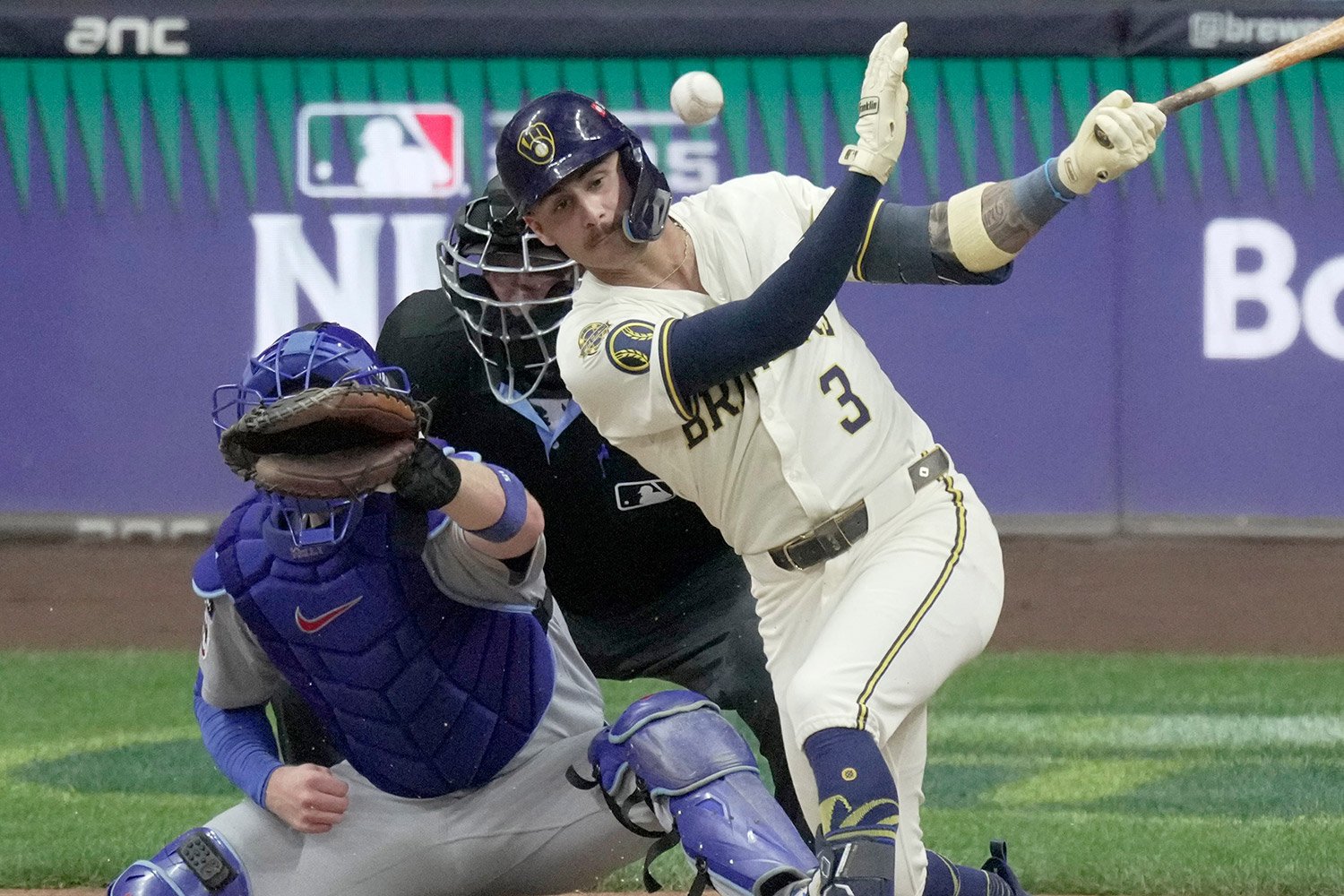
The evening began with Pat Murphy quoting a Shakespearean tragedy.
“To be or not to be, that is the question,” Murphy recited to reporters in the Wrigley Field media room two hours before Game 4 of the NLDS. “Whether it’s nobler in the mind to suffer the slings and arrows of begotten fortune, or bear arms – I’ll stop. What is that, Hamlet? Was that pretty good?”
Hours later, Murphy and the Brewers were faced with another question, one they were likely to encounter rather quickly in the postseason: to let Joey Ortiz swing the bat in a key situation, or to take it out of his hands?
Ortiz’s offensive struggles this season were well documented. His bat went especially cold after returning from the injured list for September, as he posted just a .482 OPS in the regular season’s final month. The Brewers value his glove highly enough that his starting role was never in question for October, but the question was how eager they would be to substitute a superior hitter in a pivotal run-scoring situation. Murphy pinch-hit for him before the ninth inning 18 times throughout the year, typically replacing him with Andruw Monasterio at shortstop.
Such a moment presented itself in the fifth inning on Thursday. Sal Frelick doubled and Blake Perkins walked against Matthew Boyd to open the inning, bringing Ortiz to the plate as the tying run. With nobody out, it wasn’t a situation where the Brewers had to replace him with a better hitter. They chose to keep his glove in the game.
“We have a choice to make in the game, taking out a guy that’s one of the best defensive shortstops,” Murphy said. “It’s early in the game. It’s in the fourth inning. Who do you suggest we pinch-hit there, you know what I mean? And then use two players?”
The Brewers didn’t let him swing, though. Instead, Ortiz dropped down a sacrifice bunt on the first pitch to advance the runners. Christian Yelich struck out, and Jackson Chourio chased Danny Palencia’s first-pitch fastball for a jam-shot popout. A promising inning flamed out quickly with nobody crossing the plate.
“I thought putting a bunt down and getting us on the board to get us going,” Murphy explained of the thought process. “We’ve got Yeli coming up. Yeli has hit Boyd well, too, and Boyd made great pitches in that at-bat.”
In the vast majority of cases, sacrificing does not spur scoring. If anything, it kills big innings. The average number of runs a team scores in an inning decreases when it trades an out for advancing runners. While there is no complete public data for the 2025 season, here are the numbers from 2021 through 2024, as compiled by Ben Clemens of FanGraphs. The before and after scenarios surrounding Ortiz’s bunt are highlighted in yellow.
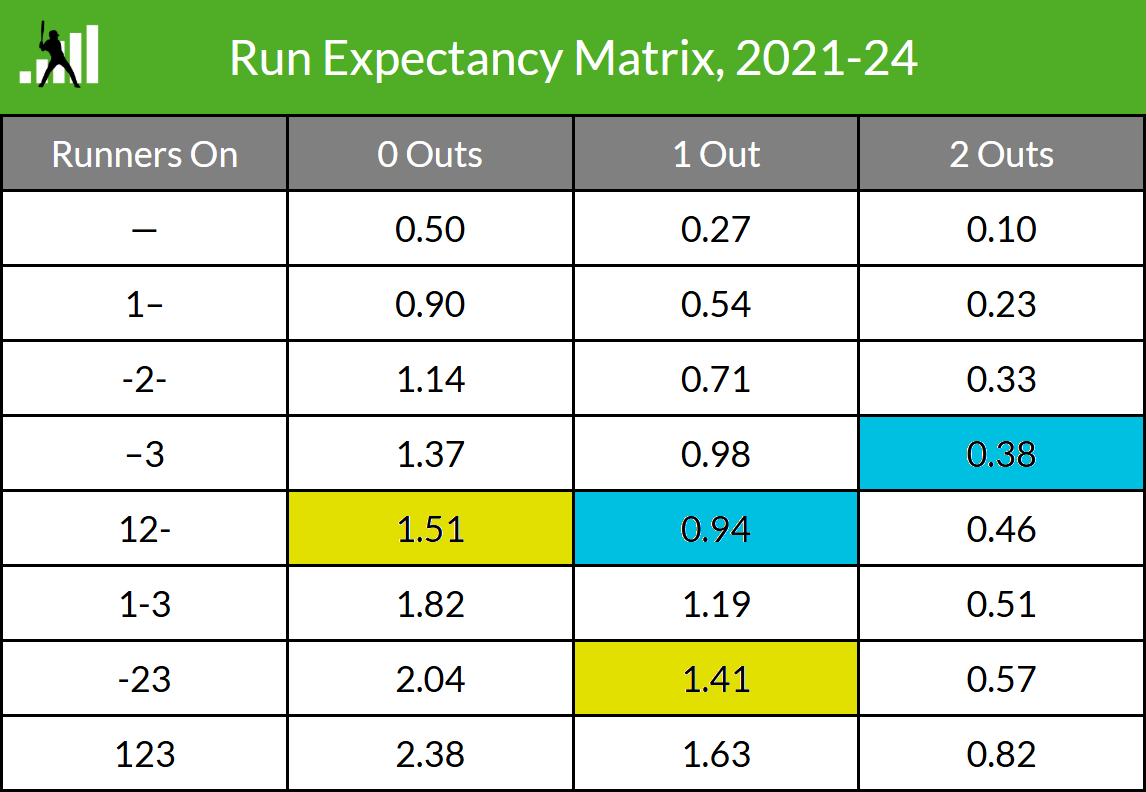
After Ortiz’s sacrifice, a medium-depth flyout would have scored one run, but the number of total runs the Brewers could expect to score in the inning slightly decreased. The best approach is to give the hitter a chance at producing a positive outcome that will drive in runners and keep the inning going. Murphy knows this, which is why he refused to call for a bunt when a struggling Brice Turang hit with Jackson Chourio on second and no outs while trailing by a run the night before.
“In my opinion, you don’t give up an out there if it’s that type of hitter,” Murphy said. “He’s our version of a middle-of-the-order guy. You’re not going to bunt him. You’re going to try to win the game.”
The calculus changes with Ortiz, whose .276 on-base percentage and .317 slugging percentage forced the Brewers to shift from an opportunistic thought process to a risk-averse one. Had he gotten out while failing to advance the runners or hit into a routine double play, they would have faced one of the run expectancies highlighted in blue. Either of those outcomes would be far more detrimental than a bunt.
Of course, counting on Ortiz to get it down was inherently risky. In his two seasons in Milwaukee, he has attempted a bunt 31 times and successfully executed the sacrifice only nine times, a horrendous 29% success rate. Even so, it was still the safest route because a standard Ortiz at-bat posed such a serious threat to the Brewers’ scoring odds.
Therein lies the dilemma. Ortiz’s defense is invaluable, but his poor offense effectively forces the Brewers to forgo an opportunity for a big inning if he comes up to bat with runners on base. Playing for one run or to avoid the worst-case scenario is not the best approach in a multi-run deficit, yet they felt they had no other choice on Thursday. Their best scoring threat quickly evaporated, and the Cubs ultimately shut them out.
That cannot happen in an elimination game on Saturday. If Ortiz’s spot comes up in a key run-scoring setup in the middle innings, Murphy may need to be more aggressive in hitting for his shortstop at the risk of a worse defender finishing the night at shortstop. With their season on the line, the Brewers can’t go down conservatively.