
Part 1 of 2.
Mayor Ken Welch is reviewing a new $6.8 billion proposal to reimagine the Historic Gas Plant District “in detail.” How does it compare with what the Tampa Bay Rays had planned?
The Rays and global development firm Hines submitted a 243-page proposal for a $6.5 billion project in December 2022. A local group led by St. Petersburg-based ARK Investment Management unveiled its 98-page, $6.8 billion vision for Tropicana Field and the surrounding area Oct. 3.
The most glaring difference between the two is that the latter “preserves the option” for a new Rays stadium, “but is not dependent on it.” While new team ownership likely prefers to build a ballpark in Tampa, Welch had a “productive” meeting with the group following Tuesday’s introductory press conference.
“As the team’s leadership continues to settle into their positions, I anticipate ongoing conversations about the future of Major League Baseball in St. Petersburg,” Welch said in a prepared statement. “I look forward to learning more about the ownership group’s goals and vision for the Rays.
“We know that there’s a lot of interest in the City of St. Petersburg and, especially, the Historic Gas Plant District right now. As a result, we continue to explore, identify and review the most impactful avenues to develop the Historic Gas Plant District.”
Costs
ARK, Ellison Development and Horus Construction offered to purchase the initial 86-acre Gas Plant site and an additional 9.5 acres for $202 million. That equates to $2.1 million per acre, which the group believes reflects the project’s “premier location and the transformative potential.”
The purchase price includes $140 million for the land, $50 million in community benefits and $12 million to demolish the Trop. Ark Ellison Horus plans to pay for an estimated $239 million in infrastructure costs through a mix of bonds, tax increment financing and capital improvement program funding.
The Rays planned to purchase 65 acres for $105 million – $1.6 million per acre – and also offered $50 million in community benefits. City officials agreed to contribute $142 million for infrastructure, and the team exited the arduously negotiated deal in March due to delays and cost increases.
Additional public funding, including $287.5 million from the city and $312.5 million in Pinellas County tourism tax dollars, would have subsidized stadium construction costs. However, the latter government would have owned the 13-acre ballpark site.
The team’s new ownership will still ask local governments on one side of the bay to help pay for a new stadium. Ark Ellison Horus pledged to build a district that will “thrive with or without the Rays.”
“With a modest $120 million public investment, the district will unlock maximum returns from private capital, tourism and venture funding,” states the proposal.
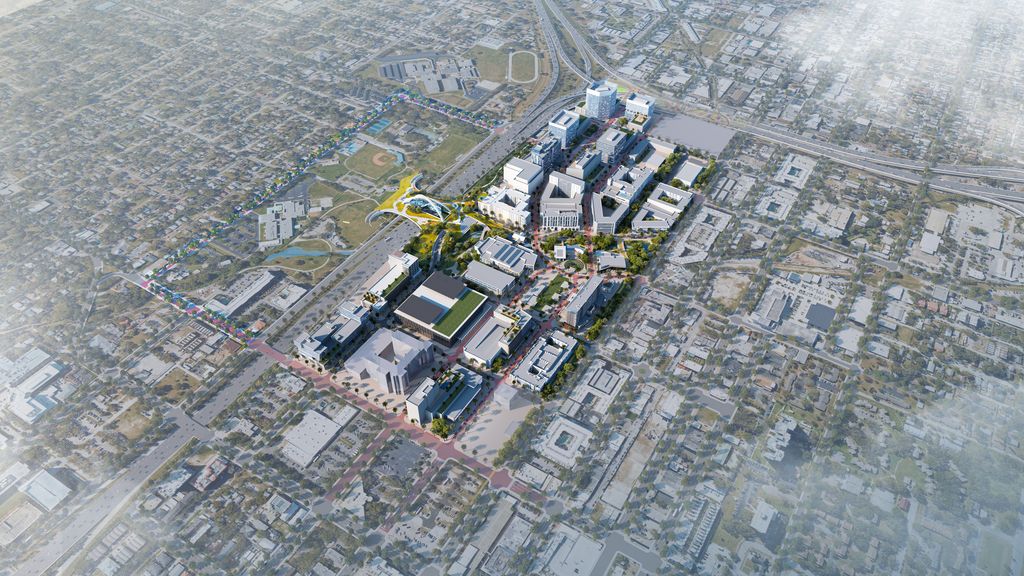
An aerial view of Ark Ellison Horus’ vision for the Gas Plant.
Attractions
Ark Ellison Horus plans to develop 67.25 acres and dedicate the remaining 28.29 to open space. The developers would pay $3 million per developable acre.
Hines and the Rays planned to develop just under 36 acres, dedicating 14 acres to open space. That equates to $2.9 million per developable acre, and the land is arguably more valuable now than it was when the former development team submitted its proposal or reached a deal with the city in July 2024.
Ark Ellison Horus will allocate 42 acres to public organizations. The project includes a 750,000-square-foot academic cluster, 500,000 square feet of innovation hubs and labs, a 200,000-square-foot Innovation Hall for conferences, 218,500 square feet of storefronts and 1,543 hotel rooms “across mixed-use towers” and 1.2 million square feet of Class A office space.
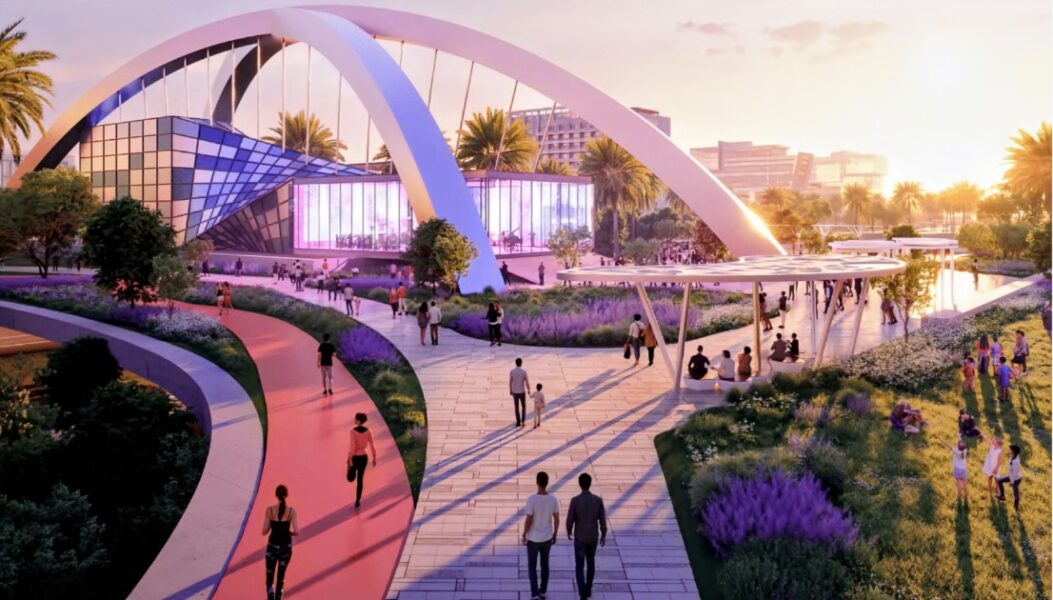
Entertainment venues include an 80,000 square-foot music hall, a 1,500-seat Stage House Amphitheater and a “festival-ready” Convergence Park. Ark Ellison Horus called the district a “global draw” with the capacity to host 300,000 to 400,000 people over a 10-day festival, comparable to South by Southwest (SXSW) in Austin.
“The new proposal, which is different from how I’ve been thinking about it, has multiple ways to draw people to the site,” City Council Chair Copley Gerdes told the Catalyst. “Through festivals, meeting spaces, concert venues, the museum – they’ve picked 10 or 12 different ways to bring people to the site, and I think that’s a unique perspective.”
The Rays proposed 1.4 million square feet of Class A office and medical space, a 90,000-square-foot conference center and ballroom, 730,000 square feet of retail businesses, a 20,000-square-foot grocery store, 750 hotel rooms, a childcare center and a startup incubator. It also included 100,000 square feet of entertainment space, in addition to the 30,000-seat stadium.
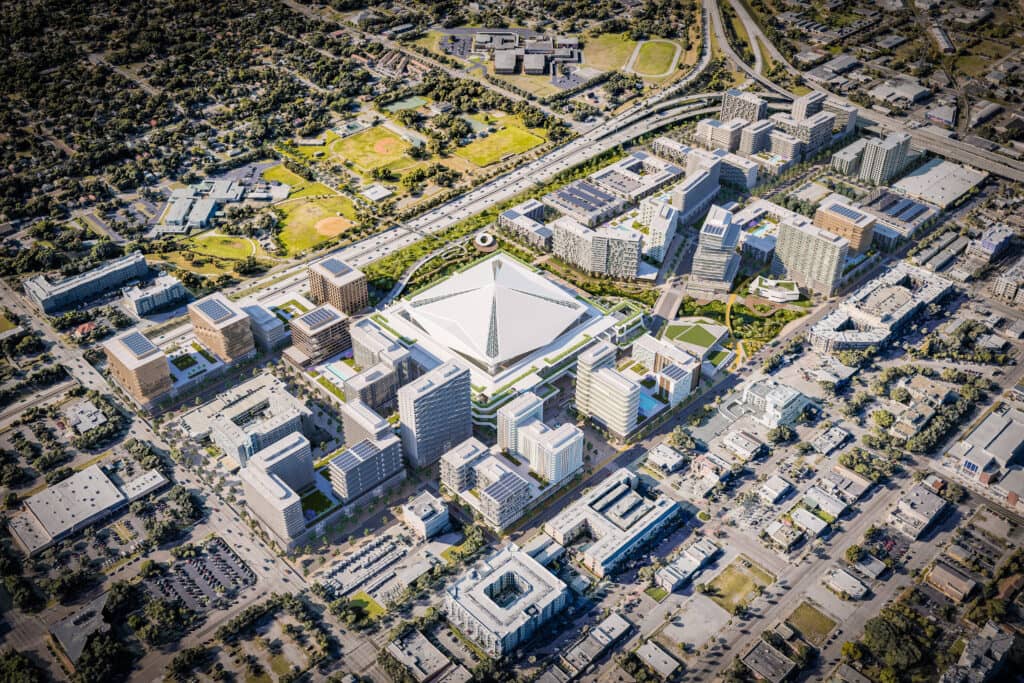
An aerial view of the Tampa Bay Rays and Hines’ vision for the Gas Plant.
Both development teams dedicated 50,000 square feet to a new Woodson African American Museum of Florida, although the Rays pledged to contribute $10 million toward construction. Ark Ellison Horus also plans to create a 20,000-square-foot arts and cultural center.
“This is more than a redevelopment; it is a chance to reshape the future of the City in a way that is inclusive, equitable and lasting,” states the proposal.
The two development teams also included big plans for Booker Creek. The Rays and Hines envisioned a revitalized and reconnected stream with art installations, pocket parks, an educational boardwalk, stormwater gardens and a community lawn and pavilion.
Without providing the same level of detail, Ark Hines Horus included a “Booker Creek Promenade” as part of 17.8 open acres. However, the group’s announcement noted that the “Booker Creek Cultural Corridor” will also offer public art, history installations and year-round programming.
Next: Part 2 will compare efforts to fulfill broken promises at the site, proposed housing, expected economic impacts and the development teams.