
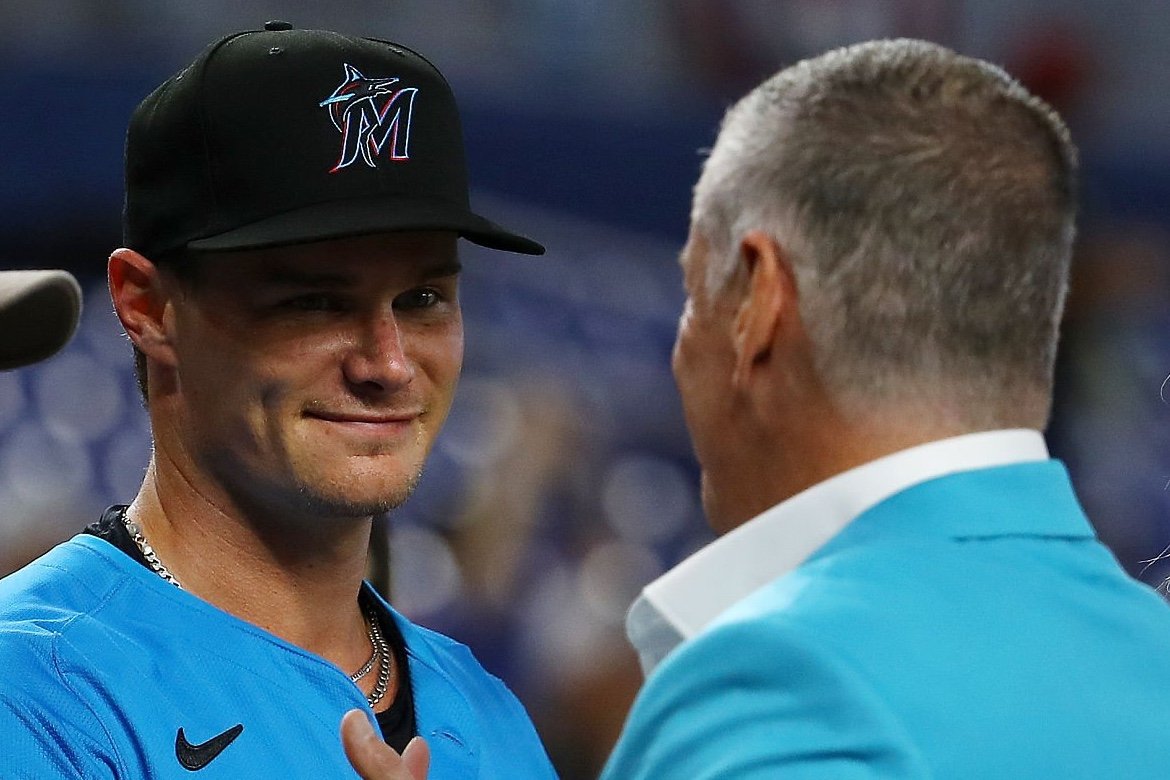
At this time two years ago, it was unclear whether Griffin Conine would ever play in the major leagues. While he had ascended to Triple-A, his first stint there—as a 26-year-old—had gone poorly. During the 2021-2023 seasons combined, Conine struck out more times than any other hitter in Minor League Baseball. He was not on the Miami Marlins’ 40-man roster and had been repeatedly passed over by the rest of the MLB teams in the Rule 5 draft.
There was immense pressure on Conine to make meaningful adjustments in 2024. He did, and it has changed his career trajectory. The left-handed-hitting outfielder reached the majors on August 26 of that year, cracked Miami’s Opening Day roster in 2025 and is well-positioned to do so again next season.
There are significant differences between Conine and his legendary father, Jeff Conine. Griffin has more raw power and arm strength than Jeff ever had, while the latter had the superior hit tool. Even if Griffin maximizes his potential as a player, the shape of his production won’t resemble Niner’s.
That is why I wanted to show you this. It’s still a small sample—equivalent to one-third of a full MLB season—but Griffin’s offensive numbers across the board actually are very comparable to what Jeff did through the same number of games at the start of his Marlins tenure:
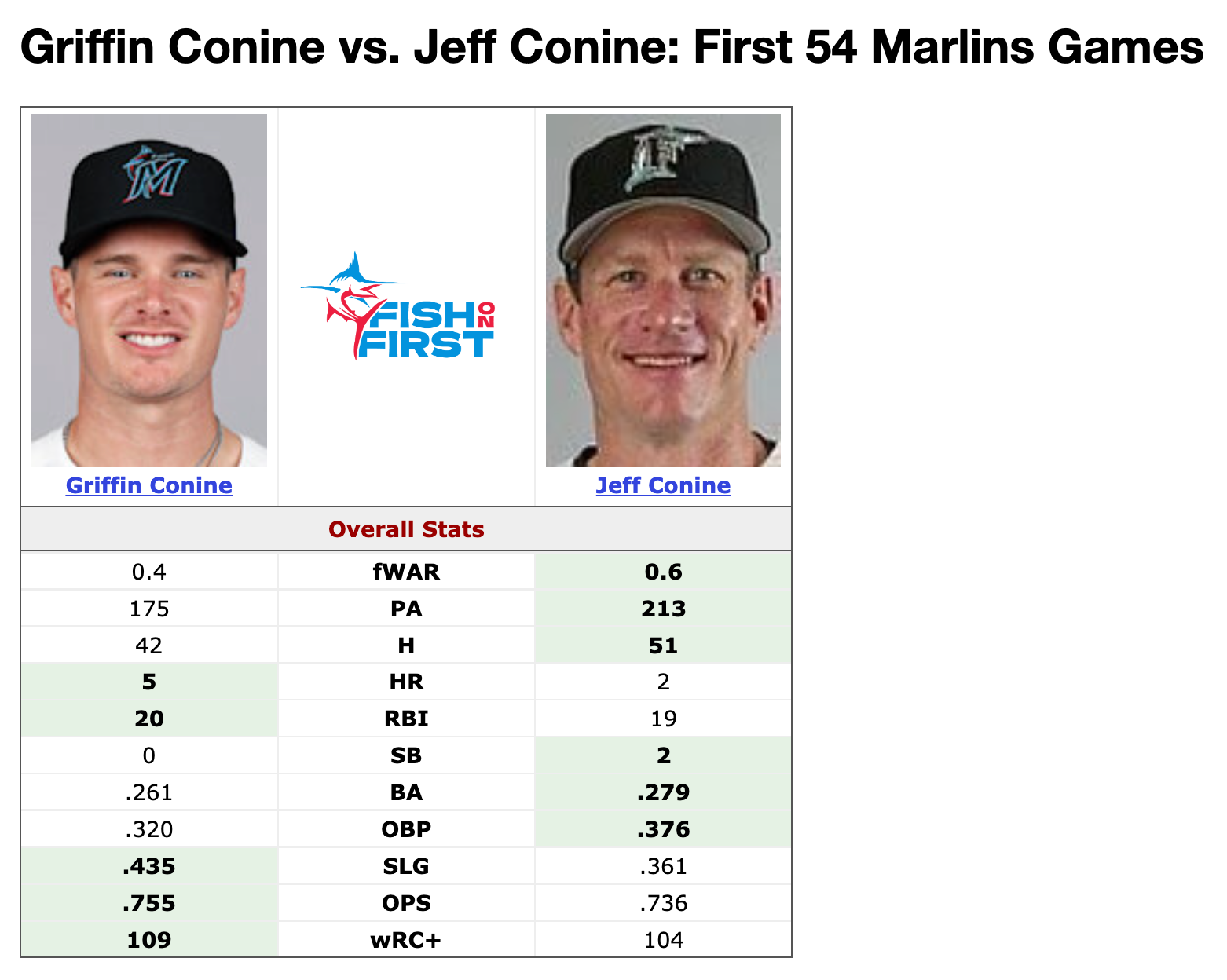
Age is a massive variable when projecting a baseball player’s future. Jeff was an outlier who celebrated his 27th birthday midway through his rookie season and still wound up compiling 22.1 fWAR. For context, there are zero active hitters whose careers meet those criteria—the closest comps would be Jeff McNeil and Mike Yastrzemski.
Already 28 years old, Griffin is even more of a late-bloomer. To be fair, the COVID-related cancellation of the 2020 MiLB season deprived him of valuable reps, and he was sidelined for the vast majority of the 2025 season after dislocating his non-throwing shoulder on a slide, which is a rare (some would say “unlucky”) injury in this sport. Even without considering genetics, there’s reason to believe that he offers more upside than the typical 28-year-old with his résumé would.
The younger Conine will not be following directly in his dad’s footsteps. He’ll swing-and-miss more frequently and receive less consistent playing time (the byproduct of living in this era where teams are obsessed with gaining the platoon advantage). If Conine can be for the Marlins what Brandon Moss was during the 2010s, that’d be a great outcome.
Beginning next week, Conine will be playing for Tigres del Licey in the Dominican Winter League. Nearly half of the pitchers in the league have previous MLB experience, so it’s the best environment for Conine to continue challenging himself heading into what will hopefully be his first complete MLB season in 2026.