
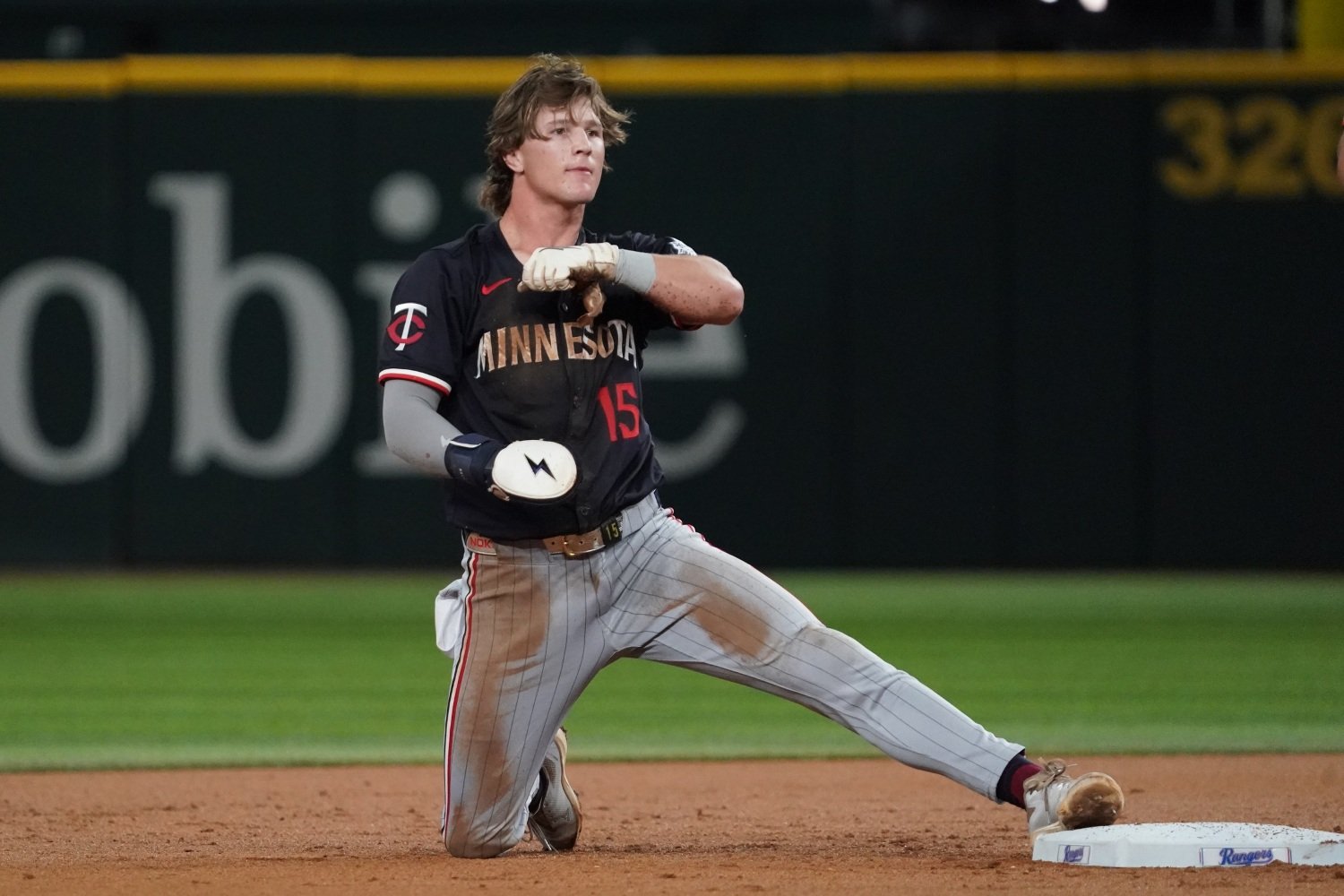
You read that right. This September, the Twins have stolen 34 bases. The next-highest total for a team is 25, by the Baltimore Orioles. And it’s not like the Twins have been inefficient, either. They’ve only been caught six times, successfully stealing 85% of the time, which ranks them as the ninth-most efficient team in the league during that period. Since the trade deadline, they have the second-most stolen bases, at 57. They’ve been caught only 12 times, an 83% success rate, which ranks eighth in efficiency. Only the New York Yankees have stolen more bases since the deadline (58).
Granted, part of the runaway by the Twins (pun intended) could be chalked up to some teams taking their foot off the gas at the end of the season, opting to take fewer risks now that their teams are either out of contention or locked into a playoff spot, but to have 36% more stolen bases than the second-highest team over the course of a month is notable—especially for a team like the Twins.
From the 2024 season back to 2018, the Twins have ranked 30th, 24th, 30th, 25th, 30th, 30th, and 27th, in that order, in stolen bases per year. Over the past 10 seasons, the Twins rank dead last in baseball in stolen bases. This year? They’ve snuck up to 15th, with 112 steals, 57 of those (over half) coming in August and September. Those 112 are the most bases the team has stolen since 2012, and if they steal four more in their final three games, they’ll be tied for their second-highest total since 2000.
That’s a heck of a development. After the trade deadline, the team has made a concerted effort to lean more heavily into the running game—a move that has been echoed around the league, due to rule changes regarding pickoffs and base sizes. But beyond the league-wide shift toward running more, the Twins’ formula—slugging teams to death—hasn’t worked. As a whole, the team is below-average offensively (.708 OPS and 97 wRC+, both 17th in MLB), which necessitates that they attempt to score runs some other way, or at least vary their approach.
A lot of this effort has been spearheaded by Byron Buxton, who is 24-for-24 stealing bases this season and has accounted for 21% of the team’s total stolen bases in his healthiest year since 2017. However, only seven of those have come in August and September. Royce Lewis has been the standout in this late-season effort, going 11-for-12 since the deadline, more than doubling his career steals total, and Austin Martin, the belle of the post-deadline ball, is 11-for-14. Luke Keaschall has also helped in the effort, going 9-for-12, and Kody Clemens (perfect on five attempts) and Matt Wallner (four of five) have sneakily added to the total.
Actually, almost all of the Twins who have played a game since the deadline have attempted a steal—the lone exception being depth catcher Jhonny Pereda. Yes, even Carson McCusker and Ryan Jeffers have tried to steal (unsuccessfully), and lead-footed Christian Vázquez and Brooks Lee have both been successful in their only steal attempts. Some of these attempts are failed pickoffs that the opposing teams have thrown away after successfully catching the newly aggressive Twins leaning, but that’s baked into every team’s throwing numbers. It’s been fun to watch everyone get the green light.
Yes, much of this effort has been spearheaded by the fastest guys still on this team. But some of those fast guys are new additions—like Keaschall and Martin—who replaced other fast guys like Harrison Bader and Willi Castro, and they’ve been given the green light far more often than even the fastest guys have in the past.
And the slow guys? Sure, they’re allowed to run now, too, though that’s not necessarily a new development. Last season, Trevor Larnach, Carlos Santana, Jeffers, Vázquez, Wallner, and Lee, among the slowest players in baseball (with the exception of Wallner, who is more middle-of-the-pack but with poor acceleration) managed to go 20-for-22 stealing bases, stealing off pitchers who stopped paying attention to them. I think this is where I’m supposed to say that the Mariners’ rotund first baseman Josh Naylor is 29-for-31 this season and that stealing bases isn’t all about being fast, or whatever.
The biggest development in this regard is probably Royce Lewis’s emergence as a base stealer. Once a prospect with 70-grade speed, Lewis has been slowed by repeated lower-body and core injuries, including tearing his ACL twice in a little over a year, to the point that he’s now in the bottom third of the league in sprint speed as a 26-year-old. Despite his speed, scouts had questions about his ability to consistently steal bases in the big leagues, and he wasn’t an electric base stealer before the injuries, successful on just 74% of his steal attempts between Single-A and Double-A.
For years, the reasoning for the Twins not utilizing the running game was that they were simply slow. Now, though, they’re not exactly fast, but they’re also not the slowest team in baseball. They’ve just been given the green light far more often. The other argument against them running was health, and that’s reared its ugly head this season, with Buxton appearing shaken up after a couple of steals and Keaschall ending his season with an injured thumb that may require offseason surgery. So I guess they were onto something there.
Some of this success may be a gap in the scouting reports. If a team has spent a decade stealing almost no bases, they’re naturally going to see less attention from pitchers and catchers. You’d guess that by this point in the season, those would start to change, but they’ve only increased their number of steals and gotten more efficient as the season has gone on. It’s fascinating, and it may be the proof of concept that the team needs to lean more into the running game in 2026—if they can stomach the risk, when they may be trying to compete for real again.