
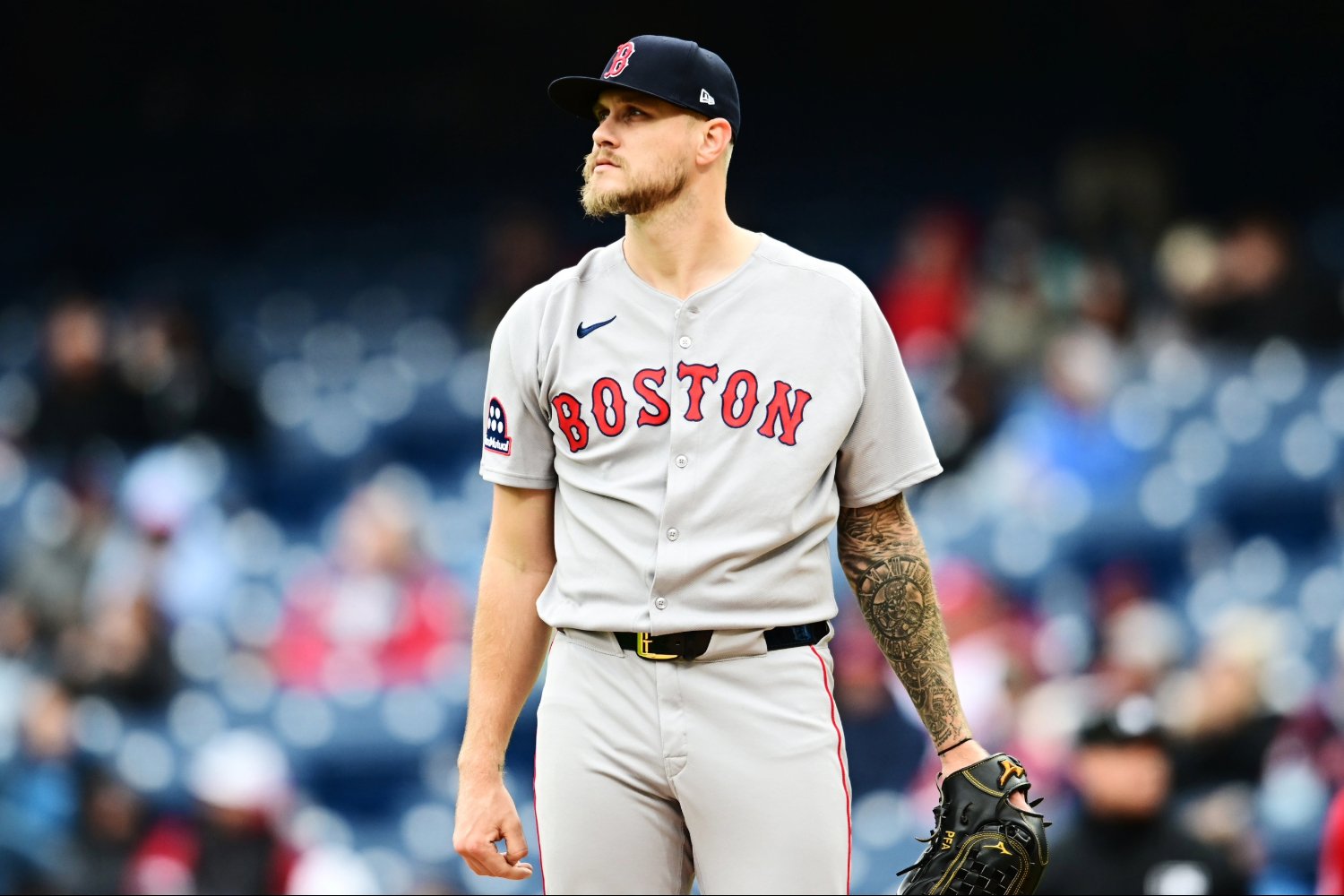
With the offseason having begun for the Boston Red Sox, the organization now needs to make tough decisions pertaining to its roster. One of which involves a former All-Star and a key component of their rotation, Tanner Houck.
Houck, a first-round draft pick in 2017, has been a part of Boston’s pitching plans since 2020, when he first made his MLB debut. Since that time, Houck has bounced between the rotation and bullpen depending on the team’s need, even serving briefly as the team’s closer before getting shut down in 2022 due to a back issue.
After dealing with injuries in every season since 2021, Houck appeared to finally break out and put everything together in 2024, when he made the All-Star team and became the ace of the rotation as the team tried to claw its way into the playoffs. The future seemed bright for both Houck and the team once he was paired with Garrett Crochet as the team’s 1-2 punch in the rotation last winter.
Unfortunately, that vision never came to fruition, as Houck began the 2025 season incredibly ineffective and inconsistent before going on the injured list. In nine starts, Houck allowed 39 earned runs on 57 hits, 10 of them home runs, and 17 walks. Opponents’ batting average against ballooned from .230 in 2024 to .315 in 2025. Houck attempted to work his way back from injury in 2025, but upon completing his rehab, he was still in pain, and it was revealed that his flexor strain had turned into a need for surgery. On August 2, Houck would undergo Tommy John surgery, ending his 2025 season and costing him (more than likely) his 2026 campaign.
Because of this, the Red Sox have a decision to make. Houck is still under arbitration for both the 2026 and 2027 seasons, but will be unlikely to pitch in the former while the latter is very likely headed to a shortened season due to a potential lockout. Does it make sense in that case for the Red Sox to non-tender the right-hander instead of offering arbitration? For 2025, Houck made $3.95 million and will be unlikely to receive any notable increase for 2026 knowing he would be out for the entire season. There’s a chance they could instead have his salary be decreased by the maximum 20% in the arbitration process, but even then they would be paying around $3.2 million for a player to rehab.
With these Red Sox, that isn’t out of the realm of possibility considering they’ve signed players to multi-year deals who they knew they would miss most or all of the first season of a contract. Patrick Sandoval and Liam Hendriks are prime examples, and it would be a tough look for the Red Sox to non-tender a homegrown player due to injury while having signed injured players in the past so they could rehab within the organization.
Because of that, the Red Sox would be wise to follow a format used previously by themselves when it comes to signing injured pitchers. Take both Hendrik’s contract and Sandoval’s contract into account, where both players were signed to multi-year deals that were heavily backloaded. In Hendrik’s case, he received a guaranteed $10 million across two years with the chance for it to increase to $20 million across three years. The contract worked with him receiving $2 million in the first season (which he missed) and then $6 million this season, with a mutual option for $10 million for next season or a $2 million buyout. Had Hendrik’s time in Boston worked out, the team would have gotten an elite back-of-the-bullpen arm on a rather cheap deal. Instead, Hendriks was often injured and when he did pitch, he was mostly ineffective on the mound.
Sandoval, on the other hand, was signed to a two-year, $18.25 million contract despite having Tommy John surgery in 2024 and missed all of 2025. He received $5.5 million this season and will now earn $12.75 million in 2026 as the Red Sox hope he proves the contract was worth it.
The Red Sox would be smart to try and work out a similarly structured deal with Houck, especially knowing the talent he has shown signs of when healthy. It would be worth an attempt to try and sign Houck to something similar to Hendricks’ three year deal with the third year being a mutual option or even a vesting option based on either innings or appearances in 2027. It would allow the Sox to keep Houck around for a few more seasons at a reasonable price as he rehabs, while not delaying the right-hander’s free agency too far out. Even if he fails to reach his 2024 self and instead pitches to his career averages, that’s still a guy with a 22.4% strikeout rate and 3.97 ERA.
Of course, the team could just non-tender him and look to bring him back on a minor league deal, though Houck may seek out other major league opportunities in that case.
In the end, it’s completely up to Craig Breslow and the team to decide what course of action they’ll take, but they currently have multiple options and paths to look at for the 29-year-old pitcher. Whether Houck is in the organization by the end of the offseason is something they will have thought about long and hard before deciding either way. Though one thing about Breslow is that he’s shown no hesitation to moving players who have been part of the organization if he thinks the Red Sox will be a better team without them.