
“How much have you ever lost on a coin toss?” is a line delivered masterfully by Javier Bardem’s titular character, Anton Chigurh, in the movie “No Country for Old Men”. It’s sneered in the direction of an unsuspecting, aging, gas station clerk, as Anton flips a coin and asks the man to call it: heads or tails. The insinuation is that the clerk is playing for his life. Call it correctly and he lives, call it incorrectly and he dies. It is a haunting moment.
This same backdrop can be applied to the MLB playoffs. No one is holding MLB teams at gunpoint, but the concept of a coin toss seems apt when it comes to teams’ chances of surviving and moving beyond each round of the playoffs. Since playoff expansion to 12 teams, entering 2025, six of 12 higher seeds in the NLDS had moved on; exactly a 50/50 split. Entering last night in Milwaukee, FanGraphs gave the Brewers a 52% chance to win and move on to the NLCS. Call it correctly and you’ll be rewarded with flying to Los Angeles to meet the Dodgers. Call it incorrectly, and you get to start your offseason a little bit earlier.
The Cubs’ moment to stare down baseball mortality came in the top of the sixth inning. The Cubs, down 2-1 on the scoreboard are not dead; truly one swing of the bat can swing momentum back in their favor, but their lifelines are quickly running short. They did’no; have many chances to climb out of this hole remaining. Using the win probability chart provided by Baseball Savant to quantify just how the game is slipping away from them, the game odds have shifted towards the Brewers, sitting at 67% likelihood to win.
As the inning began, Brewers manager Pat Murphy selected left handed Aaron Ashby out of the bullpen. That made his third time facing the Cubs in the truncated series; the Cubs are quite familiar with him at this stage. Both teams needed to require some shaky decisions to get them through Johnny Wholestaff games like this, and the Brewers decided that would be their time to gamble. They quickly jumped on Ashby, as first baseman Michael Busch singled up the middle—despite sporting a sub-90 wRC+ against lefty pitchers this year. Nico Hoerner was then plunked by a non-competitive waste pitch, as the left-handed hurler lost all semblance of control. The winds of probability had shifted, from 67% in favor of Milwaukee to just 52%; it was a coin toss once again. The Cubs’ had given themselves a platform to win the baseball game. All they had to do is call it in the air.
Realistically, Chicago couldn’t be in a better position. The tying run was on second, and the middle of the order would get a shot at a familiar pitcher with waning control. Ashby had to pitch to Kyle Tucker, due to MLB’s three-hitter-minimum rule. Tucker had walked twice against Ashby in the series already, and the lefty had never retired the Cubs’ star outfielder. Tucker is essentially split neutral; Ashby wouldn’t be saved simply due to his splits. He was going to have to make some real pitches to get out of this.
Pitch one to Tucker was yet another uncompetitive ball, a sinker out of the zone that no one would consider offering on. A second pitch was a decent, inside sinker that Tucker fouled off. Three and four were once again, poor balls off the plate, putting Tucker in the driver’s seat. Then Ashby made a mistake: he piped a 98-mph fastball right down Broad Street. Tucker, on the year, wasn’t great on 98+ mph heaters in the middle of the plate, sporting just a .300 xwOBA on the pitch, but that was going to be his best chance for his signature Cubs moment. With a mighty swing of the bat, Tucker could deposit this get-me-over-heater into right field, putting the Cubs up on the scoreboard and deflating the raucous crowd in attendance. Instead, he swung through it for strike two. Tucker’s hero moment would turn into a “Casey-At-The-Bat” moment one pitch later; he struck out. Ashby’s night was done after this, but the Brewer’s weren’t out of the woods yet.
With Seiya Suzuki strolling to the plate, the Brewers swapped Ashby for rookie Chad Patrick. Patrick was a member of the starting rotation for much of the year, but has been used out of the pen in the playoffs. He generally throws three pitches; a cutter, a sinker, and a fastball, which generally grade out well using FanGraphs’s Stuff+ model, especially considering the boost they receive out of the pen. Suzuki, however, does well against these types of pitches, his lowest xwOBA on any of those types of pitches on the 2025 season was a .380 on cutters, so something had to give; you had a good pitcher going against a hitter who excels against his offerings.
Patrick did himself no favors, starting the Cubs’ right fielder with back-to-back misses and putting himself in a 2-0 count. Hitters who get up 2-0 in the count have a .410 wOBA and Suzuki, himself, has a massive .450 wOBA in this count. His OBP when ahead 2-0 in the count sits at .482; we’re back to a coin toss. If Suzuki could get on, even via a walk, the Cubs wouldn’t even need a hit to score the tying run. A well-placed fly ball would get the job done. The rookie righty battled back, however, leveling the count at 2-2 by getting Suzuki to expand the zone and chase a 97-mph fastball well above where the hitter would like to swing. Unlike Tucker with two strikes, though, Suzuki didn’t swing and miss when he was offered a hittable pitch, as the fourth cutter thrown in this specific plate appearance was one that the hitter saw well, and he crushed it: 101.6 mph off the bat, the ball screaming toward left field.
Suzuki couldn’t have chosen a better fielder to hit the ball to. Chourio is a good fielder, and a great runner, but on Saturday night, there was a reason he was playing in left instead of his customary center field; he was sporting a bum leg. Making him run into the gap was going to push him to his limits. Alas: unlucky. From one outfielder to another, the ball was caught nearing the warning track, harmlessly finding its way to Chourio’s glove, bum leg and all. “How much have you ever lost on coin toss?”
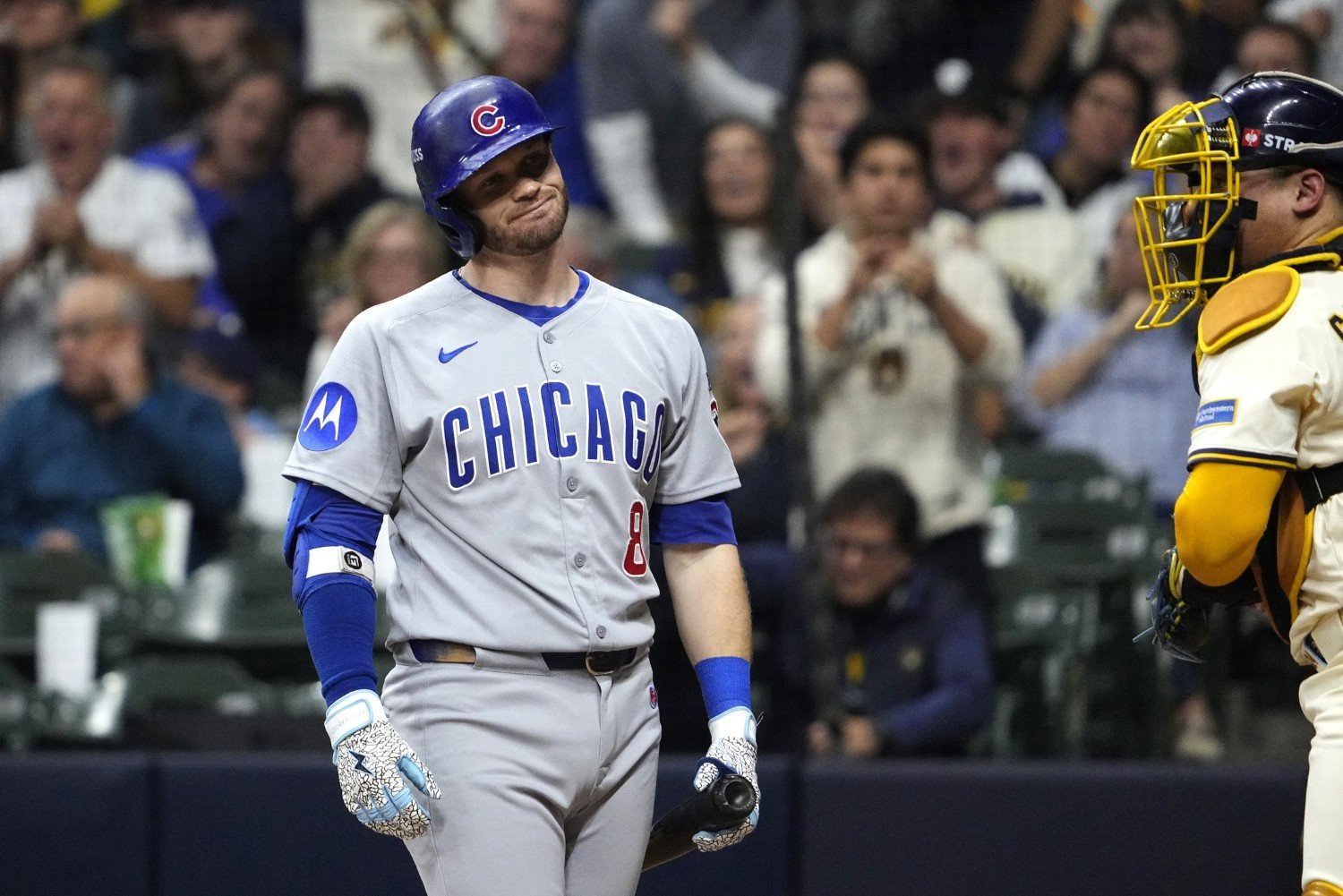
All was not lost, however. Game 4 hero Ian Happ still had a chance to tie the game. Happ, unfairly maligned in Cubs social media circles, looked great Thursday against Brewers ace Freddy Peralta. Not only did he smash a home run directly into the teeth of the wind to give the Cubs the early lead, but had the winds been kind to him, he likely would have ended up with multiple home runs; he hit three separate fly balls over 101 mph off the bat. Saturday night, there was no wind to take a hit away from the Cubs’ left fielder in a climate-controlled Uecker Field, Happ was free of weather complications. One more strong swing in the sixth would at least bring home Busch, and if the left-handed-hitting Happ could hook a ball down the right-field line, the speedy Hoerner may have been able to score. The last two plays had lowered the Cubs’ chances of winning to under 35%, but one swing still could have changed everything.
Happ has absolutely crushed sinkers on the season. His +11 run value on the pitch is among the league leaders, and his xwOBA on the pitch is .496. You probably don’t want to throw a sinker to Ian Happ. On a 1-0 count, Patrick did just that, and one down the heart of the plate. Happ watched it sail by. I’m sure he’d like that pitch back; just 15 hitters in the league have a better xwOBA on sinkers thrown in the heart of the plate. This was placed on a tee for him, and he just stood there.
Now at 1-1, and perhaps out of frustration from watching the previous pitch, Happ chased the sinker, this time well out of the zone to get up 1-2 in the count. There was no hope for the Cubs hitter to do anything on that pitch, the moment he chose to swing. The Cubs were down to their last strike in the inning, their last gasp at getting Busch home to tie the game up. After spiking his rarely-used new slurve, Patrick threw another. It was at the bottom of the zone, but hittable, and Happ was just in front of it—another foul ball. He remained alive in the at-bat, if barely.
The count remained 2-2. The Brewers had already hit two home runs on the day. William Contreras‘s and Andrew Vaughn‘s bombs came on full counts with two outs, so anything is possible. Perhaps the Cubs could turn the tables on Milwaukee with two strikes this time. It’s moments like these in which teams separate themselves. Unlike in “No Country for Old Men”, this is not just a coin flip; the participants have agency. They make swing decisions, and they impact the game on their own. On this pitch, Happ chose not to swing. He put his fate into the hands of the home-plate umpire, who (correctly) rang him up on a perfectly placed cutter on the outside edge of the plate. It’s a pitch that sometimes is called a ball. It wouldn’t be that crazy if it went his way, but Happ never moved the bat and it didn’t go his way. Strike three.
50-50 situations are littered across baseball, and the sixth inning was a perfect microcosm of them. The Cubs had brought the game back to, virtually, a coin flip. They had a ball hit with an exact expected batting average of .500. They had a pitch called strike three, right on the black. These are things that could go either direction. In another universe, Suzuki’s line drive to left field is just five or six feet more into the gap, tying the game. Or maybe the home plate umpire misses Happ’s call, and gives him a shot at 3-2, with the runners going on the pitch. Maybe Tucker or Happ punishes pitches over the heart of the plate, instead of them getting to the catcher’s glove. Should have. Would have. Could have.
So, Chicago, how much have you lost on a coin toss? For the Cubs in Game 5, they certainly lost the game. They lost a chance to become the 11th team to come back from a 2-0 deficit in a three-game set. They may have lost Kyle Tucker to free agency, though that has yet to be settled. The Cubs had a chance to make their own version of history in the sixth inning, but couldn’t make things happen on their own. Nor did the ball bounce in their direction.
These moments were the difference between the Brewers and the Cubs in 2025. When it was time for the 50-50 situations, it always felt like the Milwaukee Brewers had a little extra magic, while the Chicago Cubs had a little extra bad luck. That’s not taking away anything Milwaukee did. They won 97 games this year, but the difference, sometimes, between winning and losing can come down to those little coin flips, and the teams who advance are generally those whom fortune favors. Maybe next year the Cubs will call “tails” instead of “heads” when Anton Chigurh comes a-knockin’.