
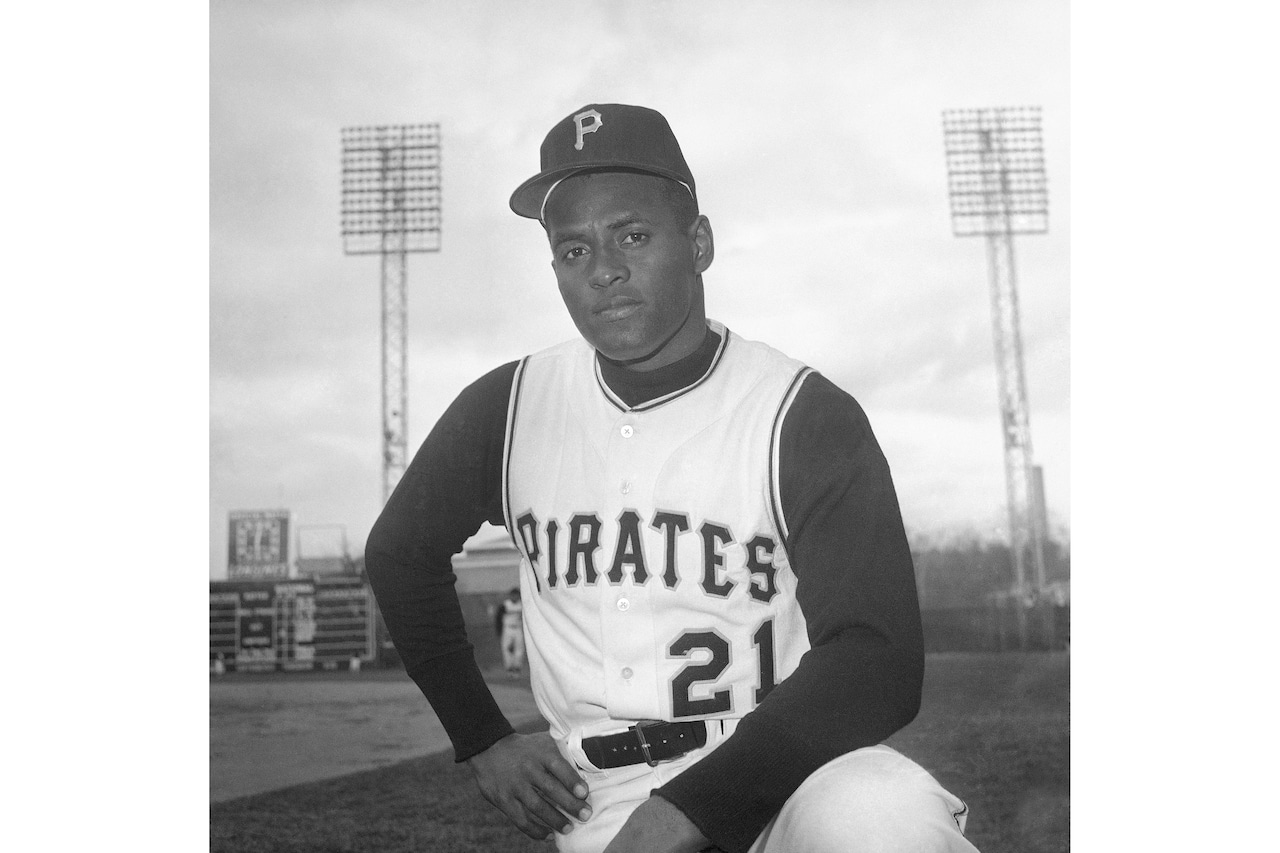
Roberto Clemente was born in Carolina, Puerto Rico. Today, the town has about 125,000 people, dwarfing the size when Clemente was born there in 1934.
Maria Isabella Casares was a school teacher. She had taught the children of Carolina for 30 years, most of which was in 10th grade. Among all the children she taught, Roberto Clemente was something even more special to her. His father was an overseer at a sugar plantation, but he did not make much money, she explained in an empty classroom at Julio Coronado School.
PART 1: Roberto Clemente’s last mission was a story of sacrifice
“But then, there are no rich children here. There never have been. Roberto was typical of them. I had known him when he was a small boy because my father had run a grocery store in Carolina and Roberto’s parents used to shop there,” she said.
There is this thing that you have to know about Maria Isabella Casares before we hear more from her. She is the model of what a teacher should be. There is this common bond of mutual respect between her and her students. Earlier in the day, I had watched her teach a class in the history of the abolition movement in Puerto Rico. I don’t speak much Spanish, but even to me, it was clear that this is how a class should be and these are the kinds of students such a teacher will produce.
With this as a background, what she had to say about Clemente carries much more impact.
“Each year,” she said, “I let my students choose the seats they want to sit in. I remember the first time I saw Roberto. He was a very shy boy, and he went straight to the back of the room and chose the very last seat. Most of the time, he would sit with his eyes down. He was an average student. But there was something very special about him. We would talk after class for hours. He wanted to be an engineer, you know, and perhaps he could have been. But then he began to play softball, and one day he came to me and said, ‘Teacher, I have a problem.
“He told me that Pedrin Zarrilla, who was one of our most prominent baseball people, had seen him play and that Pedrin wanted him to sign a professional contract with the Santurce Crabbers. Roberto asked me what he should do.
“I have thought about that conversation many times. I believe Roberto could have been almost anything, but God gave him a gift that few have, and he chose to use that gift. I remember that on that day I told him, ‘This is your chance, Roberto. We are poor people in this town. This is your chance to do something. But if in your heart you prefer not to try, then, Roberto, that will be your problem — and your decision.’”
There was, and there always remained, a closeness between this boy and his favorite teacher.
“Once, a few years ago, I was sick with a very bad back. Roberto, not knowing this, had driven over from Rio Piedras, where his house was, to see me,” Casares said.
“Where is the teacher?” Clemente asked Casares’ stepdaughter that afternoon.
“Teacher is sick, Roberto. She is in bed.”
“Teacher,” Roberto said, pounding on the bedroom door, “get up and put on your clothes. We are going to the doctor whether you want to or not.”
“I got dressed,” Casares told me, “and he picked me up like a baby and carried me in his arms to the car. He came every day for 15 days, and most days, he had to carry me. But I went to the doctor, and he treated me. Afterward, I said to the doctor that I wanted to pay the bill.
“Mrs. Casares,” he told me. “Please don’t start with that Clemente or he will kill me. He has paid all your bills, and don’t you dare tell him I have told you.
“Well, Roberto was like that. We had been so close. You know, I think I was there the day he met Vera, the girl he later married. She was one of my students, too. I was working part-time in the pharmacy, and he was already a baseball player by then, and one day, Vera came into the store.
“Teacher, who is that girl?” Clemente asked Casares.
‘That’s one of my students,” I told him, “Now, don’t you dare bother her. Go out and get someone to introduce you. Behave yourself.”
He was so proper, you know. That’s just what he did, and that’s how he met her, and they were married in Carolina in the big church on the square.
On the 1972 night when Clemente died in a plane crash, Casares was at home when a delivery boy from the pharmacy stopped by and told her to turn on the radio and sit down.
“I think something has happened to someone who is very close to you, Teacher, and I want to be here in case you need help,” she recalled.
Later, when we were standing in front of the empty crypt in the cemetery at Carolina, where Clemente would be buried, Casares told me: “He was like a son to me. Whatever you write, make people — particularly our people, our Puerto Rican children — understand what he was. He was like my son, and he is all our sons in a way. We must make sure that the children never forget how beautiful a man he was.”
The series will conclude Wednesday.
If you purchase a product or register for an account through a link on our site, we may receive compensation. By using this site, you consent to our User Agreement and agree that your clicks, interactions, and personal information may be collected, recorded, and/or stored by us and social media and other third-party partners in accordance with our Privacy Policy.