

Across 464 plate appearances, Ryan Jeffers posted the second-most productive season of his six-year career in 2025. His .752 OPS, 47 runs scored, 47 runs batted in, and wRC+ of 113 were each his second-best outputs. His 10.8% walk rate and 19.6% strikeout rate were not only career bests, but considerably better than his career averages. One area in which his offense seemed to regress, however, was in the power department.
After hitting a combined 35 home runs across 281 games in 2023 and 2024, the Twins’ erstwhile backstop hit just nine in 2025. Despite a career high in doubles (26), this power outage led to a career-low isolated power (ISO) of .131, 65 points lower than his career mark entering the season. For those unfamiliar with it, ISO measures a player’s raw power, by subtracting their batting average from their slugging average to find the number of extra bases they accrue per at-bat. The league’s average ISO this year was .159. Given his doubles output, you might think Jeffers was just the victim of some bad luck, but his Savant profile tells a different story.
Despite his hard-hit rate falling in the 44th percentile for the league, his mark of 42.1% was above his career average—but that didn’t translate to a strong quality of contact, as evidenced by a career-low 6.3% barrel rate. At the macro level, Jeffers seemingly adjusted his approach at the plate, but what implications did that have on the micro level? Can Jeffers’s loss of power be attributed to more hesitant swing decisions, which then impacted the timing and quality of contact on the ball? Let’s keep diving.
One significant shift in his swing decisions in 2025, compared to previous seasons, was swinging at pitches in the upper and inner halves of the zone. For many hitters, those zones are their bread and butter. It typically leads to more pull-side power, which leads to more home runs.
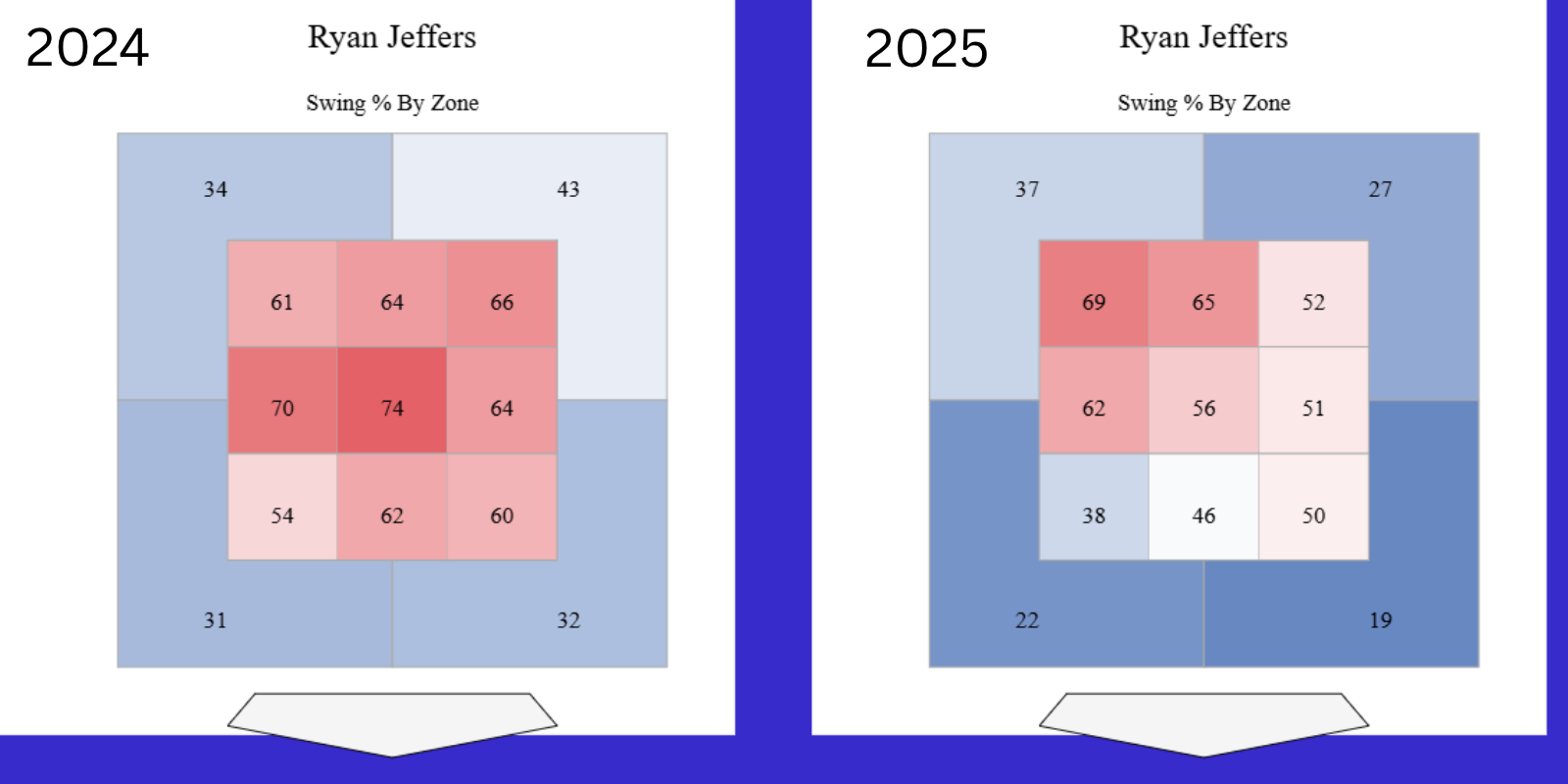
Additionally, Jeffers stood deeper in the box and further away from home plate, while also adopting a more open stance. It stands to reason that Jeffers adjusted his mental and physical approach to the plate in an attempt to target inside pitches and create more power. However, that reasoning falls apart quickly when you look at the batted-ball data.
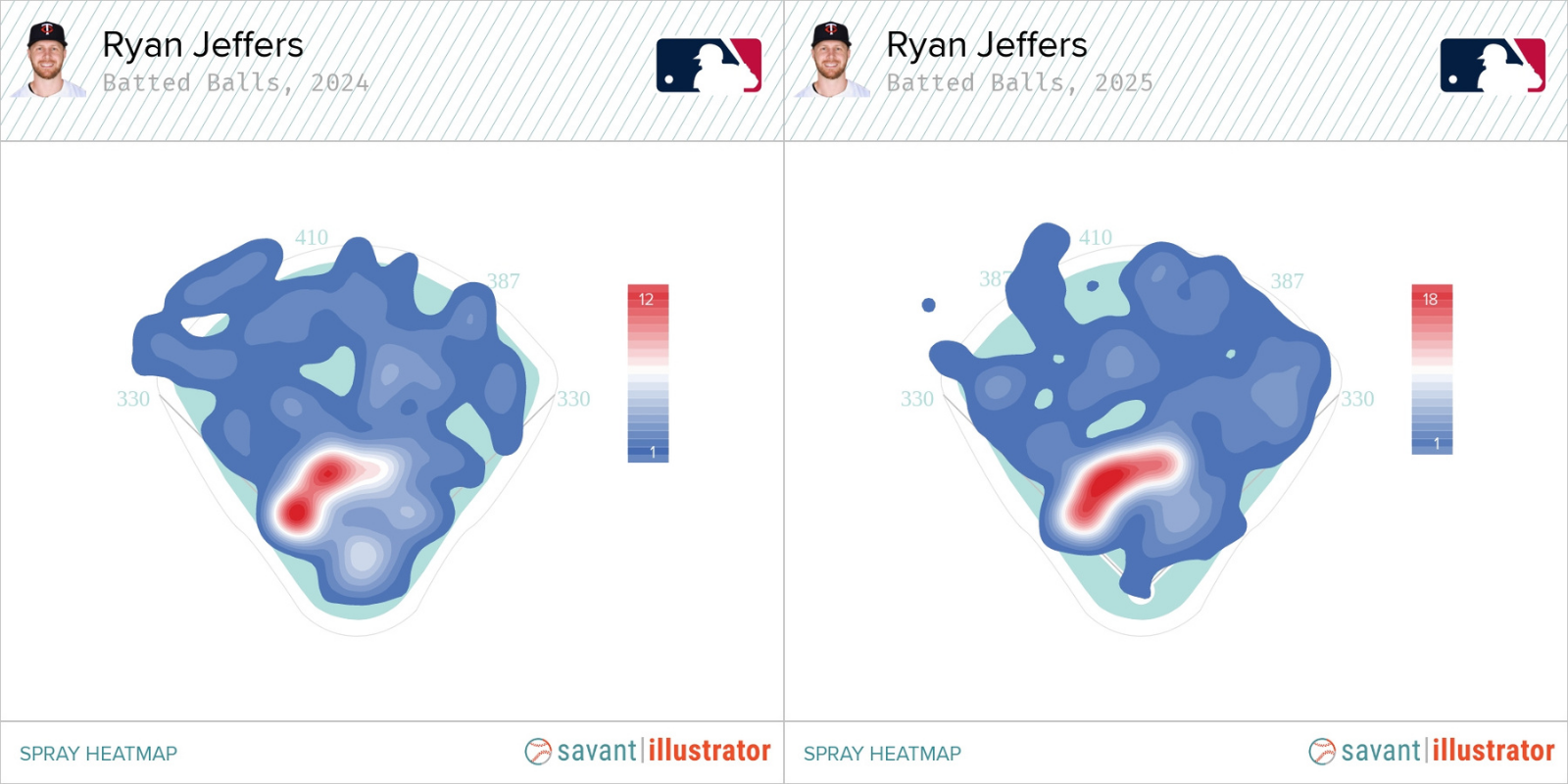
Jeffers pulled the ball less in 2025 and went to the opposite field more—not an ideal outcome when setting your sights on the inner part of the zone. His bat speed has dropped in each of the last two seasons, from 73.9 mph in 2023 to 72.3 mph in 2025. In 2023, he ranked in the 78th percentile, whereas in 2025, he’s merely average. In all, his approach at the plate led to the bat meeting the ball deeper in the zone. It led to a decrease in his quality of contact, and ultimately to fewer pull-side air outcomes in 2025.
It shouldn’t be overlooked that Jeffers performed 13% better than the average hitter in 2025. While he didn’t provide the power we’re accustomed to, he was still a productive hitter—and maybe not as productive as he could have been, given the imperfect translation from approach to results. In 2026, he could return to his previous approach, or (if he believes he can better convert what he did at bat from plan to action) he could double down on this attack and try to tap all the way into all that latent pop.