
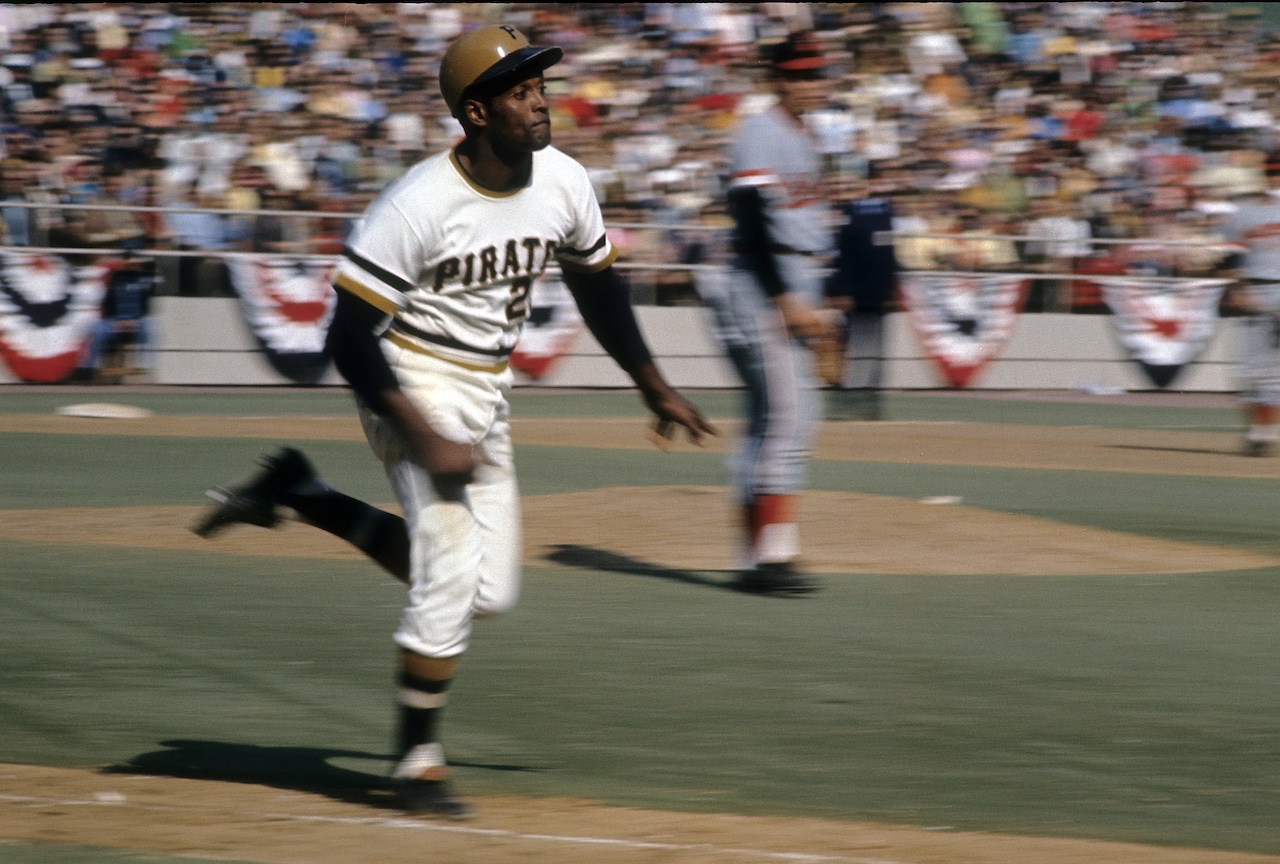
The next person to touch Roberto Clemente was Pedrin Zarrilla, who owned the Santurce club. He was the man who discovered Clemente on the country softball team, and he was the man who signed him for a $400 bonus.
“He was a skinny kid,” Zarrilla recalled, “but even then, he had those large, powerful hands, which we all noticed right away. He joined us, and he was nervous. But I watched him, and I said to myself, ‘This kid can throw, and this kid can run, and this kid can hit. We will be patient with him.’ The season had been through several games before I finally sent him in to play.”
PART 1:Roberto Clemente’s last mission was a story of sacrifice
PART 2:Before the legend, there was a teacher: Roberto Clemente ‘was like my son’
Luis Olmo, an outfielder with the Brooklyn Dodgers, remembered that game. When I met him, he was in the insurance business in San Juan. He sat in his office and recalled very well that first moment when Clemente stepped up to bat.
“I was managing the other team. They had a man on base, and this skinny kid comes out. Well, we had never seen him, so we didn’t really know how to pitch to him. I decided to throw him a few bad balls and see if he’d bite.
“He hit the first pitch. It was an outside fastball and he never should have been able to reach it. But he hit it down the line for a double. He was the best bad-ball hitter I have ever seen, and if you ask major-league pitchers who are pitching today, they will tell you the same thing.
“After a while, it got so that I just told my pitchers to throw the ball down the middle because he was going to hit it no matter where they put it, and at least if he decided not to swing, we’d have a strike on him. I played in the big leagues. I know what I am saying. He was the greatest we ever had, maybe one of the greatest anyone ever had. Why did he have to die?”
Once Zarrilla turned him loose, there was no stopping Clemente. As Clemente’s confidence grew, he began to get better and better. He was the one the crowds came to see at Sixto Escobar Stadium.
“You know, when Clemente was in the lineup,” Zarrilla said, “there was always this undercurrent of excitement in the ballpark. You knew that if he was coming to bat, he would do something spectacular. You knew that if he was on first base, he was going to try to get to second base. You knew that if he was playing right field and there was a man on third base, then that man on third base already knew what a lot of men on third base in the majors were going to find out — you don’t try to get home against Roberto Clemente’s arm.”
Soon, the major-league scouts began to make their moves, and in 1955, Clemente came to the Pittsburgh Pirates. He was the finest prospect the club had had in a long, long time. But the Pirates of those days were spectacular losers, and even Clemente couldn’t turn them around overnight.
“I will never forget how fast he became a superstar in this town,” said Bob Friend, a former Pirates pitcher. “Later, he would have troubles because he was either hurt or thought he was hurt, and some people would say that he was loafing. But I know he gave it his best shot, and he helped make us winners.’’
The first winning year was 1960, when the Pirates won the pennant and went on to beat the Yankees in the seventh game of the World Series. Whitey Ford, who pitched against him twice in that Series, recalled that Clemente actually made himself look bad on an outside pitch to encourage Ford to come back with it.
“I did,” Ford recalled. “And he unloaded. Another thing I remember is the way he ran out a routine ground ball in the last game, and when we were a little slow covering, he beat it out. It was something most people forget, but it made the Pirates’ victory possible.”
The season was over. Clemente had hit safely in every World Series game. He had batted over .300. He had been a superstar. But when they announced the Most Valuable Player Award voting, Roberto had finished a distant third.
“I really don’t think he resented the fact that he didn’t win it,” Friend said. “What hurt — and in this he was right — was how few votes he got. He felt that he simply wasn’t being accepted. He brooded about that a lot. I think his attitude became one of, ‘Well, I’m going to show them from now on so that they will never forget.’
“And you know, he sure did.”
Clemente went home and married Vera. He felt less alone. Now he could go on and prove what it was he had to prove. And he was determined to prove it.
His moment finally came. It took 11 years for the Pirates to win a World Series berth again, and when they did in 1971, it was Clemente who led the way. “I will never forget him as he was during that 1971 Series with the Orioles,” his teammate Willie Stargell told me. The Pirates were expected to lose, and they, in fact, dropped the first two games in Baltimore.
When they got back to Pittsburgh for the middle slice of the tournament, Clemente went to work and led his team. He was a superstar during the five games that followed. He was the big man in the Series. He was the MVP. Most important of all, the entire country saw him do it on network television, and never again — even though nobody knew it would end so tragically soon — was anyone ever to doubt his ability.
The following year, Clemente ended the season by collecting his 3,000th hit. Only 10 others had ever done that in the entire history of baseball.
“When I think of Roberto now,” Stargell, his closest friend on the Pirates, told me, “I think of the kind of man he was. There was nothing phony about him. He had his own ideas about how life should be lived, and if you didn’t see it that way, then he let you know in so many ways, without words, that it was best you each go your separate ways.
“He was a man who chose his friends carefully. I didn’t think many people took the time and the trouble to try to understand him, and I’ll admit it wasn’t easy. But he was worth it.
“The way he died, you know, I mean on that plane carrying supplies to Nicaraguans who’d been dying in that earthquake — well, I wasn’t surprised he’d go out and do something like that. I wasn’t surprised he’d go. I just never thought what happened could happen to him.
“But I know this …”
And then Stargell put his head in his hands and cried. It took a minute for him to compose himself. “He lived a full life. And if he knew at that moment what the Lord had decided, well, I really believe he would have said, ‘I’m ready.’ That is who he was.”
He was 38 years old when he died. He touched the collective heart of Puerto Rico in a way that few people ever could. He touched a lot of other hearts of people who understood who he really was.
About a decade later, I was back in Carolina to invite Vera Clemente to Newark to dedicate a grammar school named in his honor. The student body was heavily Puerto Rican. She joyously accepted. Before I left, she told me that every year on her husband’s birthday, she returned to that jagged piece of land I had seen by the dawn’s early light on my first trip. She explained she always dropped rose petals into the angry waves and stood there silently until they vanished.
If you purchase a product or register for an account through a link on our site, we may receive compensation. By using this site, you consent to our User Agreement and agree that your clicks, interactions, and personal information may be collected, recorded, and/or stored by us and social media and other third-party partners in accordance with our Privacy Policy.