
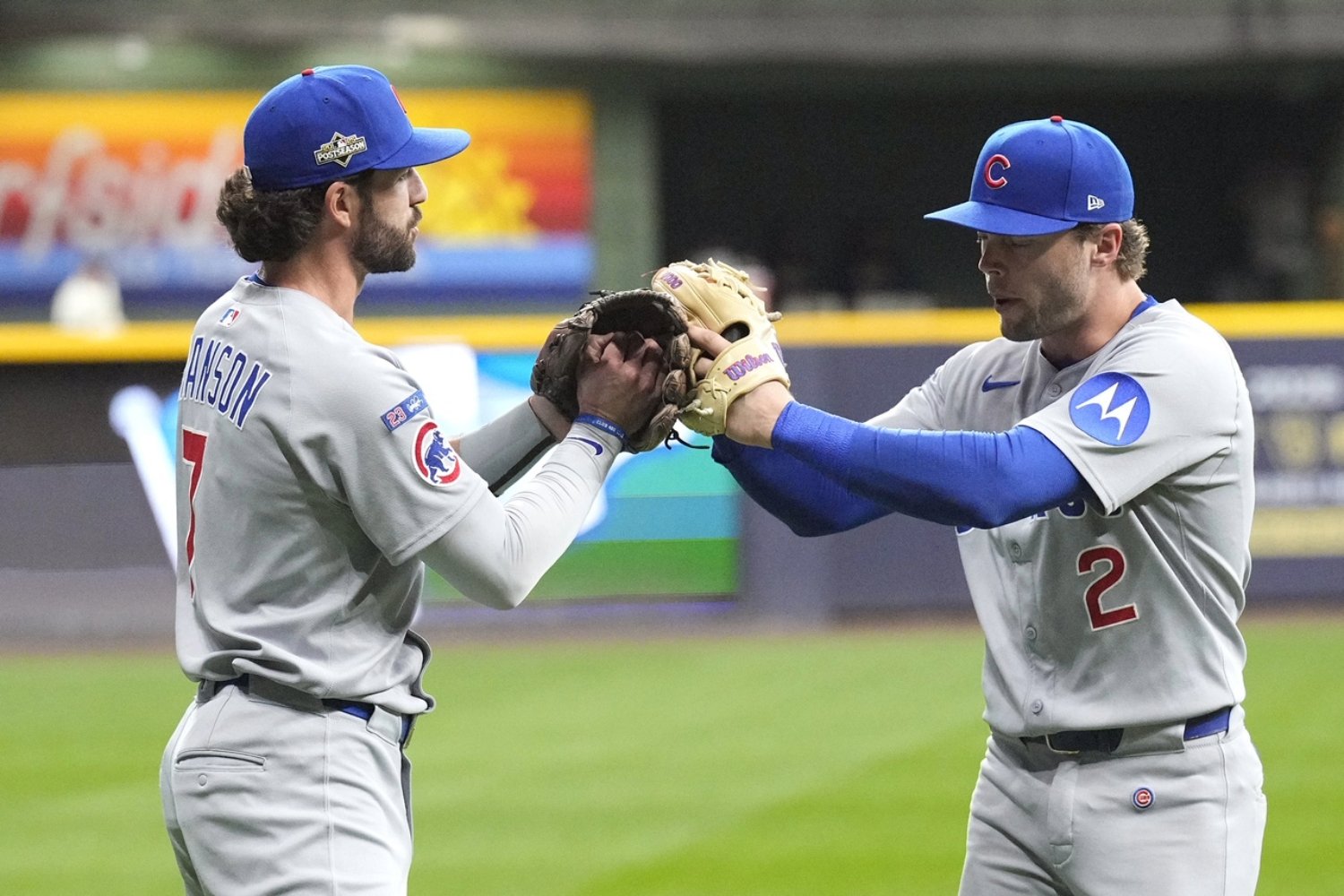
There are three components that make the infield collective of the Chicago Cubs perhaps the most stable aspect of their franchise ahead of 2026. The first is on the defensive side, where they succeeded at virtually every position in ’25. As a collective, their work with the leather is some of the finest you’ll see from the four spots on the dirt.
Another is in each of their respective contract statuses, where each starting infielder is under contract through at least the end of next year, including another pre-arbitration offseason for Michael Busch and three more years of it for Matt Shaw.
The third is their health. While we watched Kyle Tucker battle injuries in the second half of the season and Pete Crow-Armstrong maybe begin to burn out a bit in September, the Cubs got the full run of virtually all of their infielder defenders. Busch appeared in 155 games. Nico Hoerner was plugged in for 156 and Dansby Swanson for 159. Matt Shaw appeared most of the time when he wasn’t in Iowa and reached 126 games in his rookie campaign.
It’s not all positive, of course. While there were numerous flashes of offensive competency from a couple of their starting infielders, the left side of the infield, in particular, was ravaged by inconsistent play and adjustments that came and went. It’s a tough sell to necessarily want this to be the same group ahead of next season given that, but the aspects of defensive quality, financial certainty, and ability to stay on the field do help them to maintain their status as the most stable phase of the Chicago Cubs’ operation.
With all that being said, let’s see how each starter and the *gulp* bench group grade out from their work in 2025.
Michael Busch: A
It’s almost difficult to overstate the offensive value that Busch brought to the group in his second season on the North Side. We knew he was a certified stick when he was acquired from the Los Angeles Dodgers two offseasons ago. But Craig Counsell found a sweet spot of where to deploy him against lefties and where to protect him, which led to some really strong results in ’25.
Busch’s numbers landed at a .261/.343/.523 slash, with a 23.5 percent strikeout rate, a 9.5 walk rate, and a 140 wRC+. The walk rate was the only one of those numbers that (slightly) regressed, as he raised each of his average, on-base, and especially the slug from his first go-round with the Cubs. It all culminated in a wRC+ that sat 22 points higher than the number he posted in 2024. The power is, of course, the most notable element. Busch reached 34 homers and finished in the 90th percentile in average exit velocity (92.2 MPH) and 95th in barrel rate (17.1 percent). Despite questions elsewhere, there’s little doubt that they have an impact first baseman in the mix moving forward.
The only caveat for him this year was on defense, where he finished just below average (-1) in the eyes of Outs Above Average. It’s close enough to the threshold considering the position, though, that there isn’t any real reason to be concerned. especially when he’s miles ahead of some of the other upper-tier bats at the spot with which he now finds himself in league.
Nico Hoerner: A+
If you went by FanGraphs‘ Wins Above Replacement metric, then Nico Hoerner was a top-10 player in the National League in 2025. If you went by Baseball Reference‘s Wins Above Replacement metric, then Nico Hoerner was a top-10 player in Major League Baseball in 2025. It’s kind of wild for a player we have likely perceived as a lighter-hitting second baseman that brings elite defense to finish with either kind of credential, but it also speaks to the balance that Hoerner was able to bring to each phase of his game this year.
On the offensive side, it mostly boils down to Hoerner’s contact ability. He was fourth in the league in contact rate (89.9 percent), seventh in whiff rate (4.9 percent), and third in strikeout rate (7.6 percent). His already-modest power regressed slightly (.097 ISO), but he was able to ride a slight uptick in his average on balls in play (.313) to post what would be the highest wRC+ mark of his career (109). He was his typical elite self on the defensive end, posting an OAA of 15 that ranked 11th among all qualifying defenders in the sport. Even sans power, there were simply very few players that had a better blend of offensive and defensive success than Hoerner in 2025.
With that said, his future is the murkiest of the four starting infielders. With Busch and Shaw still pre-arb and Swanson locked into his hefty contract, Hoerner is the odd one out in that he’s set to be a free agent after 2026. Will the Cubs extend him a second time, or are we in for another season of trade rumors?
Dansby Swanson: D+
It’s a harsh grade for the captain of the infield, but it’s also a harsh reality that Swanson provides up against his contract.
Offensively, Swanson’s saving grace was his uptick in power. His .173 ISO came in roughly 30 points higher than the previous season. His barrel rate (11.7 percent) and hard-hit rate (47.7 percent) each represented career highs. When he wasn’t finding the barrel, though, the results were simply not there. Swanson’s strikeout rate (26.0 percent) was his highest in a Cubs uniform, while his walk rate (7.3 percent) was his lowest since 2022. His swing rate and whiff rate were each the highest of his career, too, including a 27.1 swing-and-miss percentage against fastballs that stands as a career-worst figure. As far as trends go, there was certainly a selling-out-for-power component to Swanson’s game this year. While the occasional power is nice, the other elements of his game regressing made it too infrequent a contributor on a price tag approaching $30 million.
That’s especially true because he didn’t have the elite defense on which to fall back this time around. While the glove spoke for a lot of his game in the last two years in Chicago (20 OAA in 2023 and 17 OAA in 2024), he posted an OAA of just two in ’25. Neither is a particularly encouraging trend with another four years to go on his contract.
Matt Shaw: C+
It’s true that Matt Shaw was a below-average hitter in his rookie season—his wRC+ finished at 93. It’s also true that he showcased growth in the second half, when that number jumped up to 130. While his strikeout rate was higher and his walk rate lower, he was able to generate more quality contact in the second half on his way to a .263 ISO, nearly 200 points higher than the mark he had in the first half of the year. Adjustments came fast and furious for Shaw that allowed him to take off in that respect. They didn’t all stick, however, as the strikeout rate catapulted to over 30 percent in the postseason, with just a pair of hits in 23 plate appearances. There’s still work to be done, even if the upside was apparent.
Where Shaw did impress was with the glove. Despite questions about his ability to stick anywhere but the keystone long-term, he was a regular on the highlight reals and quite adept at run prevention. His 12 Defensive Runs Saved ranked third among big leaguers at the hot corner and earned him a spot as a Gold Glove finalist. So, while the bat remains a mixed bag (and the first half of ’25 was truly dismal for him), the glove helps him to salvage a solid grade for this season.
The Bench: F
That the Cubs lacked positional depth heading into the year was not a secret. Names they rolled out on the infield at various points in 2025 included names (and wRC+ outputs) like Justin Turner (86), Vidal Bruján (42), Gage Workman (57), Nicky Lopez (1), Jon Berti (42), Carlos Santana (-36), and Willi Castro (40). It’s a little bit paradoxical to both praise the health and stability of the infield while simultaneously criticizing the depth, since depth is a little bit less crucial when you don’t have to ride them out as frequently as a team that didn’t have either of the former. Still, with Shaw’s early struggles and Swanson’s inability to produce in the batter’s box any sustained fashion, having some sort of supplement (particularly in October) might’ve done the Cubs some good. They failed to address the bench in any meaningful way last winter and during the season, leaving no other grade as an option.