
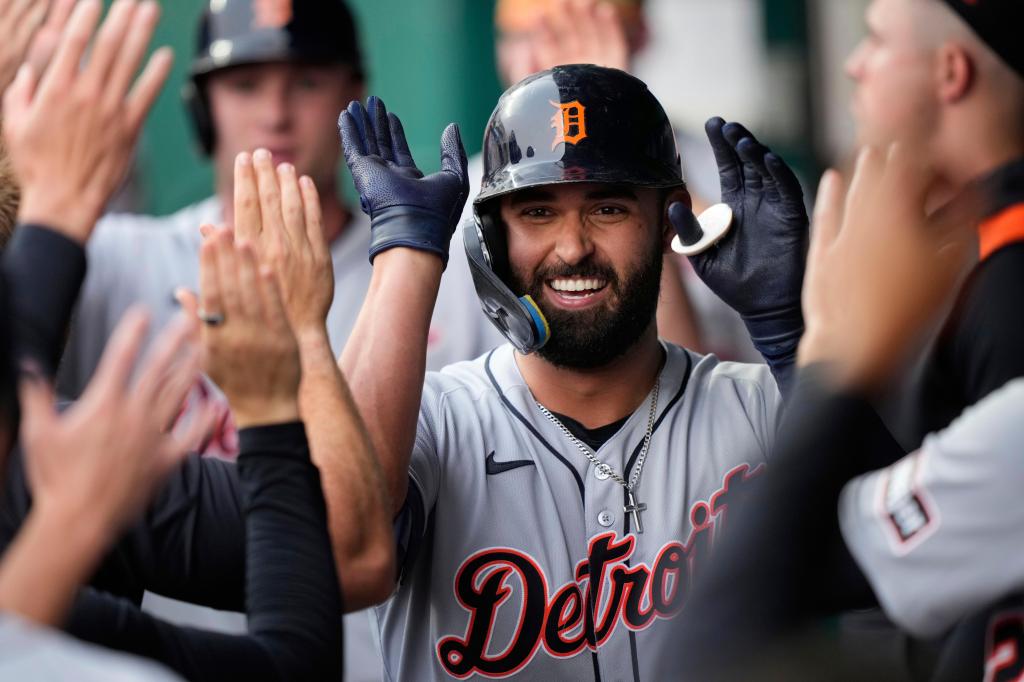
DETROIT – Tigers president Scott Harris asked the salient question at the postseason press conference Monday.
How did the Tigers go from being a top-eight offense for five months to being a bottom-eight offense in September?
“That’s the question that keeps me up at night,” he said. “It’s a function of our approach changing, it’s a function of our (lack of) contact, it was the environment and it’s something we’re going to spend a lot of time thinking on.”
Was September a blip? Or was it truer indicator of where this offense is going forward?
The actual truth probably lies in between.
The strikeouts and general contact issues certainly need to be addressed. From July on, the Tigers had the second-highest strikeout rate in the American League (25%) and had a minus-11.5 offensive WAR, fifth worst.
They weren’t built to play feast-or-famine baseball but that’s what they morphed into by the end of the year. The Seattle Mariners’ pitchers masterfully exploited the Tigers’ over-zealous swings in ALDS with a lethal diet of sliders, splitters and curveballs.
The Tigers struck out 55 times in the five-game series.
But for five months, the same group of hitters produced one of the most potent offenses in the game. They consistently worked counts, got on base, slugged and averaged nearly five runs a game.
That can’t be discounted.
The core of this offense, Riley Greene, Spencer Torkelson, Kerry Carpenter, Dillon Dingler, Zach McKinstry, Colt Keith and Wenceel Perez, played more baseball this year than any other in their career. Only Greene, Torkelson and Carpenter have more than two years of major league service time.
And, even though the season ended in the same spot as it did in 2024, the journey was far more fraught and rigorous down the stretch because of the September swoon.
Perhaps allow for the fatigue factor – mental and physical. Allow for some relative immaturity manifesting in out-of-character performances in those big moments. And maybe don’t define a player’s season by his worst statistical stretch, even if it came on the biggest stage and under the brightest lights.
But absolutely reexamine, organizationally and individually, the general offensive approach, the game-planning (both the messaging and implementation) and rediscover the balance that was there for so long between contact and damage.
Get back, most of all, to one of their foundational tenets — controlling and winning the strike zone.
Manager AJ Hinch was in his office on Monday as players were cleaning out their lockers and saying their goodbyes.
“I asked Carp what the difference was between his struggles in September and his dominant October, when he was in control of all his at-bats,” Hinch said. “He said it all centered around getting a good pitch to hit.”
It’s that simple and it’s that bloody difficult.
Here are the final assessments for the 2025 Tigers’ position players:
Catchers
Dillon Dingler, 3.1 WAR (.278/.327/.425, 108 OPS-plus): It’s a rare thing for a team to lose its starting catcher in April and become a better team. But that’s what happened. Everything seemed to come together all at once for Dingler. A Gold Glove finalist in his first full season, he ranked in the upper percentiles in blocking and framing and had a 31.7% caught-stealing rate. He had the trust of the pitching staff from Day One, but he steadily improved his game-planning and in-game adjustments. He was steadily productive offensively, too, especially so with runners in scoring position (.296 average, .830 OPS; .309 average, .843 OPS with two outs and runners in scoring position). And did we mention durable? He caught over 1,000 innings in the regular season and every inning in the postseason. Mid-term grade: B. Final grade: B-plus.
Jake Rogers, 0.1 WAR (.187/.277/.333, 69 OPS-plus): Last year, Rogers was a Gold Glove finalist. Last year, he caught every postseason inning. This year, his role was to support and bring positive energy. It’s a tough game sometimes. But Rogers handled it like the true pro he is. He’s going to create a decision point for the Tigers this offseason. He is in his second year of arbitration and industry estimates project a salary of $2.9 million. Going into his age-31 season, he might not be ready to settle for a full-time backup role and the Tigers have some catchers fast ascending through the system. Mid-term grade: C. Final grade: C.
Infielders
Spencer Torkelson, 2.3 WAR (.240/.333/.456, 117 OPS-plus): Last year at this time we were wondering if Torkelson was an everyday player. He responded to that by posting career-best numbers across the board, including an 11% walk rate and a low 22% chase rate. He is still susceptible to long lulls and he’s still his own worst enemy in the box at times (guessing too much). But he’s made himself a more athletic and adaptable hitter and that will serve him well going forward. Defensively, the metrics don’t show what our eyes tell us – he’s vastly improved his work at first base. This is a player, going into his age-26 season, absolutely entering the prime years of his career. Mid-term grade: B. Final grade: B.
Gleyber Torres, 2.9 WAR (.256/.358/.387, 108 OPS-plus): When the Tigers’ offense was clicking, he was the instigator at the top of the order with his ability to work long counts, get on base and deliver clutch knocks. He committed to improving himself on defense and he did that, especially his ability to handle balls hit to his glove side. Courageously, too, he played through a hernia in the final weeks of the season and through the playoffs, too, which certainly explained his offensive falloff. He was always going to be one year and out with the Tigers. He has a chance to hit the free-agent market before the age of 30 and he will take it. Mid-term grade: B. Final grade: B-minus.
Colt Keith, 1.5 WAR (.256/.333/.413, 107 OPS-plus): The Tigers asked a lot out of him this season. In the offseason he was told to learn first base. Then, when Spencer Torkelson reclaimed that spot, Keith became a designated hitter, part-time second baseman. In June, they threw him over to third base, where he hadn’t played since his early minor-league years. Turns out, his most comfortable position was third base. He’s likely to toggle between second and third and DH again next season, too. Though he had hot stretches, he’s yet to really hit his stride offensively. That’s the next step in his evolution. Mid-term grade: B-minus. Final grade: C-plus
Javier Baez, 1.9 WAR (.257/.282/.398, 87 OPS-plus): This season might end up being the most fascinating chapter in his baseball story. Given up for dead after two horrible seasons, he came back healthy and rejuvenated. A Gold Glove-winning shortstop, he moved to center field for the first time ever and was the starting center fielder in the All-Star Game. By the end of the season, he was back at shortstop and the team’s steadiest offensive player through the postseason. For all the maddening ups and downs, he remains one of the most entertaining players in the game. Mid-term grade: B. Final grade: B-minus.
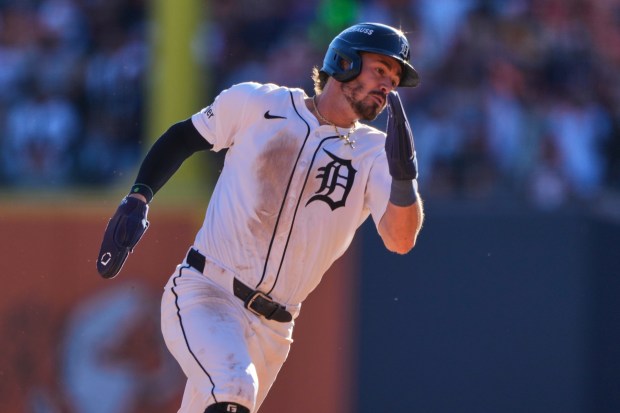 Detroit Tigers’ Zach McKinstry rounds third on his way to score during the fifth inning in Game 4 of baseball’s American League Division Series against the Seattle Mariners Wednesday, Oct. 8, 2025, in Detroit. (AP Photo/Ryan Sun)
Zach McKinstry, 2.8 WAR (.259/.333/.438, 113 OPS-plus): Finally, he got the opportunity to play every day and he validated the trust with a career-high, All-Star level production in just about every category, including an .854 OPS against left-handed pitching. He epitomized the Tigers’ aggressive offensive style, with a 74% rate on taking extra bases and 19 stolen bases. He also facilitated manager AJ Hinch’s matchup games by being able to play anywhere on the diamond. He endured his offensive lulls like the rest of the team, but he was an invaluable contributor. Mid-term grade: B-plus. Final grade: B.
Trey Sweeney, minus-0.8 WAR (.196/.258/.291, 53 OPS-plus): His fatal flaw right now is the inability to hit high-velocity fastballs. His .203 average and 28% whiff rate on all heaters is well below standard. He had a couple of stints at Triple-A this season to work on it but he never earned enough sustained playing time in the big leagues to apply the work. He’s facing a critical offseason and spring camp. Mid-term grade: C-minus. Final grade: C-minus.
Andy Ibanez, 0.5 WAR, (.239/.301/.352, 81 OPS-plus): He gave the club a huge boost when he came back from Toledo at the end of July. Over an 18-game stretch he hit .368 with a .974 OPS. Unfortunately, he didn’t sustain anything close to that production the rest of the way and wasn’t a factor in the postseason. Going into his age-33 season and entering arbitration, you wonder if the Tigers will want to run it back for another season or clear a runway for one or two of the big league-ready prospects. Mid-term grade: C-minus. Final grade: C-minus.
Outfielders
Riley Greene, 2.1 WAR, (.258/.313/.493, 120 OPS-plus): He had an historic season. He and Hank Greenberg are the only Tigers to produce 36 homers and 111 RBI at age 24 or younger. And yet, he will be the first to tell you, it wasn’t good enough. His WAR went down by 0.6 points in the second half. The American League-high 201 strikeouts are untenable. He’s too good a hitter to have that many empty at-bats. The best version of Riley Greeene isn’t a feast-or-famine slugger. It’s who he was in June, when he hit .360 with a .404 on-base percentage. He took his walks. He battled with two strikes and used the whole field, without sacrificing power. This was his first full season (157 games, 655 plate appearances). Certainly it took a physical and mental toll by the end. But, just entering his age-25 season, the struggles he battled through may be the toughest and best lesson the game ever taught him. Mid-term grade: A-minus. Final grade: B-minus
Parker Meadows, 0.2 WAR, (.215/.291/.330, 73 OPS-plus): Injured at the start, injured again in the middle, Meadows had the unenviable task of trying to play catch-up in real time against big-league pitchers down the stretch of a season. Tough duty. His defense kept him in the lineup. But it’s tempting to grade him an incomplete and write this season off. Hard to made any assessments on such a fractured season. Mid-term grade: C-minus. Final grade: C-minus.
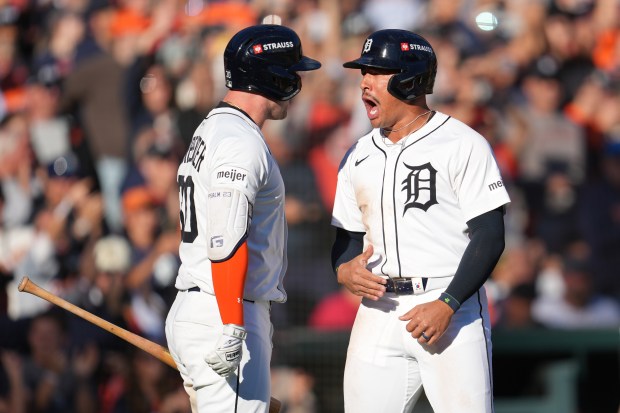 Detroit Tigers’ Jahmai Jones, right, celebrates after scoring as teammate Kerry Carpenter watches during the fifth inning in Game 4 of baseball’s American League Division Series against the Seattle Mariners Wednesday, Oct. 8, 2025, in Detroit. (AP Photo/Paul Sancya)
Kerry Carpenter, 1.8 WAR, (.252/.291/.497, 114 OPS-plus): It was a year of growth. He proved he’s more than a capable defender in right field. He proved he can hold his own against most left-handed pitchers (.638 OPS and a dramatic homer off lefty Gabe Speier in Game 5 of the ALDS). He proved he can post for a whole season (just one IL stint and 130 games played plus the postseason). His 26 homers and 62 RBI feel like the tip of his iceberg. It feels like 2026, his age-29 season, might be his true breakout year. Mid-term grade: C-plus. Final grade: B
Wenceel Perez, 0.7 WAR, (.244/.308/.430, 103 OPS-plus): In a lot of ways, he kept the team afloat for long stretches. His energy, his vastly-improved defense and his switch-hitting ability helped the Tigers navigate through the injury losses of Parker Meadows and Matt Vierling. But, like many of his teammates, he struggled hard down the stretch (5 for 65 with 25 strikeouts to end the regular season, then 2 for 19 with seven strikeouts in the playoffs). It was the most baseball he’s ever played in a single season and it took a physical and mental toll. But, just 25, he will no doubt tweak his offseason strength regimen accordingly. Mid-term grade: B-minus. Final grade: C.
Matt Vierling, minus-0.3 WAR, (.239/.310/.307, 73 OPS-plus): It was heartbreaking to watch him work so hard to get back and have his body thwart his efforts at every turn. From a rotator cuff injury in spring to a lingering oblique strain in August, he was limited to 31 games. A healthy return in 2026 will be a huge boost to the Tigers in all facets. Mid-term grade: Inc. Final grade: Inc.
Jahmai Jones, 0.9 WAR, (.287/.387/.550, 157 OPS-plus): Sometimes everything aligns – exactly the right skill-set and demeanor for the prescribed role. Jones became the team’s lefty-slayer this season, posting a .970 OPS with seven homers and nine doubles against left-handed pitching. He was also a unifying and energizing presence in the clubhouse. Mid-term grade: B-minus. Final grade: B.
Justyn-Henry Malloy, minus-0.2 WAR, (.221/.346/.308, 73 OPS-plus): He’s posted a .902 OPS in four Triple-A seasons and for whatever reason, that hasn’t translated against big-league pitching. He got a 45-game run early in the year and he hit .215 with minimal power and too many strikeouts. He was brought back late in September as an extra right-handed bat against the lefty-heavy Cleveland bullpen but he was left off the ALDS roster. Still just 25 and under team control with minor-league options remaining, but you wonder when or where his next real opportunity might come. Mid-term grade: C-minus. Final grade: C-minus.
Incomplete: Ryan Kreidler, Jace Jung, Tomas Nido, Akil Baddoo, Brewer Hicklen.