
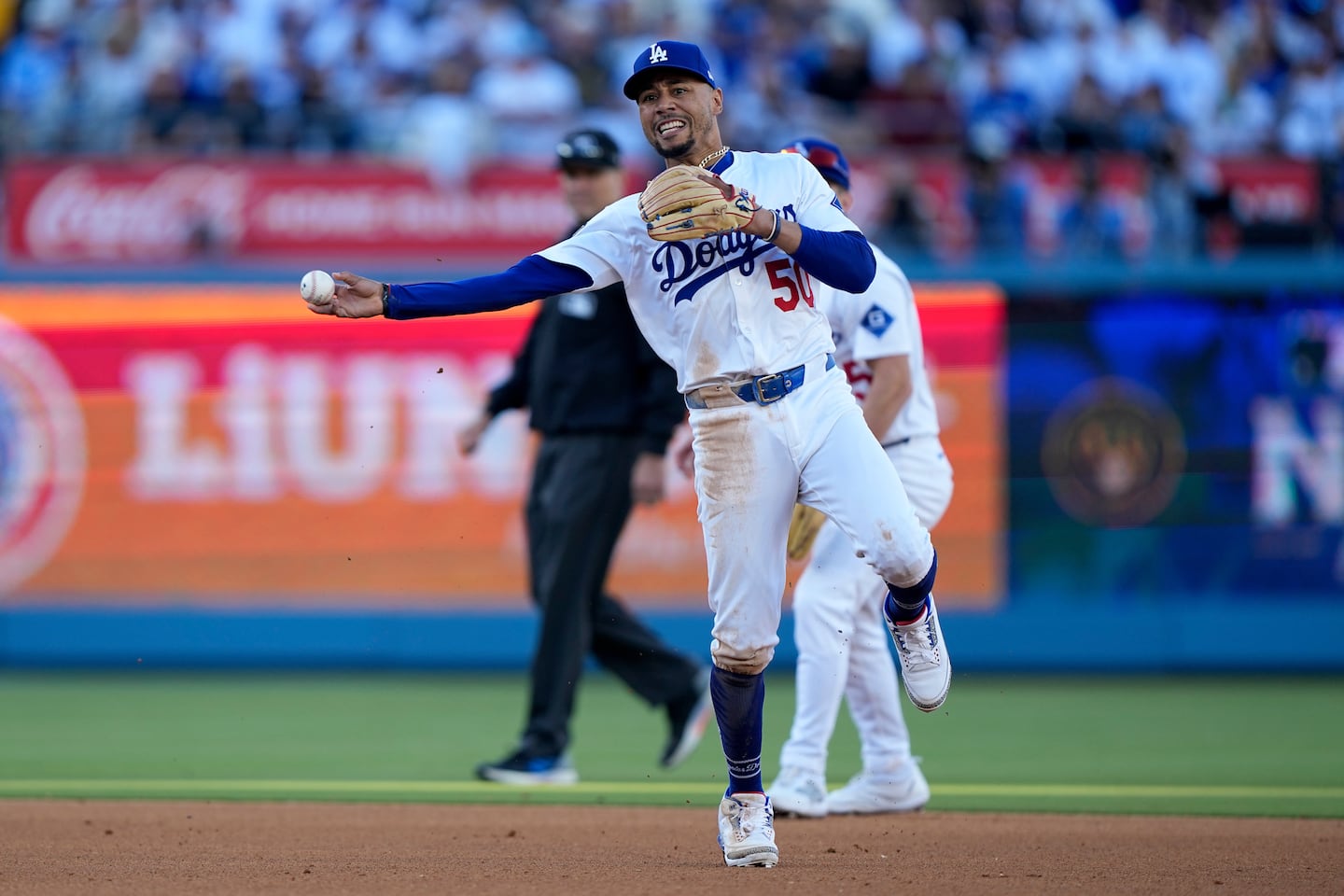
Betts turned 33 this month. This year for the Dodgers, he became the first player in big league history to start at least 140 games at short in his age-32 season (or later) after making fewer than 100 career appearances at the position prior.
“Honestly, I don’t think enough people talk about it,” said Dodgers game-planning and communication coach J.T. Watkins, who played with Betts as a Sox minor leaguer in 2012 and whose father, Red Sox area scout Danny Watkins, led the scouting process with the shortstop in high school. “He doesn’t get enough credit for it.”
No one else had the convergence of skill, audacity, opportunity, and team need to become an everyday shortstop at such a late career stage. The closest anyone had come was Tony Womack, who emerged as a full-time shortstop as a 30-year-old with the Diamondbacks in 2002 after playing just 33 games at the position in his 20s.
Betts not only did it but excelled, leading all big-league shortstops in Defensive Runs Saved with 17. (Statcast’s Outs Above Average credited him with a more modest, but still well above average, four runs saved.) Along with the recognition as a finalist for the NL Gold Glove Award at short, he’s been spectacular there in the playoffs (while hitting .297/.381/.459 and driving in six runs through nine games) to help stoke the Dodgers’ ambitions of back-to-back titles.
“He’s just a rare athlete and individual from head to toe,” said Andy Fox, who was the Red Sox’ minor league infield coordinator when Betts was coming through the system from 2011-14. “I don’t know who’s [made a late-career move to short] before, but it doesn’t surprise me that he has done it.”
As a shortstop, Betts has addressed arguably the most glaring failure from the start of his professional career.
After the Sox took Betts in the fifth round of the 2011 draft, he started his time in the minors at short. It didn’t go well. He made three errors in his one-game pro debut, then another six in 13 games at short for the Lowell Spinners in 2012.
Seven of those nine errors were throwing. He misfired three times on July 6, 2012, including on back-to-back ninth-inning plays in a walkoff loss.
“It’s crazy to me that in one game, I hit a homer and he made three errors,” mused Watkins when reminded of that contest. “What’s more rare?”
Those who saw Betts at the time believed he had a shortstop’s range, anticipation, and footwork. But he rushed his throws, his internal clock not yet calibrated to the level of competition.
“The game was fast, and he wasn’t able to slow it down,” recalled Bruce Crabbe, the Spinners manager in 2012.
“He’s always had a very good arm,” added Fox. “There were no yips concerns. It was just a matter of the consistency of finding that throttle for the arm.”
After that three-error game, the Sox moved Betts to second base full time. The extra time afforded by the shorter throws permitted Betts to gain comfort and show extraordinary defensive ability that convinced the Sox he had Gold Glove potential as an infielder, along with elite bat-to-ball skills (albeit without power).
“The game slowed down for him,” said Crabbe. “The light bulb was on, and he was like, ‘This is it. I know what I’m doing here.’ It was amazing, the transformation from short to second.”
Crabbe saw Betts as a potential All-Star second baseman while believing he had the physical skills to return to short if the Sox ever wanted to retry the experiment. But even amidst Betts’s meteoric rise through the system in 2013 — and with an obvious need to move off second in deference to Dustin Pedroia — the Sox were reluctant to give Betts another shot at short, particularly given that Xander Bogaerts was ahead of him in the organization.
Betts played two innings at short in the Arizona Fall League after the 2013 season, made one throwing error, and that was it. Though Betts continued to take grounders there as part of his pregame routine throughout his career, the team never again considered him at the position.
When the Sox needed to create Betts a path to the big leagues in 2014, they moved him to the outfield, where he rapidly emerged as one of the best defensive players in baseball — and, for that matter, one of the best overall players in the game.
With Betts on teams featuring Bogaerts, then Dodgers teams with Corey Seager and Trea Turner, there wasn’t a need to reconsider shortstop. But with the departures of Seager and Turner in free agency, the Dodgers started triangulating Betts between short, right, and second in 2023 and 2024 before committing to him full time at the position this year.
With extraordinary results.
“Last year he tried it and it wasn’t great, and he’d probably be the first to admit that,” said Watkins. “For him to say, ‘I’m going to double down on this, and I’m going to play short,’ what a testament to him being able to do what’s best for the team, one, and two, not giving up on something that he’s struggled with in the past. I think it just speaks to his character. He’s just not going to give in.”
“You’re talking about a genuine human being that really wants to win, who says, ‘I’ll play second base. I’ll play shortstop. I’ll figure it out. If it’s going to help us win, I’ll figure it out,’” added Fox.
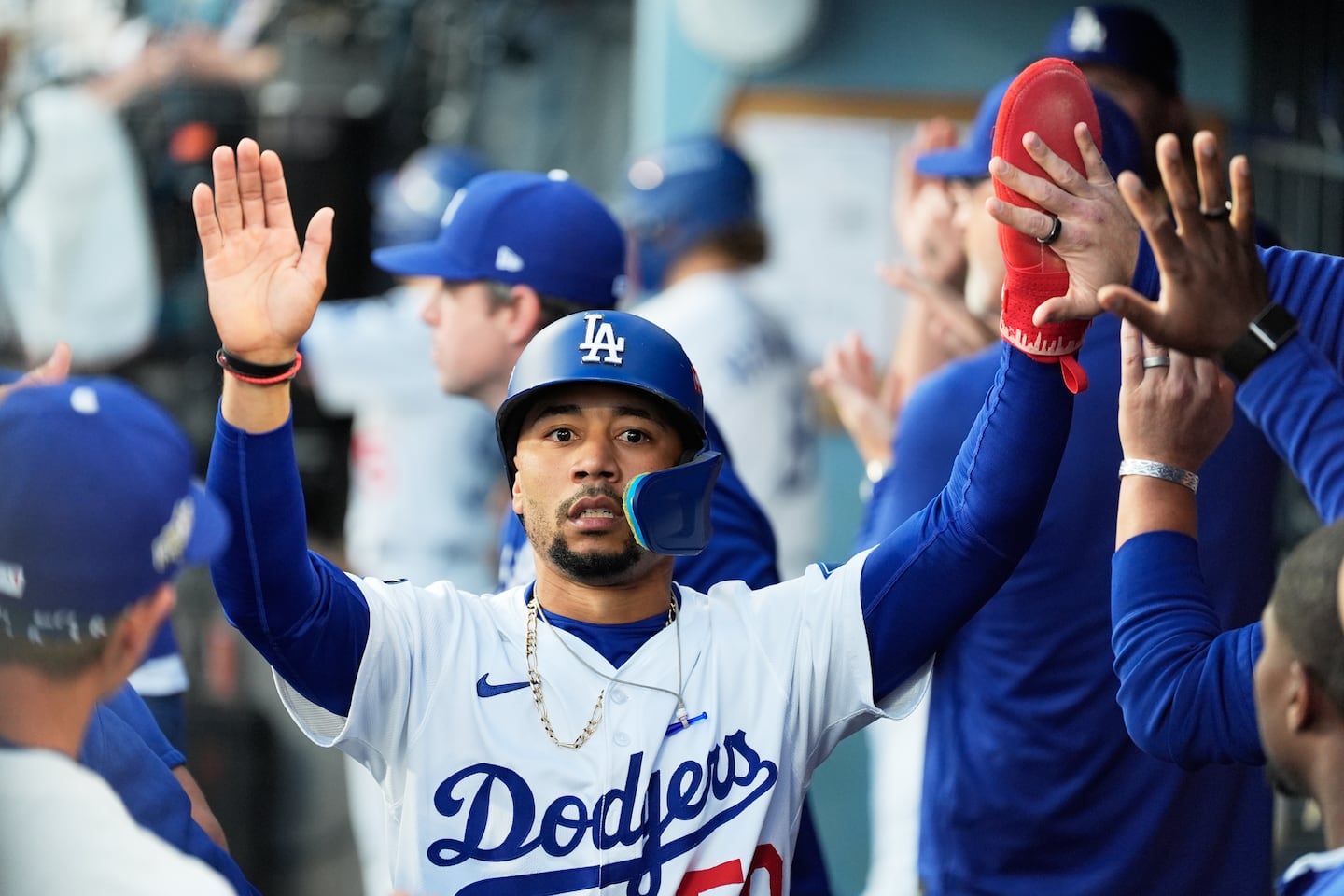 A defensive stalwart at shortsthop, Mookie Betts leads the Dodgers into the World Series.AP Photo/Ashley Landis/Associated Press
DEALING ACES
Pitching figures to be active hot-stove market
The 2025 trade deadline was an industry-wide dud on the starting pitching front. This coming offseason, by contrast, could provide fireworks.
Multiple industry sources expect the Tigers to at least listen to offers on ace of aces Tarik Skubal, who is likely to win his second straight AL Cy Young Award next month but has just one year of team control remaining before he reaches free agency and a potentially record-setting contract.
The Twins discussed trade proposals for Joe Ryan at the deadline and are expected to do the same this offseason, when he will have two years of team control remaining. Sandy Alcantara (two years of control), who struggled early in his return from Tommy John but had a 2.68 ERA and averaged 6⅔ innings per outing in his last eight starts, will be available.
Flamethrowing Reds righthander Hunter Greene (2.76 ERA, 29 percent strikeout rate in 2024-25) and Nationals lefty MacKenzie Gore (27 percent strikeout rate) — both of whom have three years of remaining team control — could be dangled. Cardinals righthander Sonny Gray (3.63 ERA, 177 innings per year, 27 percent strikeout rate from 2023-25) is likely available with one expensive year (and a no-trade clause) left on his three-year contract.
For now, the pool of trade candidates remains speculative, but the GM Meetings from Nov. 10-13 should give more shape to the group. The array could complicate the free agencies of lefthander Framber Valdez, Michael King, and Dylan Cease (among other starters) — which, in turn, suggests upper-rotation upgrades could remain available throughout the offseason.
Evan Petzold of the Detroit Free Press reported the Tigers offered Skubal a four-year deal for less than $100 million after the 2024 season, when he was two years from free agency — a similar service time position (with a stronger record as a starter) to Garrett Crochet when the Sox extended him in April with a six-year, $170 million deal. Now, Skubal is positioned to shoot for the first $400 million contract for a pitcher in free agency next winter.
Skubal was the standout pitcher of this postseason, with 36 strikeouts in 20⅔ innings across three starts. The standout hitter? Vladimir Guerrero Jr., who has been almost impossibly good.
Through eight playoff games, Guerrero was hitting .455/.500/.970 with five homers and just one strikeout. Only four players have ever had at least five homers with more long balls than strikeouts in a single postseason: Barry Bonds in 2002, Juan González in 1996, Davey Lopes in 1978, and Red Sox second baseman Todd Walker (!) in 2003.
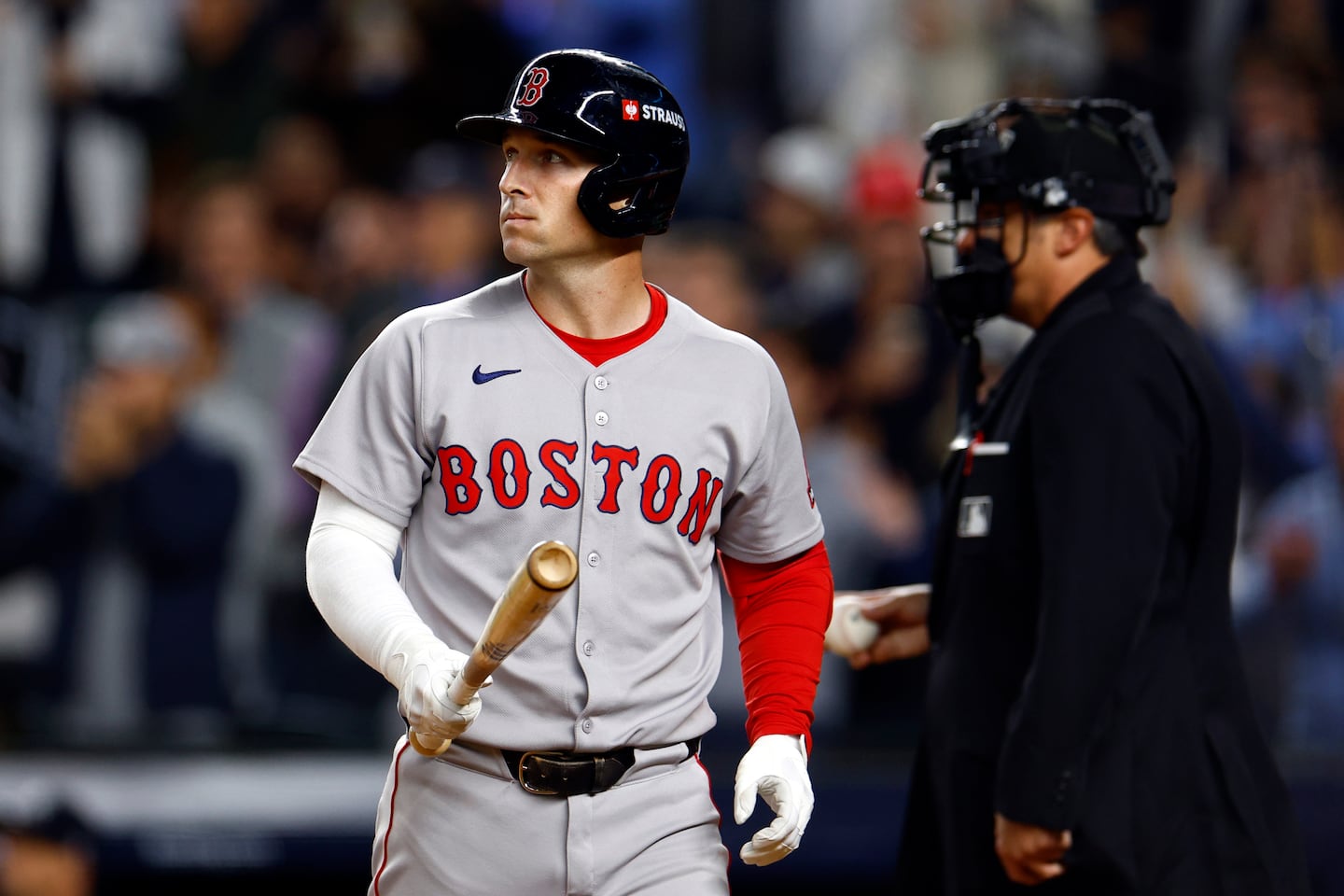 Alex Bregman opted out of his contract with the Red Sox after one season to test free agency.Danielle Parhizkaran/Globe Staff
OPTIONS ABOUND
Bregman’s opt-out fit the Boras formula
Alex Bregman’s decision to opt out of his heavily deferred, three-year, $120 million deal with the Red Sox comes as no surprise. In signing the deal, Bregman employed a strategy previously employed by other clients of agent Scott Boras: Take a short-term deal, opt out after one year, then return to the open market without the albatross of a qualifying offer that would require a signing team to forfeit a top draft pick.
After the 2023 season, third baseman Matt Chapman signed a three-year, $54 million deal with the Giants. Near the conclusion of a spectacular 2024 campaign, he signed a new six-year, $151 million deal with the Giants. Similarly, Blake Snell — coming off a Cy Young season in 2023 — signed a two-year, $62 million deal with the Giants. He opted out of the deal after one year, returned to the open market last winter, and signed a five-year, $182 million deal with the Dodgers.
Chapman always represented a likely harbinger for Bregman, who like his colleague a year ago just finished his age-31 season. Now, Chapman’s $151 million guarantee represents an obvious basis of comparison for teams interested in Bregman.
Other Red Sox notes:
⋅ Bregman isn’t the only righthanded Red Sox hitter on the open market. Rob Refsnyder — who hit .269/.354/.484 in 2025, including a .300/.391/.470 line at Fenway — will be a free agent. Though he’d mused about the possibility of retiring after the 2024 season, the 34-year-old plans to play in 2026 and has had informal talks with the Sox about a possible return, though he should have a healthy market given his productive against lefties and strong clubhouse reputation.
⋅ The Mariners reached the ALCS in no small part because of the work of former Red Sox righthander Eduard Bazardo, who had the longest outing of his big league career — 2⅔ scoreless innings — in Seattle’s epic 15-inning Game 5 victory over the Tigers.
Bazardo signed with the Red Sox as an undersized 18-year-old for just $8,000 in 2014, gained strength and velocity, got a couple cups of coffee in 2021-22, then with the Orioles in 2023 and the Mariners in 2023-24 before finally forging a meaningful role in Seattle’s bullpen this year at age 30.
“From a 150-pound 18-year-old throwing 88 to now consistently throwing mid-90s with an above-average breaking ball, he’s done well for himself. It’s really cool to see,” said Red Sox assistant GM Eddie Romero. “He’s always been fearless. He comes into tough situations and I’m like, ‘He’s not going to walk this guy. He’s going to go right after him.’ That’s part of why he’s been successful.”
⋅ While the Sox had their best home record (48-33) since 2021, their improvement was driven chiefly by pitching. Despite an offseason meant to provide home lineup balance, the Sox had one fewer homer at Fenway in 2025 (86) than they did in 2024 (87). When their righthanded hitters put the ball in play at home, they hit liners or fly balls to the pull side just 14.7 percent of the time – 20th among big-league teams. Their pitching staff, on the other hand, allowed just 72 homers at Fenway, down from 88 in 2024.
⋅ One area of offensive concern: Outside of their July eruption, the Sox got beaten by velocity for most of the season. The team hit .230 (25th) and slugged .355 (23d). Those struggles may add to the intrigue of Pete Alonso, who slugged .561 with nine homers against pitches 95 miles per hour or faster.
⋅ Team CEO/president Sam Kennedy, in an appearance on the “310 to Left” podcast, on whether adding a middle-of-the-order masher will be a priority this offseason: “For sure. … That’s an area that definitely needs focus and where we’ll have our focus this offseason, but hard to know where all the conversations will lead.”
⋅ Members of the Red Sox were thrilled to hear that the Twins requested an interview with bench coach Ramón Vázquez as part of their search for a manager. Vázquez is heralded as a tremendous baseball mind and strong leader, attributes that helped him manage four teams to winter ball championships in Puerto Rico.
ETC.
Murakami latest intriguing slugger heading stateside
Pete Alonso isn’t the only hitter with titanic power who is likely to be available to teams this offseason. Nippon Professional Baseball star Munetaka Murakami, a 25-year-old lefthanded-hitting masher, is expected to be posted by the Yakult Swallows.
In 2022, Murakami set an NPB record with 56 homers. Though injuries limited him to 69 games in 2025, he hit .273/.379/.663 with 22 homers. One evaluator who expects Murakami to play first base in MLB described him as a “Mark Teixeira type” with significant risk thanks to his swing-and-miss issues — his 29 percent strikeout rate this year was sixth highest in NPB — but massive power. …
While MLB has reduced the size of its Minor League system, NPB is considering doing the opposite in Japan. According to the Japan Times, amid concerns about a shrinking amateur player pool, NPB is considering expansion of its minor league system as part of its efforts to broaden the game’s appeal.
The Sports Museum’s 24th annual Tradition fundraiser will take place on Nov. 18 at TD Garden. This year’s class of honorees will include Fred Lynn, who will be introduced by Gold Dust Twin Jim Rice. Isaiah Thomas (the ex-Celtic), Tim Thomas, track star Gabby Thomas, Vince Wilfork, and Keegan Bradley also will be honored. Tickets are available at sportsmuseum.org … Happy 60th birthday to Mike Gardiner, who thought he was being pranked when informed the Sox had acquired him in a trade from the Mariners on April Fools’ Day 1991. Gardiner — who attended Indiana State and once informed Nick Cafardo that he lived in the same college dorm room that Larry Bird had — spent two years with the Sox in his six-year big league career … And a happy half-century to Alex Cora, who turned 50 on Saturday. Cora was born on the first of three rainout days during the 1975 World Series, meaning the first MLB game for which he was alive was the fabled Game 6 — the most classic of all Fall Classic games.
Alex Speier can be reached at alex.speier@globe.com. Follow him @alexspeier.